
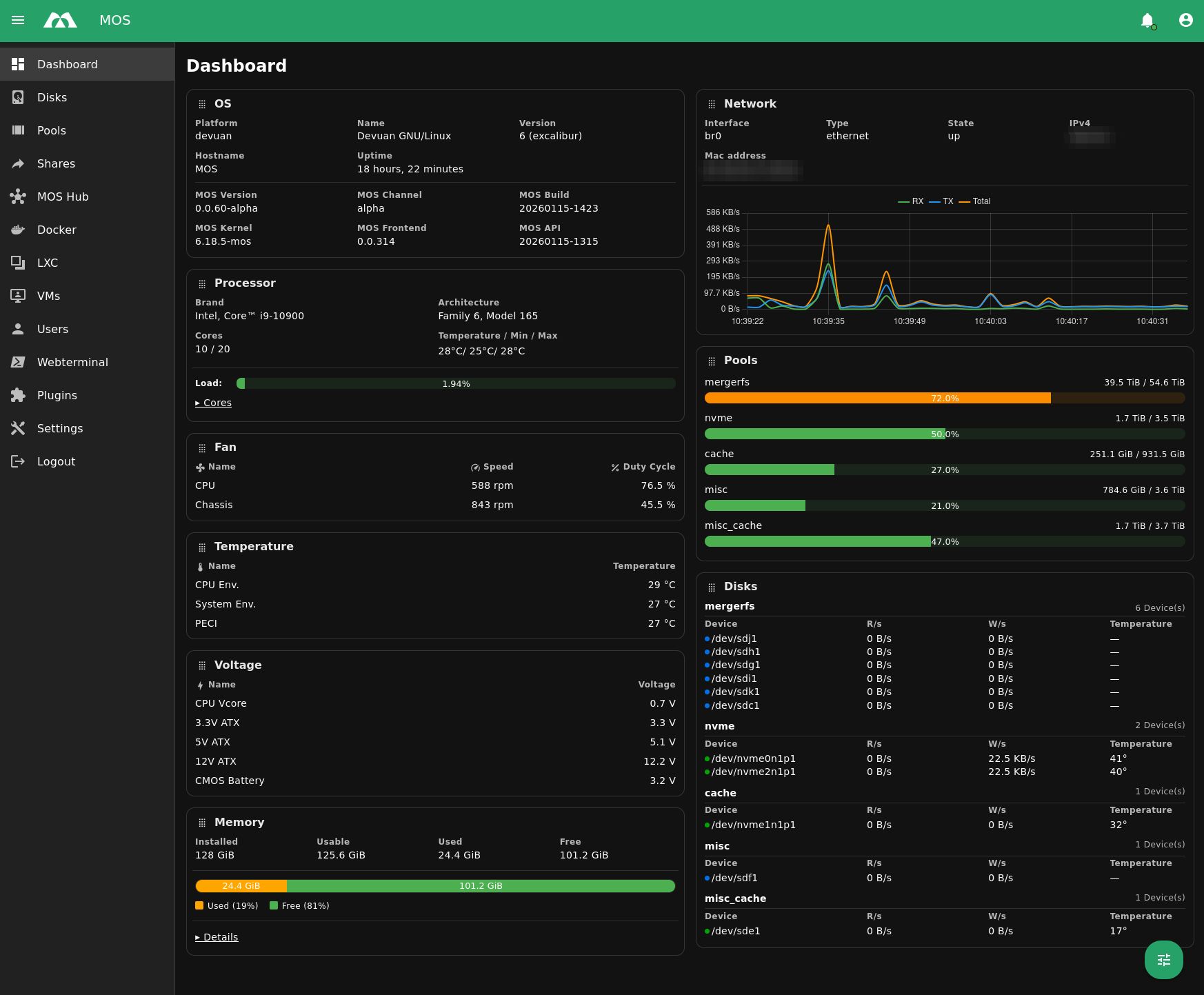
In the world of self-hosting and homelabs, there are two recurring trends: more and more people want to centralize services (NAS, containers, virtualization, monitoring) and at the same time escape from closed platforms or layers of complexity that end up “kidnapping” day-to-day management. In this context, a new name is beginning to sound familiar: MOS (Modular Operating System), a lightweight and modular operating system based on Devuan, completely open source, designed for managing home servers and small racks through a web interface and an API.
MOS is presented with a straightforward idea: it’s not just aiming to be a traditional NAS focused on storage but a management platform for modern setups where pools and shares, Docker, LXC, and virtual machines coexist, all under a “service-based” approach that can be expanded through modules and plugins.
A web console that doesn’t “absorb everything”: UI as client, API as core
A key technical decision is its architecture: MOS describes its UI as a client that relies on a API (routes like /api/v1) and a WebSocket channel for real-time event notifications. In other words, the main logic resides in backend services; the interface handles presentation and management.
This detail, which might seem minor, is gold for technical marketing and automation enthusiasts: a clear API opens doors for integrations (scripts, custom dashboards, internal tools) without relying solely on clicking through the interface.
What MOS promises: modularity, lightness, and zero telemetry
MOS explicitly targets users who value three things: low overhead, full control, and privacy by default. Its documentation and repositories emphasize that it doesn’t collect data: “no telemetry, no tracking, and no usage reporting”; everything runs locally.
It also emphasizes a modular approach: the official website highlights that Docker, LXC, and VMs are activated separately, and the UI displays components “based on active services.” A recurring concept is also present: plugins to keep the core lightweight and add features as needed.
Storage and virtualization: the “combo” sought by a modern homelab
MOS isn’t just about a pretty panel. Its releases repository details specific components:
- Docker and LXC as default bases.
- QEMU for virtual machines (with the frontend still in development, though the API “almost” supports everything).
- For storage, MOS mentions built-in support for mergerfs and SnapRAID, a popular combination in home servers for expanding storage by disks and adding parity through snapshots without using traditional RAID.
This list aligns with what a modern homelab user needs: a system that enables storage sharing, agile container deployment, and if necessary, VMs for legacy services or labs.
Security and access: tokens and deployment over HTTPS
On the security front, the official website recommends an access model based on tokens and advises operating behind TLS/HTTPS and a reverse proxy. It also emphasizes classic principles: least privilege and regular updates.
It’s not a grandiloquent speech, but it is consistent with the nature of the product: an OS for managing infrastructure at home (or in a small closet) cannot afford ambiguity with remote access.
Early-stage project: usable but with a beta mindset
MOS is described as a project still in very early development: its repository warns of potential bugs and recommends maintaining backups, especially given the critical nature of storage and service management.
Nevertheless, both the website and repositories make clear the call for community feedback: feedback, beta testers, and contributions to accelerate polishing and bring more complete modules.
Why this matters for marketing and social media: “the OS of modern self-hosting”
The message from marketing and social media perspectives is clear: MOS is born at a time when the conversation about home infrastructure has become popular (mini-PCs, NAS, containers, media servers, automation). Its positioning is well-defined:
- Open source and control (strong message within tech communities).
- No telemetry (a clear privacy differentiator).
- Modularity as an alternative to “all or nothing.”
- API-first as a bridge to automation and ecosystems.
If the team succeeds in turning that promise into stability, MOS could carve out a space among users seeking a modern platform without “noise” and without dependency on third parties.
Frequently Asked Questions
What is MOS and what type of user is it designed for?
MOS is a modular operating system based on Devuan, aimed at homelabs and self-hosting, with web management and an API for managing storage, users, services, containers, and virtualization.
Does MOS have telemetry or collect usage data?
According to the project documentation, no: there’s no telemetry, tracking, or usage reporting; everything runs locally.
What container and virtualization technologies does MOS support?
MOS supports Docker and LXC, and considers QEMU for virtual machines (with the frontend still in development, according to the repository).
What does MOS recommend for securely deploying its management interface?
The official web suggests authentication with tokens and recommends running the interface behind HTTPS/TLS and a reverse proxy, applying least privilege and regular updates.