
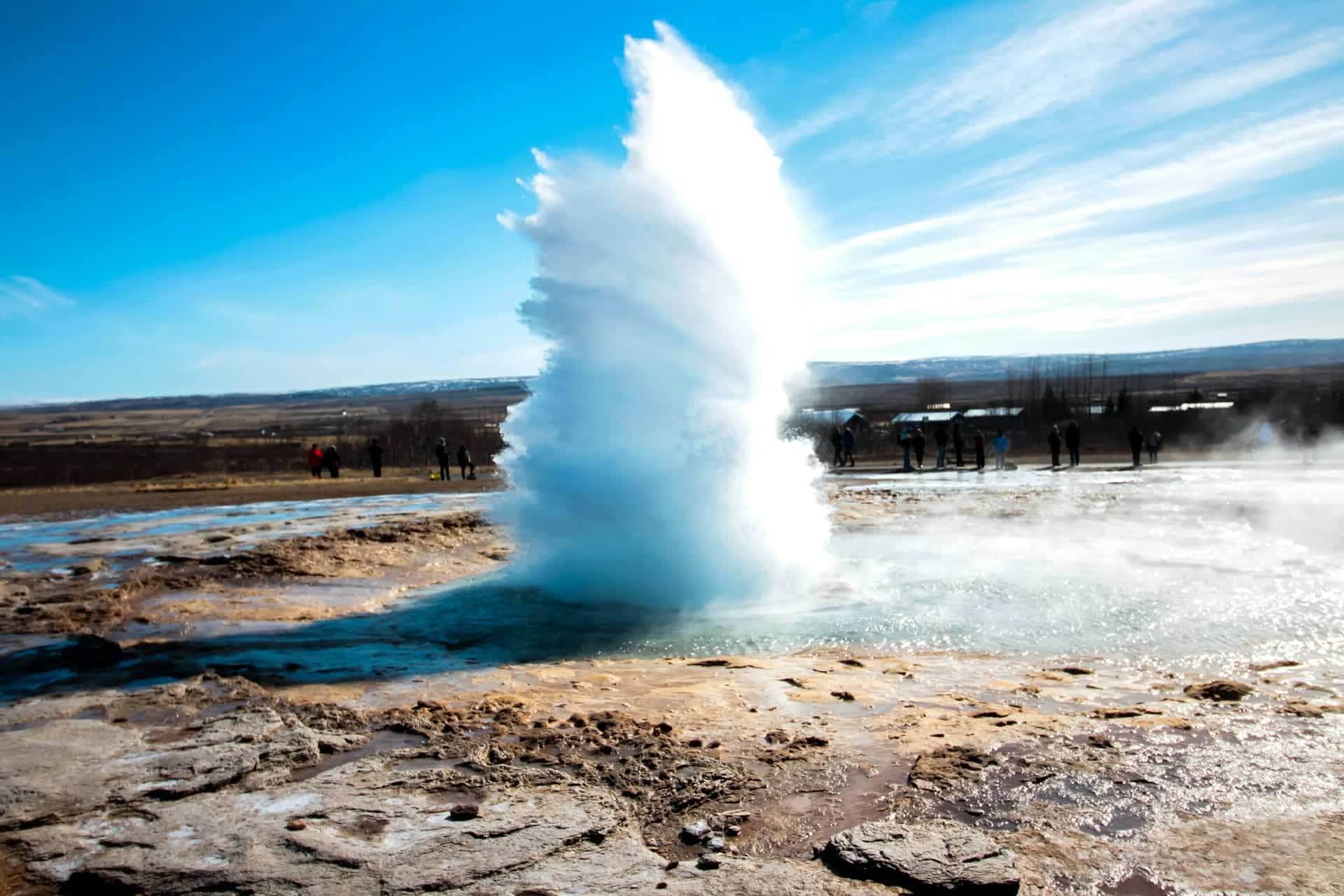
The image may be deceiving: the buzzing of a drill in the New Mexico desert isn’t seeking oil but heat. Underground, just a few kilometers deep, the rock is at temperatures capable of generating steady electricity, 24/7. That promise— of next-generation geothermal or EGS (Enhanced Geothermal Systems)— is attracting today’s Internet giants. Over the past two years, Google, Microsoft, and Meta have signed agreements with geothermal developers to explore whether this technology can become the baseline supply that AI data centers need.
The effort isn’t starting from scratch. Geothermal has been used for decades, mainly in shallow wells (≈400 meters) for climate control, or in volcanic regions where electricity generation is feasible with wells over 1 kilometer deep. But its deployment has been limited and very localized: today, it accounts for less than 1% of global energy. EGS changes the game because it doesn’t require the “perfect spot”: fracturing hot, dry rock at great depths to create an artificial reservoir through which a fluid circulates to extract heat. Where no natural hydrothermal deposit exists, EGS aims to create one.
Initial tests began in the 1970s, demonstrating technical viability, though high costs and complexities slowed its expansion. The revival has gained momentum through industry learning from oil and gas (such as directional drilling, complex well management) and the pressure from the AI boom: clusters with continuous loads, high density per rack, and firm power needs, precisely where wind and solar require storage or backup support.
From Lab to Contract: Why “Hyperscalers” Are Looking Underground
Numbers fuel the interest. The International Energy Agency (IEA) estimates that in the US alone, there are at least 7 TW accessible below 5 km and over 70 TW across various depths, with California, Nevada, Utah, Oregon, and New Mexico as particularly promising areas. To put it into perspective: conventional hydrothermal capacity available is around 25 GW. Analysis firms like Rhodium Group project that, if scaled successfully, EGS could meet much of the new electrical demand from data centers by 2030.
That horizon explains the “strategic” agreements made by big tech companies. These aren’t typical Power Purchase Agreements (PPAs); they aim to test the technology, reduce costs, and accelerate learning curves. Meta, for example, has signed with two developers representing different, complementary approaches.
Two Paths to the Same Goal
Sage Geosystems proposes a system that combines heat and pressure. It drills paired wells up to 20,000 feet (≈6 kilometers) into rock at ≥180 ºC, creating an “artificial lung” that stores mechanical energy alongside thermal energy, and cycles the wells: one produces pressurized hot water while the other recharges and reheats, alternating roles daily. The modularity is key: each well pair can deliver 3–8 MW, depending on resource quality; combining pairs can reach 100, 500 MW, or more on a single platform, with economies of scale in drilling and operation. In its agreement with Meta, the first phase (4–8 MW) aims for 2027, with expansion to 150 MW by 2029.
XGS, on the other hand, operates in New Mexico with a closed-loop design to avoid using water in an arid environment. It drills a single well into rock >200 ºC, lowers a steel casing, and injects a material that thermally “reaches” the surrounding rock. Inside, an insulated tube creates a double-tube configuration through which a pressurized, sealed fluid circulates to carry heat to the surface. The promise is predictability: stable flow rates for 20–30 years, a requirement that banks and independent engineers demand for confident financing. The project targets 150 MW by 2030 and hints at a portfolio that could range from 5 MW to over 500 MW.
Another player, Fervo Energy, signed in 2022 with Google and completed a 30-day test in 2023 at their pilot Project Red (Nevada), with published results reinforcing that EGS can operate at a commercial scale.
Grid or “Behind the Meter”? Two Ways to Integrate
In the short term, hyperscalers seem to favor injecting geothermal into the grid and buying that energy as part of their 24/7 mix. It’s, for now, the fastest and most reliable way to add new capacity. But co-location—building data centers next to the wells—appears as the next opportunity: avoids interconnection bottlenecks, reduces transmission losses, and could simplify permitting. With a basic and deployable profile, EGS even fits into “power islands” to bypass the lengthy interconnection queues in the US.
Developers emphasize that advanced geothermal isn’t just electricity: it can provide cooling for campus climate control and even clean water depending on the setup, making it an attractive infrastructure package for hyperscale campuses.
The Hard Side: Drilling Is Expensive, Risky, and Slow to Approve
Enthusiasm coexists with traditional challenges. Deep drilling is costly: studies by Stanford and the National Renewable Energy Laboratory (NREL) estimate drilling accounts for 30 to 57% of CAPEX depending on design. Moreover, wells face circulation losses, equipment failures, or mineral encrustations reducing flow. A report from Clean Air Task Force notes these issues can delay, increase costs, or even abort projects.
Bureaucracy also poses hurdles: permits are mainly managed by states (and the EPA when water is involved), and lengthy processes clash with the urgency of data center expansion. While there are bipartisan political signals supporting this in the US, the administrative pipeline still lags behind what AI demands.
Finally, competitiveness remains a concern. An analysis in Environmental Research concludes that even halving geothermal costs by 2050, the technology would still face tough competition from combinations of solar + storage; only cost reductions over 70% would make geothermal the cheapest and carbon-free option.
Beyond the US: Conventional Geothermal and “Better Safe Than Sorry”
Outside the US, movements are underway using conventional geothermal where shallow resources and perforation capacity exist. Google, for instance, signed a 10 MW PPA with Baseload Capital in Taiwan for conventional developments. The practical reason: less technical risk in markets without a mature oil industry that can mobilize equipment and talent as quickly as EGS requires. Japan, Indonesia, and the Philippines are also reviving their geothermal sectors with government support, mainly in conventional projects.
The takeaway is clear: traditional geothermal has its role in suitable markets, but its reach is limited. To leverage the resource at scale in the data center sector, the jump to EGS and demonstrable—beyond pilots—that it can provide reliable, competitive, and replicable energy is essential.
The Provisional Verdict
The hyperscalers’ strategy for EGS is, in their own words, “strategic”: aiming to expand firm capacity in a world where energy—more than GPUs—is the new bottleneck. Advanced geothermal promises a clean base load near consumption centers and can be co-located with AI campuses. The decisive testing ground will be through 2030: if costs drop and flow rates stabilize over decades, the drill buzzing in New Mexico could become the background hum of future computing.
Frequently Asked Questions
What’s the difference between conventional geothermal and EGS?
Conventional geothermal utilizes natural reservoirs with enough hot water and permeability; it’s local and geology-dependent. EGS creates artificial reservoirs in hot, dry rock through fracturing and stimulation, circulating a fluid to extract heat where no natural resource exists.
Why is EGS of interest to AI data centers?
Because it offers steady, 24/7 power, close to load, with potential for co-location and less exposure to interconnection queues. When combined with storage and thermal management, it can stabilize costs and improve the campus’ environmental profile.
What are the main current barriers?
The cost and risk of deep drilling, initial project financing, permitting hurdles, and the industrial learning curve. Additionally, competition from other zero-carbon options—like solar + batteries—has rapidly reduced costs.
Will geothermal “behind the meter” for hyperscalers become a reality?
In the short term, most agreements focus on grid injection. However, co-locating—building data centers next to the wells—is a plausible way forward if EGS scales to hundreds of megawatts with reliability.
Sources:
Datacenterdynamics, “Drilling for data: Can geothermal power meet hyperscale ambitions?” (11/20/2025, Zachary Skidmore); IEA (geothermal potential estimates in the US); Rhodium Group; MIT (2006, EGS potential); Clean Air Task Force; Fervo Energy (Project Red); statements from Sage Geosystems, XGS, Meta, and Wood Mackenzie.