
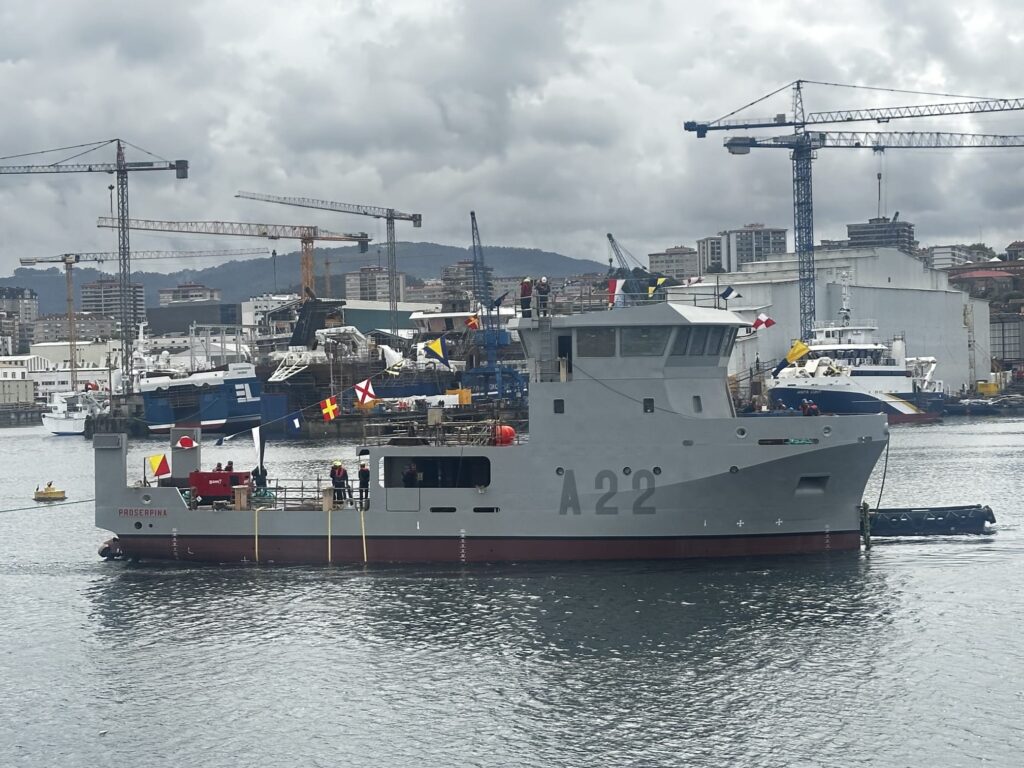
Spain has taken a new step in protecting its offshore critical infrastructures with the launching of the A22 Proserpina, a new support vessel for Navy divers that will enhance underwater intervention capabilities at a time when the security of communication cables, energy pipelines, and other strategic facilities has become increasingly important in Europe.
The launch took place on April 13th in Vigo, at Freire Shipyard facilities, and the vessel is scheduled for delivery later this year. Although its primary mission will be to support the Naval Diving School, the Navy emphasizes that this new unit is part of the broader need for adequate means to operate on the seafloor, where more and more critical assets for communications, energy, and national security are concentrated.
This is not a minor detail. Submarine cables support a significant portion of the global digital economy and are foundational for cloud services, data centers, international connectivity, and internet traffic between continents. Meanwhile, the seabed also hosts energy infrastructures and other strategic elements whose vulnerabilities are increasingly a concern for governments, operators, and international agencies.
A vessel designed for complex underwater operations
Proserpina is not merely a generational replacement. The new unit will replace the veteran vessel of the same name and is designed to enhance the Navy’s capabilities in diver support missions, advanced training, technical inspections, and deep-sea work.
Designed by Seaplace, the vessel has a length of 32.90 meters, a beam of 9 meters, and an autonomy of 500 nautical miles at a cruising speed of 10 knots, with a maximum speed of 12 knots. It can accommodate up to 15 crew members and has been conceived for prolonged missions in national waters, with a configuration suited for relatively complex underwater operations.
Among its features are a DP2 dynamic positioning system and a three-anchor anchoring system, both key for maintaining stability during delicate underwater tasks. According to the Navy, this configuration allows safe operation at depths of up to 90 meters, especially relevant for technical support, inspection, or deployment of diving gear.
Furthermore, Proserpina includes side-scan sonar, a lightweight, modular autonomous underwater vehicle (AUV), and a remotely operated vehicle (ROV) capable of reaching depths of up to 900 meters. The AUV can operate down to 300 meters. It also has dedicated spaces for diving equipment, hyperbaric chambers, and tactical coordination areas.
This suite does not make the vessel an exclusive platform for monitoring submarine cables, but it positions it as a useful tool within a broader strategy of surveillance, inspection, training, and intervention regarding submerged infrastructures.
Why the protection of the seabed matters now
The addition of Proserpina comes amid a context where the security of underwater infrastructures has shifted from a technical issue to a strategic one. The European Commission warned in 2025 that submarine communication cables carry 99% of intercontinental internet traffic and alerted that hybrid campaigns targeting these infrastructures could directly impact essential services within the European Union.
Since then, Brussels has strengthened its focus on prevention, detection, response, repair, and deterrence regarding incidents affecting submarine cables. It has also emphasized the need to improve monitoring across maritime basins, accelerate response capabilities, and reduce repair times. In this framework, any additional capacity for precise operations on the seabed gains importance.
Spain, given its geographical position, is not immune to this debate. Its location between the Atlantic and the Mediterranean, its role as a digital interconnection hub, and the presence of critical infrastructures in its waters make submarine surveillance a matter that extends far beyond purely military concerns. Protecting these assets directly impacts communications, data transmission, and the resilience of the digital ecosystem.
Enhanced capacity for the Navy and a signal for the digital ecosystem
The new vessel also has an industrial and technological significance. It boosts the Navy’s underwater intervention capabilities and adds a new specialized program built in Vigo to Spain’s naval sector. Moreover, Proserpina demonstrates how maritime defense is increasingly shifting from surface to the seabed, where less visible but more sensitive risks are concentrated.
For data centers, telecommunications, and digital infrastructure ecosystems, this development is clearly impactful. The security of submarine cables is not an abstract matter: they underpin international availability, latency, service continuity, and much of the connectivity that sustains regional internet traffic. When a country enhances its inspection and intervention capabilities in the underwater environment, it’s not just investing in defense—it’s also indirectly strengthening the resilience of its digital infrastructure.
The Navy emphasizes that Proserpina is part of its auxiliary units modernization initiative, aimed at maintaining and strengthening technical and training capacities in underwater operations. In a geopolitical context marked by rising tensions, increased dependence on critical infrastructures, and greater seabed exposure, this reinforcement is much more than symbolic.
Ultimately, the A22 Proserpina is not just a new support vessel. It’s a signal that Spain intends to take the underwater security dimension more seriously—a domain where defense, technological sovereignty, critical infrastructure protection, and the continuity of the digital economy converge.
Frequently Asked Questions
What will be the primary mission of the Navy’s new vessel Proserpina?
Its main role will be supporting the Naval Diving School and strengthening the Navy’s underwater intervention capabilities for inspections, advanced training, and technical deep-sea work.
Is Proserpina specifically designed to protect submarine cables?
Not exclusively. It is a diver support and underwater operations vessel, but its capabilities align with the growing need to safeguard critical submerged infrastructures such as communication cables and energy pipelines.
What equipment does the A22 Proserpina incorporate?
It features a DP2 dynamic positioning system, a three-anchor mooring system, side-scan sonar, an AUV, a ROV capable of reaching 900 meters depth, hyperbaric chambers, and tactical coordination facilities.
Why are submarine cables so important for Spain and Europe?
Because they carry the vast majority of international data traffic and are essential for internet, cloud services, data centers, and global communications. Their security has become a strategic priority for the European Union.
via: infodefensa
