
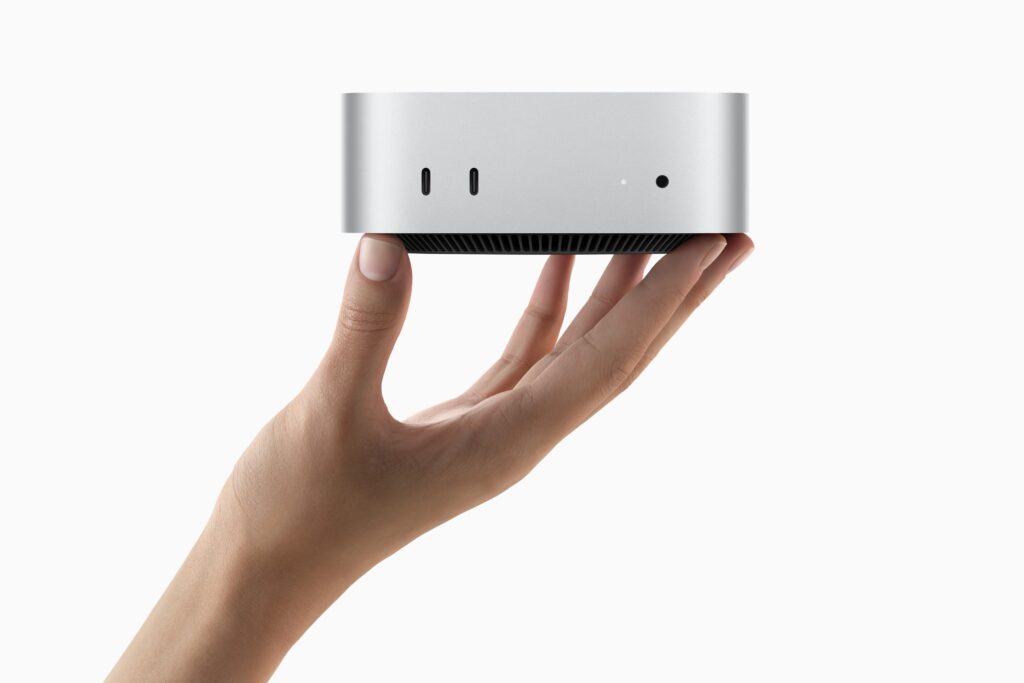
Apple has not yet announced the next-generation Mac mini, and the wait is beginning to have an explanation that goes beyond Cupertino’s usual schedule. The growth of artificial intelligence is fueling global demand for memory for servers and accelerators, while Apple’s small computer has unexpectedly become an attractive platform for running AI models locally. The result is an awkward combination: increased interest in configurations with high RAM just as industry faces difficulties in expanding supply.
The key points of the Mac mini M5 in 20 seconds
- Apple has not announced the M5 Mac mini or an official launch date yet.
- The company already sells chips M5, M5 Pro, and M5 Max in other devices.
- Unified memory makes Macs with large RAM interesting platforms for running local AI models.
- Demand for HBM and DRAM for data centers is stressing the global memory market.
- Unofficial reports suggest testing of new Mac minis even with M6 processors.
The absence is especially notable because the current Mac mini was introduced in October 2024. Apple then completely redesigned the device and equipped it with M4 and M4 Pro processors, while the rest of the Apple Silicon lineup continued advancing.
The M5 appeared in October 2025. The M5 Pro and M5 Max arrived in March 2026 with the new MacBook Pro lineup. However, the Mac mini remains on the previous generation.
The explanation could lie both in memory issues and in Apple’s product plans. MacRumors, citing information from Mark Gurman at Bloomberg, indicates that the company is testing new Mac mini configurations with M5 Pro and even M6 processors. Its release might depend on how memory supply evolves.
Apple has not confirmed these developments, so any specific date should be considered an estimate. Skipping a generation with the Mac mini isn’t unprecedented: Apple transitioned directly from the M2 to the M4 without releasing a Mac mini M3.
Local AI has found an unexpected ally in Apple Silicon
Interest in the upcoming Mac mini isn’t solely because users are waiting for a faster processor.
Apple Silicon has a feature that particularly suits local execution of AI models: unified memory.
In a conventional PC with a dedicated GPU, the CPU uses system RAM while the graphics card has its own VRAM. In Apple chips, CPU, GPU, and other components access a shared memory pool.
This difference is especially significant when the goal is to load language models with billions of parameters.
Apps like Ollama and LM Studio have greatly simplified downloading and running open or publicly available weights. No longer is manual configuration of complex inference environments necessary to experiment with Llama, Qwen, Gemma, or specialized models.
Memory remains the limiting factor.
A device with 16 GB can run relatively small and quantized models. Increasing to 32 or 64 GB opens the possibility of working with larger models, broader contexts, or multiple processes simultaneously.
This has made Mac configurations with high memory a unique alternative to workstations equipped with dedicated GPUs.
They don’t entirely replace Nvidia or AMD professional GPUs in all scenarios. Performance depends heavily on the model, framework, quantization, and operation type. But they provide ample GPU-accessible memory within compact devices and with relatively low power consumption.
The Mac mini M4 Pro supports up to 64 GB of unified memory.
The next step could be even more interesting.
M5 Pro: 307 GB/s bandwidth to power models
Apple introduced the M5 with a significant change for AI workloads: each GPU core includes a Neural Accelerator.
According to manufacturer tests, this new design offers over four times the maximum GPU performance for AI compared to the M4 in certain scenarios. While this doesn’t mean a large language model will run four times faster automatically, it highlights where Apple is placing much of its architectural improvement.
It also increased memory bandwidth.
The M5 reaches 153 GB/s, about 30% more than the M4. Later, the M5 Pro was introduced, doubling to 307 GB/s and supporting up to 64 GB of unified memory.
The M5 Max scales up to 614 GB/s and 128 GB.
Apple also features LM Studio and language model execution among the official performance examples for the new MacBook Pros, clearly indicating that it now considers local AI a relevant use case for its processors.
For a hypothetical Mac mini M5 Pro, 64 GB and 307 GB/s would likely be more appealing to certain AI users than a standard CPU performance upgrade.
The challenge is that manufacturing devices with large amounts of memory has become considerably more expensive and complex.
Data centers are absorbing available memory
The memory shortage isn’t originating from Mac itself.
It’s happening globally.
Major AI projects require enormous quantities of HBM (High Bandwidth Memory) for accelerators and DRAM for servers. Clusters with tens of thousands of processors also need significant amounts of conventional DRAM for their servers.
Samsung Electronics, SK Hynix, and Micron are responding to this demand by increasing investments in AI and data center products.
However, factories have limited capacity.
Producing HBM consumes more resources than traditional DRAM and competes for the same industrial capacity. Increasing output can’t be achieved simply by ramping up quarterly production.
TrendForce warns that growth in HBM and server memory supplies is constraining options for other markets and expects this imbalance to persist into 2027.
Prices mirror this situation.
According to the consultancy, contractual prices for conventional DRAM increased by approximately 93-98% quarter-on-quarter in Q1 2026. Future forecasts continue to point to a highly strained market.
Not all memory types follow exactly the same trends, and Apple doesn’t necessarily buy its components at open-market prices. The company negotiates large long-term contracts.
But even Apple can’t completely escape an industrial transformation of this magnitude.
Cloud AI begins to compete with local AI
This situation also presents a technological paradox.
One reason for executing AI locally is precisely to reduce dependence on the cloud.
Local models offer evident advantages for certain uses: data can stay on the device, there’s no variable cost per token processed, offline operation is possible, and users control which model runs.
However, the cloud infrastructure needed to train and serve large models is consuming some of the components that users also need to run AI at home.
First, it was GPUs.
For years, Nvidia struggled to meet demand for AI accelerators. Then HBM became a bottleneck.
Electricity and available capacity at data centers have also become constraints.
Now, pressure extends to conventional DRAM as well.
TrendForce believes that the shift toward generative AI systems, capable of executing longer processes and performing numerous inferences to complete tasks, will further increase memory needs.
In May, the firm estimated the global memory market could reach $889.3 billion in 2026 and surpass $1.28 trillion in 2027.
These are forecasts, not guaranteed revenues, but they show how much the strategic importance of this component has changed.
For years, RAM was one of the least interesting specs on a tech sheet.
AI is reigniting its importance.
Apple also depends on TSMC, Samsung, SK Hynix, and Micron
Designing Apple Silicon gives Apple extensive control over its computers, but it doesn’t eliminate reliance on the global semiconductor supply chain.
TSMC manufactures its advanced processors.
The DRAM industry is primarily concentrated in Samsung Electronics, SK Hynix, and Micron.
All face extraordinary demand from data centers.
Building more capacity isn’t immediate. A new factory requires several years of planning, construction, equipment installation, qualification, and phased ramp-up.
Hence, the Mac mini example is just a small illustration of a much larger shift.
Consumer products no longer only compete among themselves for semiconductors.
They now indirectly compete with data centers, which may require hundreds of thousands of chips and enormous quantities of memory.
Major cloud providers and AI developers also have a willingness to pay that’s hard to match in the consumer market when it comes to securing capacity.
Memory manufacturers have little reason to ignore such customers.
Mac mini M5 or a future generation directly?
The current question is what Apple will do next.
The M5 has been on the market since October 2025, with the M5 Pro arriving in March 2026. A Mac mini update with these chips makes sense technically.
However, the calendar is starting to dangerously approach the next generation.
Reports of prototypes with M6 processors open the possibility that Apple might revise its strategy again. That doesn’t necessarily mean canceling the Mac mini M5, as internal testing doesn’t always lead to commercial products.
The company might also first update the professional line or keep the M4 longer in production.
Without an official announcement, none of these options can be considered certain.
For those who need a Mac mini now for office work, development, or typical tasks, the M4 remains a modern and capable processor.
The decision becomes less clear for users specifically after a machine for local AI.
In this case, the amount of memory and bandwidth are especially important. A future Mac mini with an M5 Pro could offer significant improvements thanks to its 307 GB/s bandwidth and new GPU architecture, as long as Apple maintains configurations up to 64 GB.
And configurations with the most memory are the most exposed to the international market situation.
The small Apple Mac is thus tied to one of the major technological stories of 2026.
The AI race started with models and GPUs. Then came data centers, energy, cooling, and networking. Now, memory is becoming another limited resource.
The next Mac mini will depend on Apple’s decisions, but also on factories located thousands of kilometers away and on an AI infrastructure demand that keeps growing.
Frequently Asked Questions
When will the Mac mini M5 be released?
Apple hasn’t announced a release date. Unofficial reports suggest testing of new Mac mini configurations, but the schedule might be influenced by memory supply issues.
Why is a Mac mini interesting for running local AI?
Apple Silicon uses shared unified memory accessible by CPU and GPU. This allows configurations with ample RAM to load relatively large models without depending on a graphics card with limited VRAM.
How much memory could a Mac mini M5 Pro have?
Apple hasn’t announced the product. The current M5 Pro in Macs supports up to 64 GB of unified memory and offers 307 GB/s bandwidth, but it’s not confirmed if a future Mac mini would use exactly the same configurations.
Why is AI causing memory supply issues?
Data centers need large quantities of HBM for accelerators and DRAM for servers. Manufacturers are dedicating more capacity to these markets, but expanding production requires new factories and equipment that take years to become fully operational.
