
A single line of code can ignite weeks of speculation within the tech industry, and that’s exactly what has happened with the latest beta (or candidate release) of iOS 26.3. Internal references to two new Apple Silicon chips—identified as T6051 and T6052—have appeared in the software, linked to platform names H17C and H17D. Various analysts and leakers interpret these as M5 Max and M5 Ultra. However, what has generated the most buzz isn’t what’s visible but what’s absent: the supposed M5 Pro, traditionally associated with the suffix “S” in internal nomenclature.
The circulating image this week summarizes the situation clearly: in this beta, references exist for T6051 (H17C) and T6052 (H17D), while T6050 (H17S)—the identifier expected for an M5 Pro—does not appear. The absence alone doesn’t confirm cancellations or major changes; it could simply mean that Apple hasn’t included that identifier in this specific branch of the system yet. But in the Apple ecosystem, where every clue is analyzed meticulously, this void has been enough to reopen the debate on what the next generation of Apple Silicon high-end chips will look like.
What the code suggests: Max and Ultra, plus an elusive Pro
This interpretation relies on a naming pattern used in previous generations: “G” for the base chip, “S” for Pro, “C” for Max, and “D” for Ultra. Following this logic, seeing “C” and “D” without an “S” is, at minimum, noteworthy. In fact, multiple scenarios coexist:
- Prudent scenario: The M5 Pro exists but has not yet appeared in this beta; Apple might include it later or be using a different temporary label.
- Internal change scenario: Apple could be adjusting the naming scheme or the timeline for integrating these identifiers into the software.
- More speculative scenario: The M5 Pro might not be a “standalone” design but a variant derived from the Max.
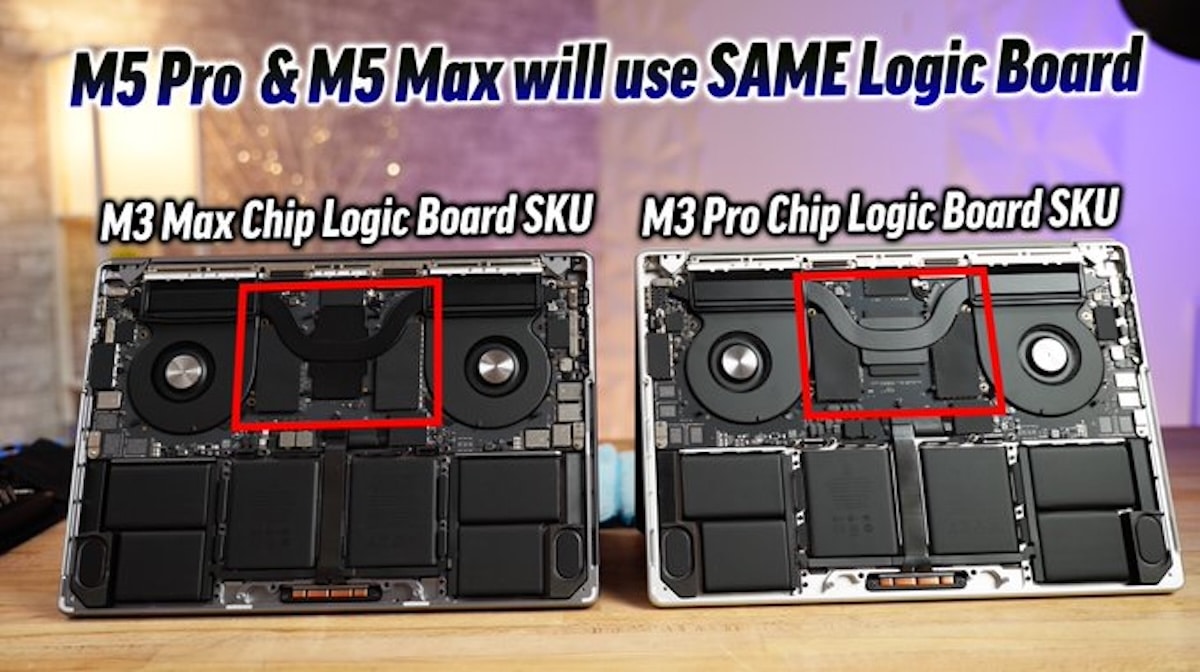
This is where the most headline-grabbing theory comes into play: that the M5 Pro would essentially be a truncated M5 Max.
The “M5 Pro as a cut-down M5 Max”: design savings and fewer SKUs
This idea stems from comments shared by Vadim Yuryev (Max Tech): if Apple adopts a more modular design approach with advanced packaging, it could produce a common base and then “segment” the lineup by activating or deactivating parts of the silicon (or modules) to build different configurations. Essentially: a single “mother” design could enable the production of units with varying capabilities, reducing the costs associated with developing separate variants.

Under this theory, the M5 Pro wouldn’t appear as a “distinct chip” in the code because Apple wouldn’t need a completely independent identifier for a different architecture, but rather a variant of the same core design. It’s an educated guess, not a confirmation, but it aligns with an ongoing industry trend: simplifying chip catalogs and turning segmentation into a matter of “binning” (classification by quality and configuration) and packaging.
The role of TSMC and 2.5D packaging: why this is being discussed now
The technical driver behind this discussion is the rumored shift toward advanced packaging technologies from TSMC, described publicly as 2.5D. Without delving into unconfirmed performance promises, the basic idea is well known: when a chip approaches thermal or efficiency limits, physical design and packaging influence performance just as much as lithography.
Recent articles have reignited the idea that Apple could employ a different packaging approach—moving from approaches like InFO to 2.5D/SoIC solutions—offering practical benefits such as better heat dissipation, more flexibility in combining blocks, and improved manufacturing yields. If this approach becomes standard, it would also make industrial sense to reduce unique designs and produce more units from a common base—particularly appealing when demand for advanced chips is high and production schedules are tight.
That said, it’s important to note: no official confirmation exists that the M5 Pro is a “renamed M5 Max” or that its absence in iOS 26.3 is deliberate. For now, it’s just a clue in a beta, an educated interpretation… and a dose of speculation.
What it means for users: less marketing mystery, more actual segmentation
If Apple moves toward a more unified design for Pro and Max models, the most visible impact wouldn’t necessarily be a major leap in performance but a more subtle shift: product differences would be dictated more by configurations and thermal constraints than by a complete redesign. Buyers might find a lineup where “Pro” and “Max” share more core elements, with distinctions based on enabled cores, available modules, or sustained performance limits.
For professionals—developers, video editors, 3D artists, or those doing intensive compile tasks—the focus remains the same: sustained performance and thermal stability. If packaging improvements help these variables, the real benefit would be seen in longer-duration workloads rather than in short benchmark jumps.
Meanwhile, the most honest signal continues to be the same: the “silence” of the M5 Pro in a beta isn’t a verdict. It’s a clue. And in Apple’s world, clues are often just the beginning of the story, not the end.
Frequently Asked Questions
What does it mean that T6051 and T6052 appear in an iOS 26.3 beta?
It indicates that the software includes internal references to unlaunched hardware. In this case, they’re interpreted as identifiers linked to upcoming M5 family chips.
Why isn’t the M5 Pro identifier showing, and what could this imply?
It might simply be that it hasn’t been added to this version of the system yet. It also fuels speculation about potential changes in schedules, naming conventions, or product strategies.
What is 2.5D packaging, and why is it related to the M5 Pro/Max?
Broadly, it refers to advanced packaging techniques that improve integration and connection of blocks with better thermal efficiency and flexibility. The current debate suggests this approach could help simplify designs and enhance dissipation and manufacturing efficiencies.
How reliable is the theory that the M5 Pro is just a “cut-down M5 Max”?
It’s a hypothesis circulated by leakers and industry commentators, based on naming patterns and industry trends in packaging and segmentation. It’s not officially confirmed at this stage.
via: Vadim Yuryev