
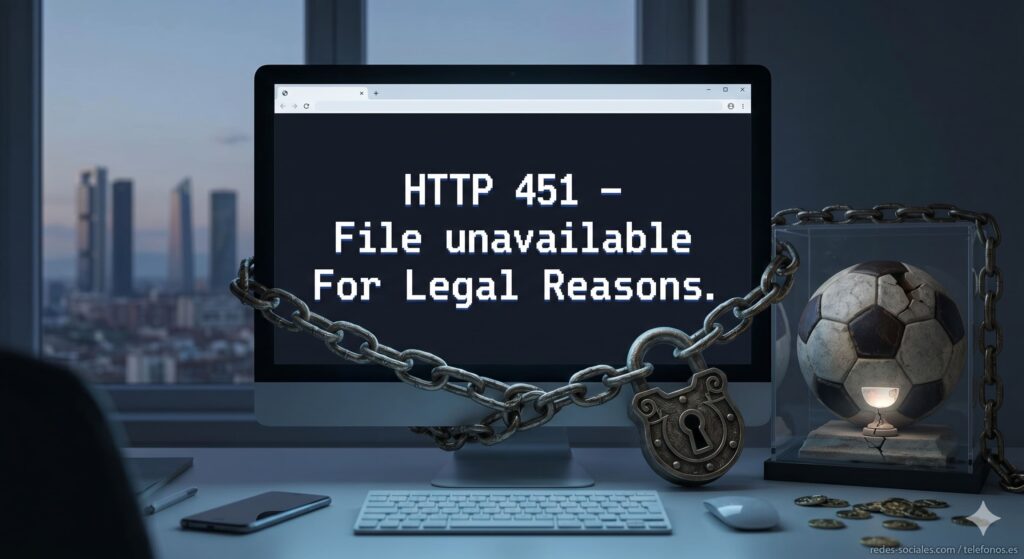
The latest wave of anti-piracy blocks in Spain has left a difficult-to-overcome image: Movistar users have seen access to domains linked to La Liga blocked, including the former website lfp.es and, according to multiple reports, also laliga.com at times. On screen, the HTTP 451 message appeared, indicating that a resource is unavailable for legal reasons.
The paradox is clear. The system designed to prevent access to unauthorized sports broadcasts may have ended up affecting the organization that has pushed hardest for stricter measures. But beyond this anecdote, the case reveals something much more serious: Spain is normalizing a model of blocking that is technically imprecise, lacks transparency, and can impact thousands of websites with no relation to piracy.
The issue isn’t piracy itself. Illegal streams exist, cause economic damage, and are part of increasingly professionalized networks. The real question is: what tools are used, under what guarantees, who audits errors, and how is damage repaired when a legitimate website gets caught in a blocking list?
Blocking an IP no longer means blocking a website
The modern web doesn’t function like it did twenty years ago. An IP address no longer corresponds to a single page. In many cases, one IP hosts hundreds or thousands of domains through cloud providers, CDNs, hosting platforms, serverless services, or attack protection networks. Cloudflare, OVH, Vercel, GitHub, BunnyCDN, and others are part of this shared infrastructure supporting companies, media outlets, developers, online stores, and personal projects.
When an operator blocks an IP to cut off access to a piracy site, they might also be blocking entirely legitimate services at the same time. That’s the core of the problem. The tool doesn’t always differentiate between the targeted domain and other websites sharing the infrastructure. The result is a kind of selective blackout, but with too many innocent sites affected.
According to BandaAncha.eu, the case of lfp.es points to an OVH IP, 213.186.33.5, which was likely added to Movistar’s filter to block other sites. The domain should redirect to laliga.com, but the operator’s filtering system intercepted it and showed the 451 message. It’s a stark example of the risks associated with IP blocking.
This isn’t an isolated case. Over recent months, disruptions have been documented across services hosted on Cloudflare, Vercel, GitHub, GitLab, Docker, and other providers used by thousands of websites. Xataka reported weeks ago that many of the blocked IPs are shared, and blocking one to prevent access to an IPTV service can also take down domains owned by individuals, businesses, and tools critical for developers.
ECH exposes the limitations of filtering
The advent of encryption complicates this scenario further. For years, some blocking systems relied on inspecting the beginning of the HTTPS connection to see which domain the user wanted to access. This data traveled in the SNI, a part of the TLS protocol that was not always encrypted.
With ECH, Encrypted Client Hello, that information is protected. From a user privacy perspective, this is a significant improvement: the operator or any third party sees fewer details about the specific site visited. But for anti-piracy filters, it means losing precision.
When the system cannot easily identify the domain, it faces two options: not blocking at all or blocking the entire IP. The latter causes collateral damage. This is the technical and political problem: to protect specific rights holders, a measure is being applied that can degrade access to legitimate third-party services.
This kind of blocking is more akin to shutting down an entire road because you suspect a specific car is passing through. It might stop that car, but it also halts everyone else.
Low transparency system for users and those affected
Another major problem is opacity. When a user encounters an HTTP 451, they rarely know what happened. They don’t know whether the block came from a court order, a dynamic list, an operator error, a third-party request, or a misconfiguration. Nor do they have a clear way to appeal if the affected website is theirs.
For large companies, a few hours of downtime can be a nuisance. For small businesses, online stores, small media outlets, or technical projects, it can mean loss of sales, reputation damage, support tickets, and loss of customer trust. The affected party hasn’t engaged in piracy, wasn’t part of any judicial process, yet their service becomes inaccessible to thousands of users of a provider.
The situation is especially delicate for developers and system administrators. If a repository, API, Docker image, technical documentation, or deployment service becomes inaccessible during an event, the problem extends beyond the domestic sphere. It impacts professional workflows, CI/CD pipelines, monitoring, deployments, and support.
Extending these mechanisms to other sports and audiovisual content increases the risk. The more competitions integrated into the dynamic blocking system, the more shared infrastructure is targeted. And as this practice becomes normalized, it becomes more urgent to demand independent oversight, technical audits, and rapid reversal mechanisms.
Network neutrality does not mean that actions against illegal activities are impossible. It means measures should be proportionate, precise, and backed by guarantees. If a system blocks thousands of legitimate websites to pursue a few infringing ones, the balance is broken.
The La Liga case, blocked by an anti-piracy system, should serve as a warning. Legal coverage alone isn’t enough. The system must also function technically. If it doesn’t, there should be accountability, transparency, and remedies.
Internet has become an infrastructure too critical to accept blunt blocks without sufficient oversight. The fight against piracy can’t be an excuse to disrupt legal services, punish third parties, or undermine trust in the web. If the remedy begins to block even the supposed beneficiaries, it may be time to reconsider the approach.
FAQs
What happened to La Liga’s website on Movistar?
Users have seen HTTP 451 messages when accessing La Liga-related domains like lfp.es, and, according to reports, sometimes also laliga.com.
Why are legitimate websites being blocked?
Because many websites share IP addresses through cloud providers or CDNs. Blocking an IP to prevent access to a pirated site can inadvertently affect legitimate pages hosted on the same infrastructure.
What is ECH and why does it complicate these blocks?
ECH encrypts part of the beginning of the HTTPS handshake, making it harder for operators to see the exact domain being accessed. This often leads to blocking entire IPs, which is less precise.
What should change in these blocking systems?
They should be more transparent, subject to technical audits, have clear appeal mechanisms, enable swift error correction, and ensure safeguards so legitimate services aren’t harmed.
via: Redes Sociales
