
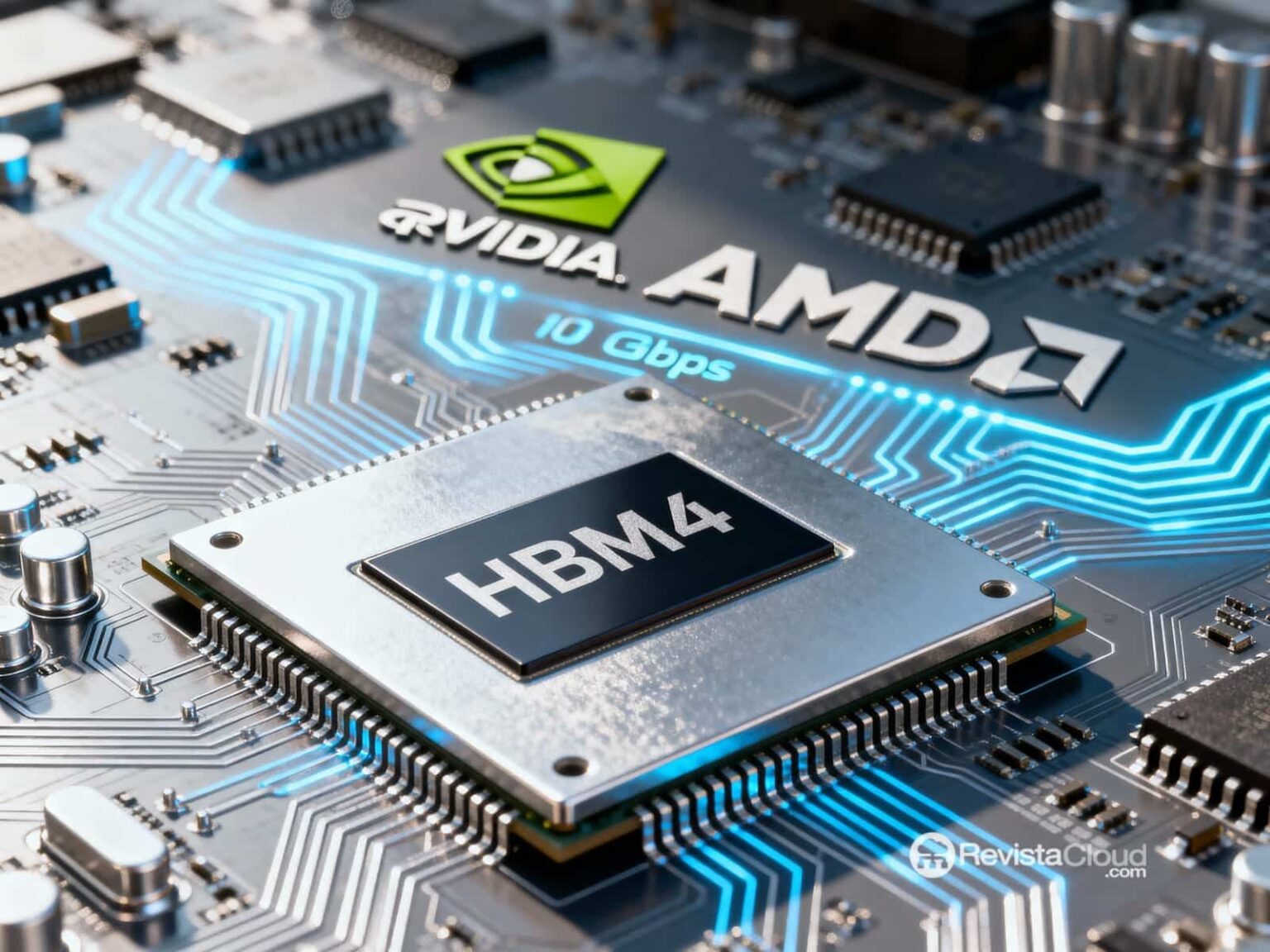
The HBM memory has become the most expensive — and most strategic — bottleneck in Artificial Intelligence. In that context, any speed adjustment has consequences that go far beyond a headline. According to several recent reports from specialized media, NVIDIA’s Vera Rubin GPUs may not meet their initial goal of 22 TB/s of memory bandwidth with HBM4, instead reaching around 20 TB/s due to practical limitations in producing HBM4 at the speeds NVIDIA intended per pin.
The change, which at first glance seems “just” a technical correction, actually signals something bigger: the industry is pushing HBM4 to its limits even before the node is fully mature at scale. And when key suppliers like SK hynix and Samsung set the limits, the rest of the ecosystem adjusts accordingly.
From 11 Gb/s per pin to a more realistic ceiling
The recurring explanation in these reports is quite specific: NVIDIA has pushed for HBM4 to operate around 11 Gb/s per pin, but manufacturers would prefer a more realistic figure of about 10 Gb/s per pin to maintain manufacturing yield, power consumption, and stability within acceptable parameters for mass production. This step back per pin, when combined across a huge bus, reduces the overall bandwidth of the package.
In HBM, this “detail” matters immensely because moving from HBM3/3E to HBM4 is not incremental, but structural: the standard switches to a 2,048-bit interface per stack (double that of previous generations), and this width amplifies any pin speed adjustments. Put another way: when the entire system is designed to sum up, reducing does matter, too.
Why is scaling HBM4 so difficult?
The memory industry has been warning for months that HBM4 is a different beast. Increasing speed per pin is not “free”: it usually entails greater demands on signal integrity, narrower thermal margins, and more complex validation for large-scale behavior. To this, add a less pleasant factor for any CFO: if yield per wafer drops, costs skyrocket.
It’s no coincidence that some technical coverage has focused on the gap between what the standard allows and what the market demands. On one hand, JEDEC’s framework defines the baseline; on the other, major buyers push to exceed the “minimum viable” because AI consumes everything. In the middle are manufacturers, who must deliver repeatable volume, not just demos.
This tension has already shown some signals within the sector. In 2025, for example, SK hynix announced improvements in HBM4 beyond initial standard references, making it clear that margins exist… but turning that into a mass-market product for the year’s most important GPU is a different story.
Competitive perspective: the advantage over AMD narrows
The buzz around “20 TB/s instead of 22” isn’t just marketing — it’s also driven by the competitive context. AMD has been presenting very aggressive figures for its upcoming HBM4-based accelerators.
Public documents show that AMD claims its Instinct MI450 Series offers 19.6 TB/s of bandwidth with 432 GB of HBM4. If Rubin stays near 20 TB/s, the gap shrinks: the race is no longer solely about memory bandwidth, but about architecture, interconnects, system scalability, and — especially — availability and total rack cost.
It’s important to remember that memory isn’t everything. In AI, final performance also depends on software efficiency, internal (and inter-node) connectivity, and how systems behave at scale under real loads. But memory bandwidth remains a key indicator because it influences the “feeding” of compute engines: without data, units wait idly.
From Hopper to Blackwell… and Rubin’s leap still huge
The fact that Rubin may not reach 22 TB/s doesn’t mean the leap isn’t spectacular. Just look at recent progress.
NVIDIA’s official specs detail that H100 (Hopper) provides 3.35 TB/s of memory bandwidth. For Blackwell, the company describes systems with HBM3E that, per GPU, reach around 8 TB/s. Even if Rubin approaches 20 TB/s, it remains an enormous jump over H100 — underscoring why industry is so focused on HBM technology.
In other words: the reduction matters in the competitive narrative, but it doesn’t change the fact that HBM4 is designed to push the ceiling for AI systems in the second half of this decade.
A warning to the industry: reserving capacity is one thing, meeting specifications is another
This kind of “adjustment” aligns with another trend that’s solidifying: leading-edge nodes and critical components are negotiated years in advance, but that doesn’t guarantee the most ambitious specs can be industrialized as quickly as the market demands.
By 2026, AI has made the supply chain a strategic weapon. HBM memory, due to its manufacturing complexity and value, is at the center. If manufacturers prioritize yield and stability over the last fraction of performance, the rest will adapt. And if final differences among competitors are measured in tenths, the real advantage shifts to other layers: software, networking, packaging, power, logistics, and installed capacity.
Summary table: bandwidth comparison (based on published figures)
| Platform | Memory | Memory bandwidth |
|---|---|---|
| NVIDIA H100 (Hopper) | HBM3 | 3.35 TB/s |
| NVIDIA Blackwell (B200 / HBM3E) | HBM3E | ~8 TB/s |
| NVIDIA Vera Rubin (initial target, reported) | HBM4 | ~22 TB/s |
| NVIDIA Vera Rubin (adjusted report) | HBM4 | ~20 TB/s |
| AMD Instinct MI450 (public data) | HBM4 | 19.6 TB/s |
The practical conclusion is straightforward: if these reports’ adjustments are confirmed, Rubin will still represent a significant leap, but the “headline race” against AMD in memory bandwidth will be less decisive than previously suggested. That shifts NVIDIA’s key battleground to where it usually excels: real-world performance at scale, ecosystem, and deployment speed.
Frequently Asked Questions
Why does moving from 22 TB/s to 20 TB/s matter in HBM4?
Because in AI, memory bandwidth is a critical factor for feeding compute. A reduction in target bandwidth also reveals manufacturing limits and can narrow gaps with competitors.
What does “Gb/s per pin” mean, and why is it so important?
It refers to the data transfer rate per memory data line. In HBM4, combined with very wide buses, small variations in speed per pin can result in massive changes in total bandwidth.
Does AMD truly have 19.6 TB/s of bandwidth in HBM4?
AMD has published figures of 19.6 TB/s for its MI450 Series with 432 GB of HBM4 in official documentation. While this doesn’t guarantee identical final performance, it sets a reference point.
Does this mean NVIDIA “loses” the Rubin generation?
Not necessarily. Even if bandwidth is slightly below the initial reported goal, Rubin would still outperform previous generations. The actual difference depends on architecture, interconnection, software, and large-scale efficiency.
via: MyDrivers