
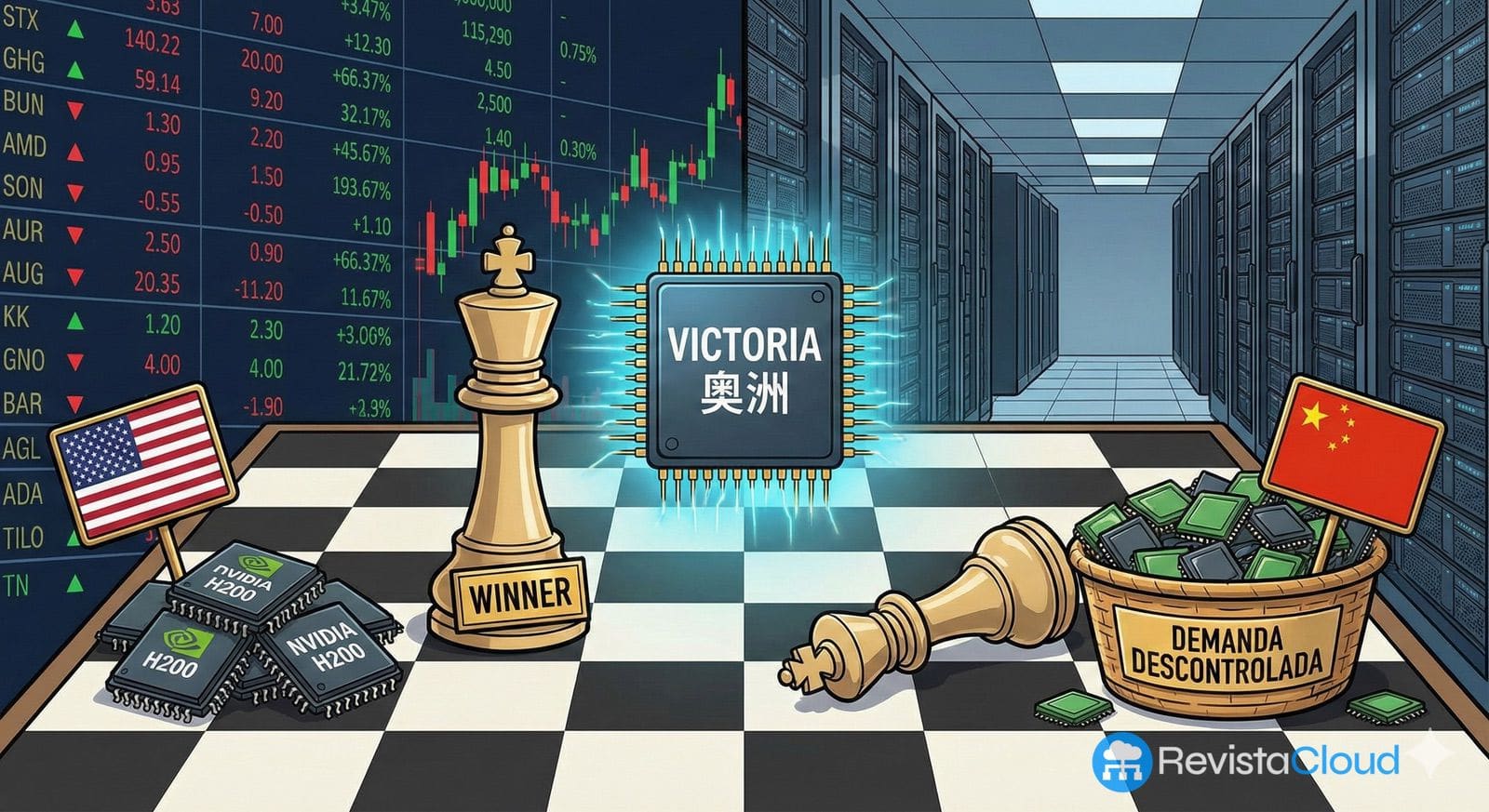
The “chip war” between the United States and China is once again at the center of the strategic game, with NVIDIA as a key piece and the H200 as currency. The latest development is not Washington’s control over which accelerators can reach the Chinese market—something ongoing since restrictions first began in 2022—but the practical turn: the White House opens a limited window for exporting H200 to “approved clients” under additional economic and control conditions. Meanwhile, China convenes urgent meetings with its tech giants to assess how many units they plan to purchase—and whether to hold back.
Why the H200 has become “the ceiling” China can now aim for
The H200 (Hopper architecture) isn’t NVIDIA’s latest generation—Blackwell already surpasses it—but in practice, it is the most powerful GPU that could legally enter China within the emerging framework. This is the critical point: if Blackwell remains off-limits, the H200 becomes the maximum performance accessible for short-term AI training and deployment.
This combination (high performance + exceptional access) explains why several Chinese tech companies have accelerated procurement discussions and demand forecasts. Reuters highlighted interest from companies like Alibaba and ByteDance, with the immediate effect being pressure to ramp up production.
Washington’s “Yes, but”: export licenses with a 25% tariff
The license isn’t an open-door policy. According to published information, Donald Trump announced that H200 exports to China would be allowed if NVIDIA pays the U.S. government a 25% share of revenue from those sales.
There’s an even more sensitive nuance: alongside this tariff, a mechanism has been described where chips produced by TSMC could pass through the U.S. for security reviews, tariffs applied, and then be re-exported to approved Chinese buyers.
Geopolitically, the message is clear: the U.S. doesn’t just restrict access; it turns it into a “tariffed” and supervised process. For NVIDIA, this remains a feasible (though conditioned) business model. For China, it’s a reminder once again of dependency.
Beijing isn’t idle: “emergency” meetings and potential new restrictions
Chinese responses, as reported through various sources, involve not ignoring the window but trying to control it from within.
According to reports, Chinese officials have held emergency meetings with Alibaba, ByteDance, and Tencent to forecast purchase plans and decide on guidance strategies. These meetings are reportedly led by agencies like the National Development and Reform Commission (NDRC) and the Ministry of Industry and Information Technology (MIIT), which have been monitoring AI chip purchases since early restrictions.
Two particularly relevant approaches under consideration to understand Beijing’s strategy are:
- Purchase limits: restricting how many NVIDIA GPUs a company can buy based on its commitment to domestic accelerators.
- Sectors bans: preventing H200 from being used in strategically important areas (such as finance and energy) via “window guidance,” an informal regulatory pressure method.
In other words: China needs power now but fears that buying “too much” NVIDIA weakens its narrative and reality of self-sufficiency.
Can NVIDIA increase H200 production without breaking its roadmap?
This is where industry factors come into play. Reuters suggested that NVIDIA might consider expanding H200 capacity because potential Chinese orders have exceeded current supply, yet the company remains focused on newer generations.
The tension is twofold:
- Limited capacity and prioritization: increasing H200 output requires balancing production with newer platforms.
- Message to the global market: NVIDIA reportedly conveyed that increasing supply for China shouldn’t affect other markets, precisely to prevent Western customers from perceiving the operation as a “diversion” of supplies.
Moreover, the bottleneck isn’t resolved by decree: if demand suddenly spikes and the supply chain is optimized for newer models, actual flexibility is finite.
What this episode leaves behind: profitable control for the U.S., strategic dilemma for China
This chapter encapsulates the current state of tech rivalry:
- The U.S. maintains leadership and control of the flow: it decides what enters, to whom, and under what rules; additionally, it monetizes the access through an explicit tariff.
- China faces a dilemma: it needs “muscle” to compete in AI and lacks an immediate equivalent for heavy loads; however, purchasing H200 at scale conflicts with internal pressure to prioritize domestic hardware and reduces political maneuvering room.
- NVIDIA remains central: it can sell… but within a narrow, supervised lane susceptible to change, both in Washington and Beijing.
The big question is whether this controlled valve will remain stable or turn into another round of regulatory back-and-forth. In a tech war, the only constant is that rules change when the strategic cost of maintaining them shifts.
Frequently Asked Questions
Why is China so interested in the NVIDIA H200 if the H20 “for China” already exists?
Because the H200 is far superior in capacity for training and advanced deployments, while the H20—designed to meet export controls—has become a more limited option for certain needs.
What does it mean that the U.S. allows the sale of H200 “to approved clients”?
It’s not an open sale: exports are framed within authorizations, controls, and specific conditions (including a 25% revenue tax as described).
Can China prevent its companies from buying H200 even if the U.S. permits it?
Yes. According to reports, Beijing is considering internal limits and sector restrictions, including informal guidance (“window guidance”).
Will this affect GPU supply for AI in Europe or the U.S.?
NVIDIA has indicated that if it expands production to meet Chinese orders, it would try to ensure that other markets are not affected, although industrial capacity has inherent limits.