
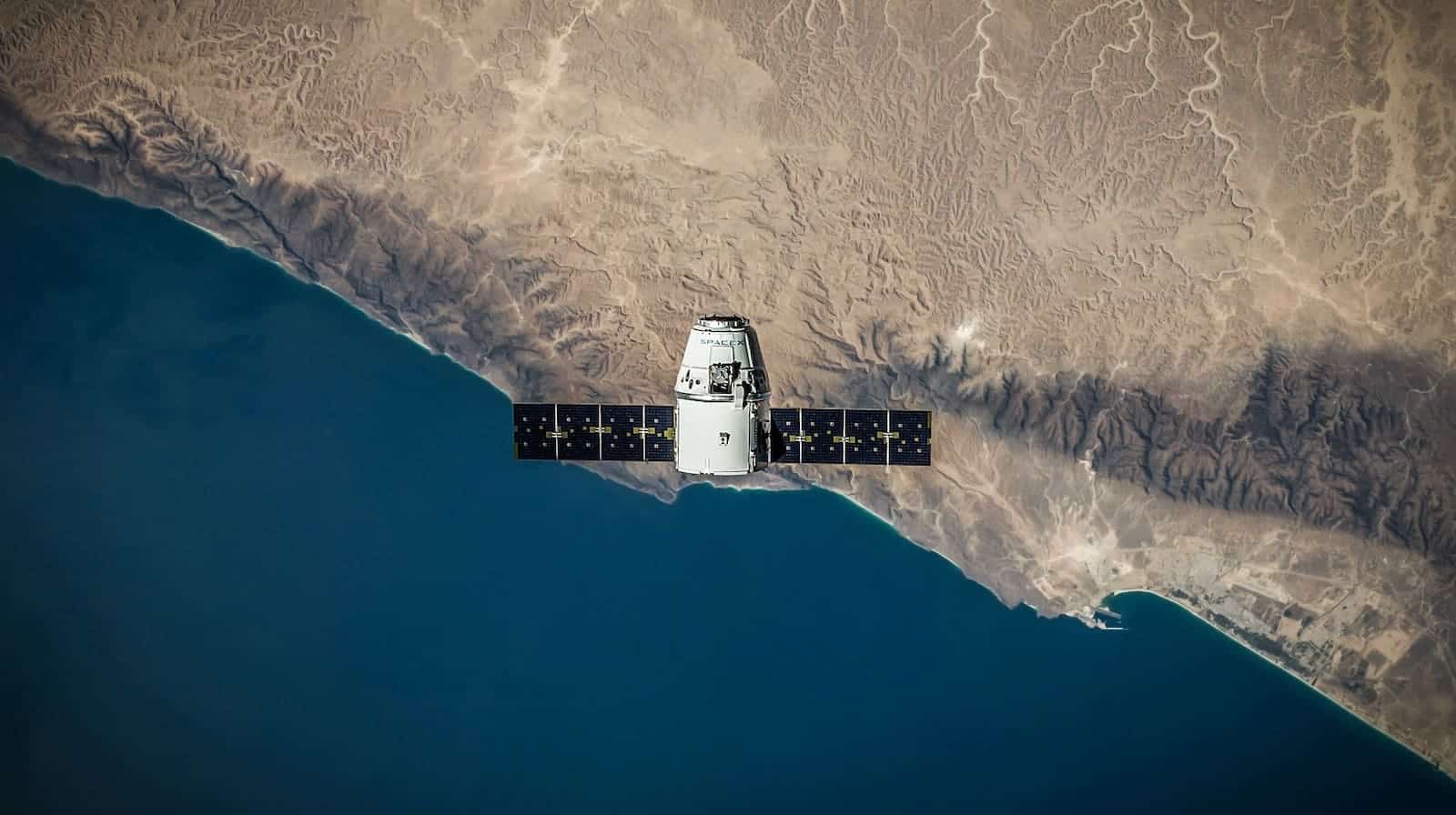
The United States has authorized the launch of Eärendil-1, an experimental satellite that will deploy an 18-meter-sided reflector in orbit to direct sunlight toward areas that are already night. The California-based company Reflect Orbital aims to demonstrate that it can illuminate works, emergency-affected zones, or solar installations from an altitude of between 600 and 650 kilometers for a few minutes.
The proposal may seem like science fiction, but the physics behind it is well understood: while part of the Earth is dark, a satellite at sufficient altitude can continue to receive sunlight and reflect a small fraction of it downward. The main challenge will be deploying a large, lightweight membrane, orienting it precisely, and maintaining the beam within the requested zone as the vehicle crosses the sky at several kilometers per second.
The keys to the first orbital mirror in 20 seconds
- The U.S. Federal Communications Commission (FCC) has authorized Eärendil-1.
- The license covers an experimental satellite, not a future commercial constellation.
- The spacecraft will weigh around 142 kilograms.
- It will deploy an 18 by 18-meter square reflector with a surface area of 324 square meters.
- It will operate in low Earth orbit, at an altitude between 600 and 650 kilometers.
- Reflect Orbital wants to direct sunlight toward specific areas for several minutes.
- The company mentions applications in nighttime works, search and rescue, emergencies, and photovoltaic plants.
- The launch is scheduled before the end of 2026.
- Astronomers and environmental organizations fear the effects of a future constellation of thousands of reflectors.
- The FCC authorization does not equate to environmental approval or a permit to deploy 50,000 satellites.
Eärendil-1 will serve to test issues not yet demonstrated at a commercial scale in space: how much the reflector deforms, how precisely it can be oriented, how much light actually reaches the ground, and how the light disperses outside the targeted area.
Reflect Orbital claims that the system can provide localized illumination on demand. Its CEO, Ben Nowack, has presented the license as the first step toward testing both the technology and measures to mitigate potential impacts on the night sky.
What the FCC has actually approved
The decision pertains to a specific technological demonstrator. It does not automatically authorize a constellation of tens of thousands of satellites proposed by Reflect Orbital for the next decade.
The FCC’s intervention is necessary because Eärendil-1 needs to use radio frequencies to receive commands, transmit telemetry, and operate from Earth. By granting the license, the regulator allows these communications and the space operations under the described conditions.
| Feature | Eärendil-1 |
|---|---|
| Mission type | Technological demonstration |
| Approximate mass | 142 kilograms |
| Reflector | Square membrane of 18×18 meters |
| Reflective surface | 324 square meters |
| Expected altitude | Between 600 and 650 kilometers |
| Objective | Reflect sunlight toward specific areas |
| Illumination duration | Several minutes |
| Planned launch | Before the end of 2026 |
| Authorized commercial constellation | No |
The distinction matters because the effect of a single experimental satellite cannot be directly compared to that of a network formed by thousands of reflective structures. Eärendil-1 will enable real measurements but will not alone resolve all questions about a potential global operation.
The FCC received about 1,900 comments on the application, mostly concerning astronomy, light pollution, and environmental impacts. Nonetheless, the agency concluded that many of these issues fall outside the scope of the spectrum authorization being processed.
In its decision, the commission argued that permitting testing of new space activities can foster innovation and the development of new services. It also noted Reflect Orbital’s commitments to coordinate with NASA, the National Science Foundation, and the astronomical community.
The decision does not certify that the project is harmless to observatories, ecosystems, or human health. It indicates that the FCC did not consider these issues sufficient grounds to deny this particular license.
How it plans to direct sunlight to a nighttime zone
A satellite in low orbit can remain illuminated by the Sun even after it’s dark on the ground. The reflector acts as a mobile mirror that changes orientation to send part of that light toward a specific point.
This approach works best near dawn or dusk. When the terrestrial zone is deep into night, the planet itself blocks sunlight, and a low orbit satellite enters Earth’s shadow.
Therefore, a single vehicle could not maintain illumination over a location all night. The beam would sweep over the terrain as the satellite moves, lasting only a few minutes per zone. Maintaining continuous illumination would require coordinating multiple reflectors, rotating their activity sequentially.
Reflect Orbital must overcome several challenges:
| Challenge | Why it matters |
|---|---|
| Deployment | A membrane of 18 meters must open without tearing or wrinkling |
| Orientation accuracy | A small orbital error can displace the reflection by many kilometers |
| Mirror shape | Deformations scatter light and reduce beam control |
| Stability | Vibrations and movements can cause flickering or inconsistent lighting |
| Nebulae and atmosphere | Weather conditions can block or scatter the light |
| Duration | The satellite only stays in an optimal position for minutes |
| Safety | Must avoid unintended illumination of observatories, aircraft, or populations |
A flexible membrane does not function like the rigid mirror of a telescope. Its surface can have ripples that spread light over a larger area than intended. This dispersion is a primary concern for astronomers.
From the ground, the reflector might appear as an extremely bright object even to observers outside the main beam zone. Its brightness will depend on the spacecraft’s orientation, the Sun’s position, and the material properties.
Eärendil-1 will enable observations to assess these variables. Future versions are unlikely to guarantee the promised brightness, as it will depend on achieved accuracy and how much light is lost along the way.
Proposed uses: construction, rescue, and solar energy
Reflect Orbital says its early application could be nighttime illumination for construction works. A temporary beam could supplement lighting towers at remote sites, linear infrastructures, or areas with difficulty deploying generators.
In search and rescue, a few minutes of light could help locate people, land a helicopter, or work after an earthquake, flood, or power outage. Success depends on having the right satellite available at the right time and authorized to illuminate the zone.
The company also suggests reflecting light onto photovoltaic plants to extend power generation after sunset. This use faces greater economic doubts: the energy received would be much less than direct sunlight, illumination would last only a short time, and the cost of deploying numerous satellites would have to compete with batteries, power grids, and other storage solutions.
| Application | Potential advantage | Main limitation |
|---|---|---|
| Nighttime works | Light without transporting heavy equipment | Short windows and orbit dependency |
| Search and rescue | Quick illumination in isolated areas | Availability and immediate authorization needed |
| Natural disasters | Support when power grids fail | Weather conditions such as clouds, smoke |
| Solar plants | Prolonged generation potential | Low intensity and high cost compared to batteries |
| Agriculture | Pointed extension of light hours | Risks disrupting biological cycles or crops |
| Events | Illumination of large areas | Light pollution and limited public necessity |
The commercial viability of the project hinges on whether clients see an advantage over terrestrial alternatives. LED lights, generators, batteries, and mobile systems are mature, relatively inexpensive, and available for many hours.
Orbital illumination could be valuable in very remote areas or during emergencies but will need to prove that its accuracy, cost, and response time offset the complexity.
Scientists fear a constellation of 50,000 mirrors
The scientific opposition focuses less on testing a single satellite than on the precedent it could set.
Reflect Orbital has envisioned a future network that could reach 50,000 vehicles. A constellation of such scale would allow chaining multiple satellites over the same area but would also introduce thousands of very bright objects into the sky.
The European Southern Observatory (ESO) has modeled how such a network would affect their facilities in Chile. Their calculations suggest the night sky’s background brightness could increase three to four times, impairing the detection of galaxies, stars, and other faint objects. Other studies warn that ultra-bright constellations could render a significant portion of astronomical images unusable.
Modern telescopes do more than take visible-light photos. Some perform long exposures to gather minimal light from distant universe regions. Moderate increases in sky brightness could obscure these signals or require much longer observation times.
Reflectors would pose particular problems because their mission is to send light back to Earth. Communications satellites try to reduce their brightness, but Reflect Orbital needs a large reflective surface.
The company states it will orient the mirrors to minimize light emission when not in use and that each illumination request will be controlled and geographically limited. Independent research on their technology’s effects has also been announced.
Astronomers doubt that the light can be confined with such precision. Even if the main beam is focused on a point, some radiation may disperse due to reflector imperfections and atmospheric conditions.
The night is also essential for ecosystems
Light pollution affects more than just stargazing. Animals and plants depend on the light-dark cycle to regulate biological processes.
Migratory birds navigate by natural signals; many insects respond to light; sea turtles use horizon brightness to head toward the ocean; and numerous species adjust their feeding or reproduction to daily rhythms. In humans, nighttime exposure can disrupt sleep and melatonin production.
Circadian rhythm specialists are urging environmental assessments before widespread deployment. They fear remote-area lighting could extend light pollution into previously dark places.
The impact will depend on the intensity, duration, frequency, and location of each reflection. Lighting a remote industrial zone for two minutes is different from routinely extending daylight over a protected ecosystem.
This testing could provide valuable data, but results must be public and include measurements both inside and outside the beam. Studies should consider observed brightness from afar, atmospheric scattering, and the capacity for rapid reflection control.
Spectacular technology amidst regulatory gaps
Eärendil-1 raises a broader question beyond its technical feasibility: who has authority over a light generated in space that crosses multiple jurisdictions and alters the visible sky for other countries?
While the FCC regulates U.S. satellite communications, it is not a global environmental authority nor an astronomical regulator. The Federal Aviation Administration (FAA) oversees launches, and other agencies can participate in specific matters, but no international system exists specifically to authorize commercial orbital lighting.
The Outer Space Treaty assigns space activity responsibilities to states, but it was drafted before the idea of private constellations of tens of thousands of satellites. This creates a regulatory vacuum that worries scientists: a national license can have visible effects globally. A reflector flying over Chile, Spain, or Australia still impacts the night sky of those countries, regardless of the company’s headquarters in California.
The Eärendil-1 license launches the experimental phase but does not settle the debate. The satellite must first prove it can deploy, orient, and emit light as claimed. Subsequently, the difficult discussion will be whether such capabilities, once proven, should be deployed worldwide.
Frequently Asked Questions
Has the FCC authorized 50,000 space mirrors?
No. The granted license pertains only to Eärendil-1, a single experimental satellite. A commercial constellation of that scale would require new approvals.
Can the satellite turn night into day?
No. It will direct a limited amount of light to a specific area for a few minutes. A single satellite cannot illuminate a place throughout the entire night.
When will Eärendil-1 launch?
Reflect Orbital plans to send it into orbit before the end of 2026, though the date may shift depending on the launch provider and final testing.
Why do astronomers oppose it?
They fear that a future constellation of thousands of reflectors could increase sky brightness, saturate instruments, and hinder the observation of very faint objects.
via: spacenews
