
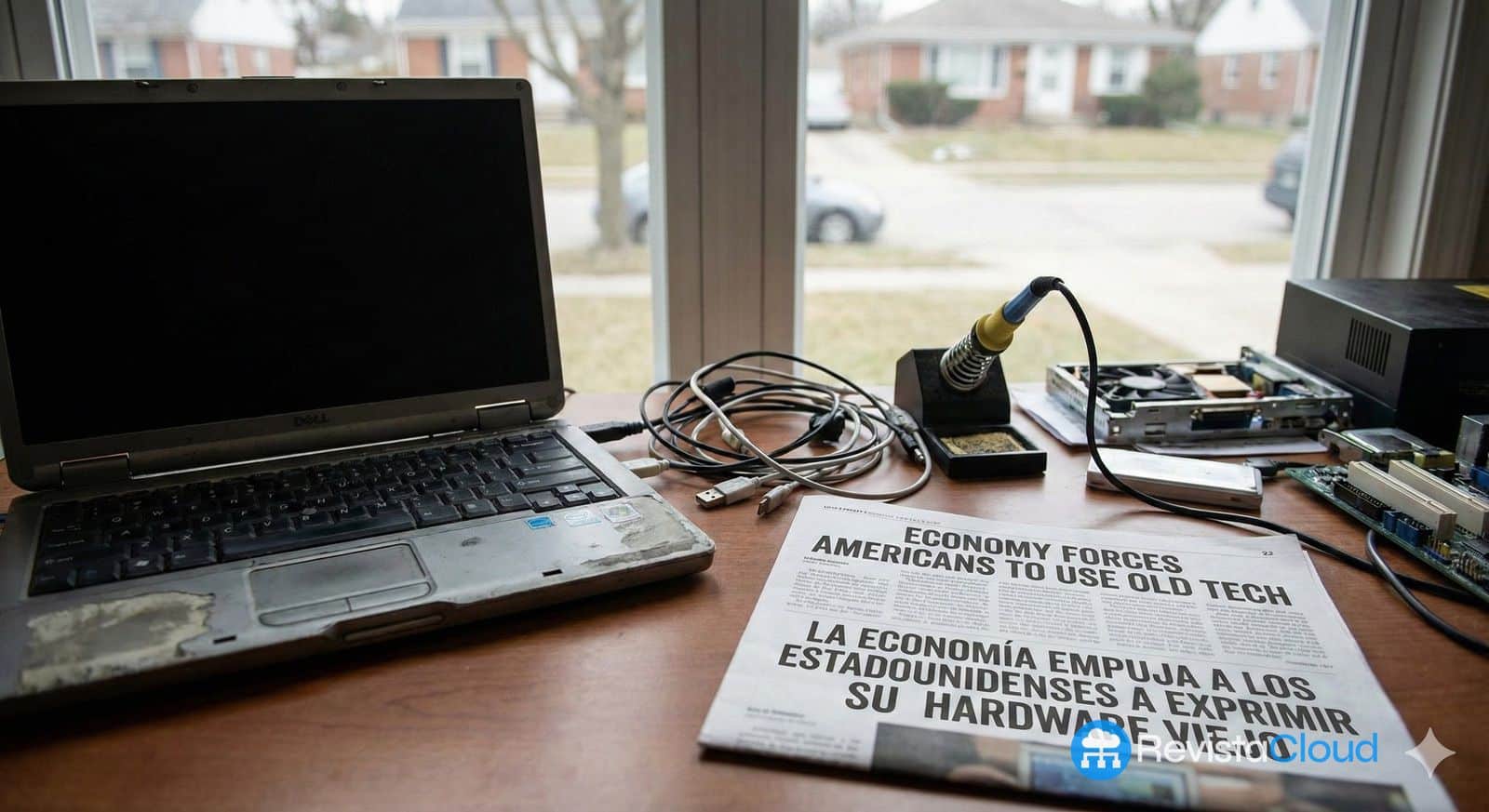
The combination of inflation, economic uncertainty, and rising hardware costs is leading to an increasingly visible phenomenon in the United States: both consumers and companies are extending the lifespan of their devices much longer than they would like. Slow computers, smartphones with drained batteries, and outdated servers remain in use because renewing them has become a costly and complicated decision.
Several experts cited by the Federal Reserve and financial media indicate that investment in new equipment accounts for a significant part of the productivity gap between U.S. corporations and some European firms. The logic is straightforward: if the hardware is old, everything takes longer. Applications open slowly, tasks stall, equipment fails exactly when needed most… and hours of work are lost without appearing in any accounting records.
The Hidden Cost of Obsolete Hardware in Businesses
A study by technology solutions firm Diversified quantifies this problem:
- 24% of employees say they’ve had to work overtime due to issues related to outdated technology.
- 88% assert that old equipment limits innovation within their company.
In other words, it’s not just about wasted time; it also hampers new projects because the tools aren’t up to par. And yet, many companies continue to delay updating their IT assets.
The reasons vary:
- Costs rising. Supply chains have experienced shocks in recent years, and trade tariffs have changed multiple times, making hardware prices unpredictable.
- AI boom. The craze for artificial intelligence has skyrocketed demand for cutting-edge hardware, especially RAM and certain types of chips. This pressure drives up prices and may lead some manufacturers to increase tariffs or halt production of more affordable ranges. Some analysts suggest this tension could persist until 2027.
- Slow internal processes. As Jason Kornweiss, CEO of Diversified, explains, large companies take so long to test and certify new technology that by the time they finish, a better option has already emerged. The result: hardware is purchased too late or buying is indefinitely postponed.
Repair and Modular Design Instead of Discarding and Buying
Faced with this vicious cycle, industry voices advocate a different approach. Cassandra Cummings, CEO of Thomas Instrumentation, argues that the key lies in improving hardware reparability and modularity, not just accelerating renewal cycles.
The idea is simple:
- Mature devices, with available spare parts and good software update support, can remain useful for longer.
- Equipment designed with modular components allows updating only what’s necessary — for example, expanding memory or changing storage — instead of replacing the entire system.
This approach aligns with trends like the right to repair and could ease both economic pressures and the environmental impact of mass-renewing device fleets every few years.
Users Enduring Old Phones Much Longer Than They Would Like
The situation in businesses echoes in consumers’ wallets. A survey by Pollfish of 1,000 adults for reviews.org shows that Americans would like to upgrade their phones every 16 months, but the reality is quite different:
- In practice, they keep their phones an average of 22 months.
- And they only renew approximately every 29 months.
Cost is the main barrier. The average price paid for a new phone ranges between $600 and $634, far less than many high-end models today, such as the latest iPhone Pro or flagship Android phones.
This explains why the most popular devices in the survey are models several years old, like the iPhone 13, iPhone 14, or Samsung Galaxy S9. They aren’t the newest models on the market, but they are within a more affordable price range.
When users finally decide to upgrade, their reasons tend to be very pragmatic:
- Faster speeds and better performance in newer models.
Fewer users cite “having the latest model,” access to new features, or a more advanced camera as primary motivations. Technology aspirations are often overshadowed by budget realities.
What Path Should We Take?
The current landscape presents an interesting dilemma for the U.S. digital economy:
- On one hand, renewing hardware more quickly could boost productivity and help companies and users make better use of artificial intelligence, hybrid work, and new apps.
- On the other hand, forcing shorter upgrade cycles conflicts with rising costs, supply chain saturation, and environmental concerns.
Between these extremes, a middle ground is gaining traction: more repairable, modular, and software-supported devices that maximize investment without severely penalizing productivity. In an uncertain economic environment and amid competitive pressures, this approach could be the key to avoiding getting stuck with outdated hardware… or continuing to advance without breaking the bank.
via: techspot