

Spain can no longer talk about digitization as an unfulfilled promise. In 2025, the digital economy accounted for 27% of Spain’s GDP, with a total impact of 455.3 billion euros, according to the sixth edition of the report Digital Economy in Spain by Adigital. This figure represents a 10% increase compared to the 414 billion euros recorded in 2024 and confirms that technology has become integrated into much of the country’s productive activity.
The report measures the digital economy broadly, not just as the weight of tech companies or the ICT sector. It includes economic activity based on digital goods and services, as well as traditional business models that have transformed part of their processes through e-commerce, cloud computing, data, digital payments, automation, artificial intelligence, or management tools.
This perspective is especially relevant for a tech-focused audience because it shifts the focus. Digitization is no longer explained solely by new apps, platforms, or startups. It also depends on infrastructures, cloud architectures, cybersecurity, connectivity, data interoperability, enterprise software, and regulatory capacity to support technologies that advance faster than many administrative frameworks.
Digitalization is no longer a sector: it permeates the entire economy
Adigital estimates the contribution of the digital economy through three components: direct, indirect, and induced impact. The direct impact reached 13.42% of GDP in 2025 and measures digitized activity within each sector. The indirect impact, linked to the effect of digitalization on the supply chain, stood at 12.49%. The induced impact, related to consumption generated by the income of workers in digitized activities, reached 1.10%.
The sum of these three blocks places the total contribution at 27.01% of GDP. The trend is clear: in 2019, the share was 18.7%; by 2024, it reached 26%, and in 2025, it rose again, albeit with a slight moderation in growth rate. This slowdown does not change the underlying trend. The digital economy grows faster than GDP and is gradually extending to sectors that only a few years ago had just begun their transformation.
| Indicator | 2025 Data |
|---|---|
| Share of the digital economy in GDP | 27.01% |
| Total impact | 455.3 billion euros |
| Growth compared to 2024 | 10% |
| Direct impact | 13.42% of GDP |
| Indirect impact | 12.49% of GDP |
| Induced impact | 1.10% of GDP |
| Share in 2019 | 18.7% |
For technology providers, this viewpoint reveals an obvious opportunity. Spain’s digital economy isn’t limited to selling more software. It involves modernizing processes, connecting systems, automating operations, deploying secure infrastructure, and turning data into a useful layer for decision-making. The report highlights, for example, the growing integration of artificial intelligence as part of this process and the maturing of public investments linked to the Recovery Plan.
The industry emerges as one of the areas where digitalization has the most direct impact on value added. Contrary to the idea that services are always the natural domain of digital, Adigital points out that manufacturing can capture more value when incorporating advanced ERP systems, digital twins, predictive maintenance, or process automation. In this domain, technology does not serve as a marketing layer but as part of the production process.
Cloud, data, and automation are transforming traditional sectors
Retail is one of the clearest examples of this transition. According to the report, the digitization of retail has been driven by growth in e-commerce, hybrid purchasing, cloud use, AI, and modernization of physical points of sale. The brick-and-mortar store, website, app, marketplace, payments, inventory, and logistics are beginning to operate as parts of a unified system.
This has very specific technical implications. A business aiming to operate seamlessly needs synchronized inventory, integrated POS and accounting systems, demand analytics, loyalty tools, return management, and systems capable of handling peak activity. Digitalization no longer means just launching a website; it depends on the entire architecture of the business.
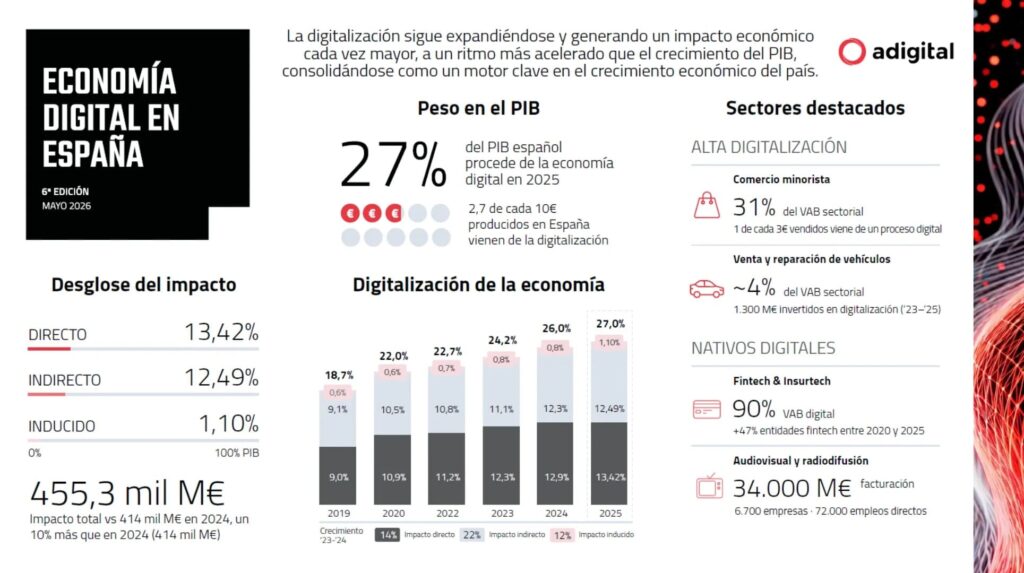
The automotive sector is also undergoing a significant transformation. The report notes that the sale and repair of vehicles have invested over 1.3 billion euros between 2023 and 2025 in digitization, electrification, and facilities. The dealership still exists, but customers arrive with much of their decision already made after comparing options, configuring vehicles, evaluating financing, or reviewing alternatives online. Meanwhile, DMS systems, digital catalogs, VIN verification, and stock management platforms are changing the operations of dealerships, distributors, and workshops.
Fintech and insurtech represent a different pattern. Their level of digitalization is much higher because many of their models are already built on technological infrastructure. Adigital highlights that Spanish fintechs have largely shifted from offering final products to functioning as infrastructure layers for banking, insurance, and traditional companies: payments, open banking, identity verification, alternative scoring, or financial software.
The audiovisual sector completes the industry map, with combined revenues exceeding 34 billion euros, over 6,700 companies, and around 72,000 direct jobs. Cloud production, digital post-production, streaming, advanced audience measurement, podcasts, on-demand radio, and digital advertising have reshaped the value chain. For technical teams, this means greater dependence on platforms, content distribution networks, storage, intensive processing, and data tools.
AGI: from content creation to task execution
The most forward-looking part of the report focuses on Artificial General Intelligence (AGI). Adigital distinguishes these systems from the more widely known generative AI. While generative models respond to instructions and produce text, code, images, or analyses, agents can plan tasks, use external tools, interact with applications, query databases, execute actions, and adapt their behavior toward an objective.
The technical leap is significant. An agent doesn’t just respond; it acts. It can connect to APIs, access documents, execute commands, coordinate steps, and make operational decisions with minimal human supervision. This opens possibilities in customer service, software development, financial analysis, IT operations, administrative automation, research, or business process management.
But it also introduces new risks. A traditional chatbot might give an incorrect response, leading to misinformation or poor recommendations. An AGI system could modify data, launch undesired actions, access sensitive information, or interact with corporate systems. That’s why the report emphasizes three pillars for governance: security, control, and transparency.
Security entails protecting the agent and its environment. This involves restricting tools and permissions, applying the principle of least privilege, avoiding unnecessary credential access, controlling extensions, filtering malicious instructions, and running agents in isolated environments when needed. Practically, agents should be treated as operational software capable of acting, not as mere conversational assistants.
Control involves defining what each agent can do and under what conditions. The report suggests practices such as separating planning and execution, requiring human validation for sensitive actions, dividing tasks among specialized agents, and documenting behavior rules via context files. Transparency requires observability: recording which decisions an agent makes, what data it queries, what tools it uses, and what actions it performs.
This approach is directly related to cybersecurity and systems administration. If companies deploy agents in real environments, they will need inventories, permissions, audits, logs, traceability, and withdrawal policies. Concepts like AI Agent Bill of Materials, system cards, or monitoring of agent flows are increasingly relevant in organizations that already manage SBOMs, dependency control, and compliance frameworks.
Regulatory bottlenecks could be the main obstacle
Adigital also dedicates a significant section to regulatory simplification. The core idea is simple: the digital economy can continue to grow, but overly complex, fragmented, or duplicated regulations might hinder technological adoption. The report does not advocate for deregulation but proposes improving regulatory quality, reducing redundant obligations, and better coordinating regulators.
It highlights the role of regulatory sandboxes as controlled environments for testing new technologies. In AGI, cybersecurity, data, or fintech, these spaces can help reduce uncertainty and generate evidence before broader deployment. The key will be ensuring they do not become an additional burden but instead serve as useful mechanisms for validating solutions, learning, and accelerating the market entry of safe technologies.
The 27% of GDP figure demonstrates Spain’s progress. The next phase will be more demanding. Digitalizing procedures, opening online channels, or deploying isolated tools will no longer suffice. The upcoming digital economy will depend on robust infrastructures, well-governed data, secure automation, controlled AI agents, and regulation that supports growth without blocking it.
For the Spanish tech sector, the report offers a clear message: growth is already happening, but competitive advantage will depend on transforming digitization into productivity. This requires less generic rhetoric and more focus on architecture, security, interoperability, and execution.
Frequently Asked Questions
What is the contribution of the digital economy in Spain?
According to Adigital, in 2025, the digital economy represented 27.01% of Spanish GDP, with a total impact of 455.3 billion euros.
Which sectors stand out for their digitalization?
The report highlights retail, automotive, fintech and insurtech, audiovisual, industry, and activities related to data, cloud, digital payments, and automation.
What is AGI?
It is an evolution of artificial intelligence where systems not only generate responses but can also plan tasks, utilize external tools, and execute actions with varying degrees of autonomy.
Why is regulation important in the digital economy?
Because clear and coordinated regulations can foster trust and accelerate technological adoption, whereas duplicated or fragmented regulations may increase costs and slow innovation.
Sources:
- Adigital, Digital Economy in Spain, 6th edition, May 2026.
