

Data center GPUs have ceased to be a specialized component and have become one of the most sought-after pieces of digital infrastructure. Generative artificial intelligence, model training, large-scale inference, advanced analytics, scientific simulation, and cloud services are driving a demand that no longer only affects chip manufacturers. It also involves cloud providers, server integrators, network manufacturers, cooling companies, data center operators, and utility companies.
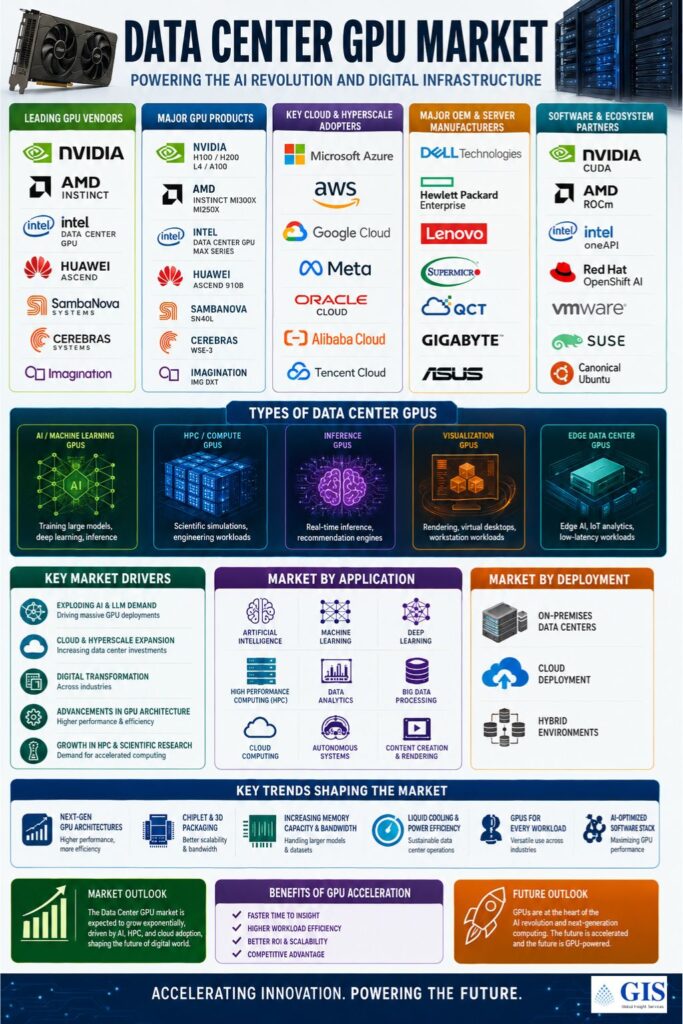
The infographic accompanying the report summarizes this shift well: NVIDIA dominates the conversation, but the market can no longer be understood as a simple race between card manufacturers. AMD, Intel, Huawei, Cerebras, SambaNova, and other players compete across different layers; hyperscalers purchase capacity en masse; OEMs such as Dell, HPE, Lenovo, Supermicro, QCT, Gigabyte, or ASUS package these accelerators into servers; and the software—from CUDA to ROCm, oneAPI, OpenShift AI, SUSE, or Ubuntu—decides much of the actual customer experience.
Market forecasts vary widely depending on the consulting firm, which is logical in a sector growing faster than many statistical models can capture. Market.us estimates that the global GPU market for data centers could grow from around $18 billion in 2024 to $183 billion in 2034. Precedence Research places it at $21.77 billion in 2025 and projects $226.87 billion by 2035. Future Market Insights predicts $21.6 billion in 2025 and $265.5 billion in 2035, while SNS Insider raises their forecast to $284.8 billion by 2035. The figures don’t match precisely, but the trend is clear: from 2025 to 2035, this will be a decade of intense growth for accelerated computing.
NVIDIA leads, but competition is moving through layers
NVIDIA remains the central player. Its financial results show how deeply AI has transformed its business: in the first quarter of its fiscal year 2027, the company reported record revenues of $81.6 billion, with $75.2 billion coming from the data center segment—up 92% year-over-year. This figure explains why talking about data center GPUs also means discussing market power, chip availability, bottlenecks, and supplier concentration.
But the market isn’t limited to NVIDIA. AMD is strengthening its Instinct lineup with accelerators like the MI350 series, aimed at generative AI, HPC, training, inference, and scientific workloads. Intel maintains its focus on accelerators and the oneAPI ecosystem, though with a more complex position. Huawei is pushing Ascend within the Chinese market and in scenarios where U.S. restrictions have accelerated the search for local alternatives. Cerebras and SambaNova operate with more specialized architectures, designed for AI workloads that can benefit from approaches other than traditional GPUs.
| Market Layer | Key Players | Why It Matters |
|---|---|---|
| GPUs and Accelerators | NVIDIA, AMD, Intel, Huawei, Cerebras, SambaNova | Define performance, availability, cost, and efficiency |
| Cloud & Hyperscalers | Microsoft Azure, AWS, Google Cloud, Meta, Oracle, Alibaba, Tencent | Purchase massive capacity and set global demand |
| Servers & Integration | Dell, HPE, Lenovo, Supermicro, QCT, Gigabyte, ASUS | Turn chips into deployable data center systems |
| Software & Platforms | CUDA, ROCm, oneAPI, OpenShift AI, VMware, SUSE, Ubuntu | Determine ease of use, portability, and adoption |
| Physical Infrastructure | Networks, power, cooling, racks, storage | Decide whether the cluster can operate at scale |
The key point is that a GPU alone isn’t enough. An AI cluster requires HBM memory, high-speed interconnects, switches, fast storage, liquid or hybrid cooling, orchestration software, stable drivers, and capable operational teams. That’s why the market is becoming a full value chain—not just a simple purchase of cards.
Demand driven by training, inference, and edge computing
The first wave of demand came from training large models. Training a foundational model requires thousands or tens of thousands of accelerators working in coordination, with huge bandwidth, memory, and stability needs. That phase remains critical, but the next major push is in inference.
When models go into production, every query, agent, recommendation, generative search, and enterprise assistant consumes compute power. Inference may be less glamorous than training, but it can become a continuous and massive load. If millions of users and companies integrate AI into daily workflows, GPU demand won’t be occasional—it will be ongoing.
Edge computing is also growing. Not all data can travel to distant cloud regions. Industries like manufacturing, healthcare, retail, telecommunications, smart cities, automotive, and infrastructure security require increasing amounts of processing near the data source. GPU and accelerator solutions for edge data centers—smaller than training clusters but designed for low latency, energy efficiency, and distributed operation—are emerging.
| Types of Data Center GPUs | Main Use | Workload Examples |
|---|---|---|
| AI & Machine Learning | Training & inference | Language models, computer vision, recommenders |
| HPC & Scientific Computing | Simulation & intensive computing | Climate, physics, engineering, bioinformatics |
| Inference | Real-time responses | Chatbots, agents, search, personalization |
| Virtualization | Virtual workstations & rendering | VDI, CAD, design, remote workstations |
| Edge Data Centers | Local processing | IOT, industrial analytics, low latency |
The bottleneck is no longer just the chip
Market growth also presents challenges. The first is cost. A high-density AI rack demands significant investment in servers, accelerators, networks, storage, power, cooling, and maintenance. For many companies, the natural choice will be to consume GPUs via cloud or specialized providers. Others will opt for deploying on-premises or hybrid infrastructure, driven by data, latency, security, or long-term cost considerations.
The second challenge is energy. The International Energy Agency projects that global data center electricity consumption will rise from 485 TWh in 2025 to about 950 TWh in 2030, with AI-focused centers growing even faster within that total. This places power availability, grid connectivity, and cooling at the core of any GPU data center strategy.
The third is thermal management. New generations of GPUs and accelerators increase per-rack density, pushing toward liquid cooling, more efficient designs, and careful data center planning. It’s no longer enough to just install servers in an existing room. AI clusters require rethinking power per rack, electrical distribution, redundancy, heat evacuation, and maintenance.
The fourth aspect is software. CUDA has given NVIDIA a huge advantage because it’s not just an API—it’s an ecosystem of libraries, frameworks, tools, documentation, and talent. AMD is working to strengthen ROCm, Intel pushes oneAPI, and enterprise environments need orchestration and compatibility layers. In the long run, software battles may be as critical as silicon battles.
North America dominates, Asia accelerates, and Europe seeks its place
North America continues to lead due to the concentration of hyperscalers, capital, talent, and AI projects. Microsoft, AWS, Google, Meta, and Oracle are building or leasing capacity at an unmatched pace. Asia-Pacific is rapidly growing with China, Japan, South Korea, India, and Southeast Asia, where data center construction and AI adoption are accelerating.
Europe faces a more challenging position. It has business demand, regulation, advanced industries, and ambitions for digital sovereignty, but suffers from greater energy restrictions, slower permitting, less availability of large local cloud regions, and significant dependence on external providers. At the same time, this pressure creates opportunities for private cloud, sovereign infrastructure, efficient data centers, and hybrid deployments tailored for regulated sectors.
The GPU data center market will not be uniform. Hyperscalers will continue to buy at scale for training and serving global models. Regulated companies will seek more controlled environments. Regional providers will attempt to offer GPU-as-a-Service, private cloud, or bare-metal acceleration. Server manufacturers will compete to package complete solutions that reduce deployment time.
The overarching message is clear: GPUs have become critical economic infrastructure. Just as x86 servers defined an era of cloud computing, accelerators will define the next stage of AI. The market will not be won solely by those with the most powerful chips but by those who can deliver balanced performance, energy efficiency, cooling, software, availability, and total cost of ownership.
The AI decade won’t be built solely on models. It will be built with racks, cables, memory, power, cooling, and platforms capable of transforming raw capacity into useful services. This is where the true size of the data center GPU market will be determined.
Frequently Asked Questions
What is a data center GPU?
An accelerator designed for intensive workloads such as AI, machine learning, HPC, inference, rendering, advanced analytics, or virtualization in servers and professional clusters.
Why is this market growing so rapidly?
Because of the expansion of generative AI, language models, inference in production, cloud, HPC, and the need to process large volumes of data more efficiently.
Does NVIDIA completely dominate the market?
NVIDIA clearly leads, especially due to its CUDA ecosystem and presence in hyperscalers, but AMD, Intel, Huawei, and others are trying to gain ground in specific segments.
What is the biggest challenge for deploying GPUs in data centers?
It’s not just about buying chips. Major challenges include energy, cooling, networking, supply, costs, software, operational talent, and maintaining stable clusters at scale.
via: LinkedIn
