
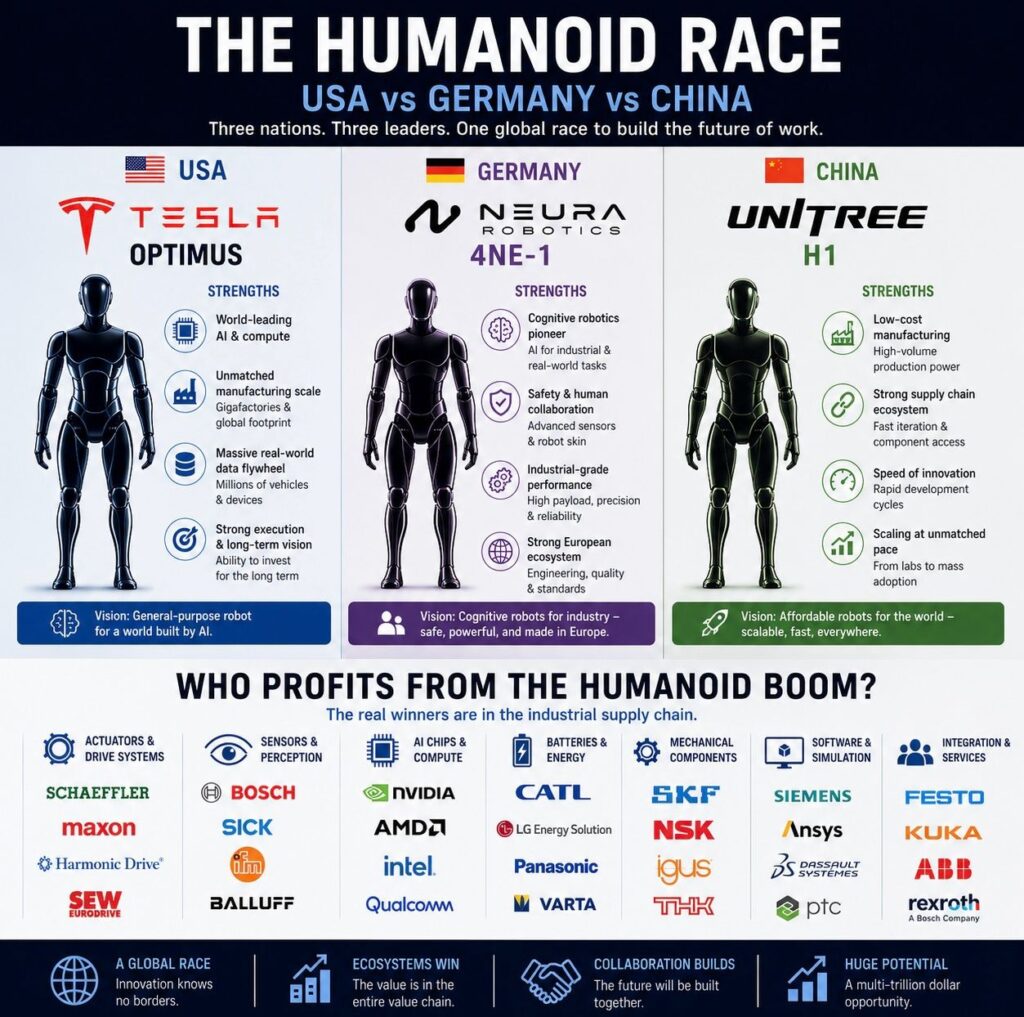
The race for humanoid robots is almost always led by three names: Tesla, NEURA Robotics, and Unitree. The United States, Germany, and China each represent different approaches to bringing Artificial Intelligence into the physical world. Tesla bets on Optimus as a general-purpose bipedal robot, leveraging its experience in AI, manufacturing, and real-world data from vehicles and factories. NEURA Robotics introduces 4NE1 as a European humanoid geared towards safe collaboration and industrial tasks. From China, Unitree pushes forward with H1, a full-sized humanoid robot exemplifying the rapid development speed and cost pressures of the Asian ecosystem.
But perhaps the most interesting question isn’t who will sell the most robots. The core question is who will capture more value once humanoids move from demonstrations to actual industrial production. History from other technological revolutions suggests that winners are not always the manufacturers of the final product. Often, it’s those supplying motors, sensors, chips, batteries, software, simulation, actuators, gearboxes, integration, and services.
This pattern could repeat in humanoid robotics. If these systems reach factories, warehouses, hospitals, retail, or logistics, the business won’t just be about selling a human-shaped shell. Instead, there will be a much deeper industrial supply chain: electronics, precision mechanics, perception systems, energy, cloud computing, edge computing, functional safety, data, maintenance, and automation. Some of the key beneficiaries may emerge here.
Three visions for the same race
Tesla, NEURA Robotics, and Unitree represent three very different approaches. Tesla has a clear advantage in applied AI, scaled manufacturing, and real-world data accumulation. It defines Optimus as an autonomous general-purpose humanoid, designed for unsafe, repetitive, or boring tasks. Its major bet is to transfer perception, planning, control, and industrial production capabilities into the robot.
NEURA Robotics takes another route. Its focus is on cognitive robotics, safe human collaboration, and integration in industrial environments. 4NE1 is pitched as a robot designed to move and work alongside people, with advanced perception and focus on real tasks—not just lab demos.
Meanwhile, Unitree reflects China’s strength in rapid iteration, cost competitiveness, and supply chain infrastructure. The H1-2 is officially listed as about 178 cm tall, weighing 70 kg, with 27 degrees of freedom, 3D LiDAR, and depth cameras. Their approach aligns with China’s proven pattern: move quickly, cut costs, and scale production.
| Country | Company | Robot | Main Focus |
|---|---|---|---|
| United States | Tesla | Optimus | AI, data, manufacturing, general-purpose robot |
| Germany | NEURA Robotics | 4NE1 | Cognitive robotics, safety, industrial collaboration |
| China | Unitree | H1 | Cost, development speed, supply chain |
These three approaches are not mutually exclusive. Humanoid robotics will require AI, manufacturing, safety, mechanics, sensors, energy management, and integration. No single company can handle it all on a global scale alone.
The business might lie in components
In robotics, the final product often captures most attention—it’s common to see robots walking, waving, lifting boxes, or appearing in spectacular videos. But the industrial value is distributed across many layers. A humanoid needs compact actuators, precision gearboxes, efficient motors, force sensors, cameras, LiDAR, IMUs, AI chips, batteries, control systems, simulation software, maintenance tools, and integration platforms.
Many industrial companies can benefit even if they don’t produce complete humanoids. Firms like Schaeffler, Bosch, Siemens, Festo, SKF, igus, NVIDIA, Qualcomm, AMD, Intel, CATL, LG Energy Solution, Panasonic, Ansys, Dassault Systèmes, PTC, KUKA, ABB, or Rexroth are categories of suppliers that could grow if the market takes off. The scale and advantage will vary, but the pattern is clear: physical robotics consumes a vast amount of industrial technology.
| Value Layer | What it provides | Companies to watch |
|---|---|---|
| Actuators & transmission | Movement, torque, precision, durability | Schaeffler, Maxon, Harmonic Drive, SEW-Eurodrive |
| Sensors & perception | Vision, proximity, force, safety | Bosch, SICK, ifm, Balluff |
| Chips & AI | Inference, control, perception, planning | NVIDIA, AMD, Intel, Qualcomm |
| Batteries & energy | Autonomy, charging, energy density | CATL, LG Energy Solution, Panasonic, Varta |
| Mechanical components | Bearings, guides, gearboxes, materials | SKF, NSK, igus, THK |
| Software & simulation | Design, digital twins, testing, control | Siemens, Ansys, Dassault Systèmes, PTC |
| Integration & automation | Industrial commissioning, services | Festo, KUKA, ABB, Rexroth |
Drawing a parallel with electric automotive industry helps clarify. Tesla, as the visible brand, benefited from a large supply chain including battery manufacturers, semiconductor suppliers, industrial software providers, charging networks, mining, power electronics, and automation. A similar dynamic could emerge with humanoids: while the final robot is the face visible to the public, the supply chain can capture a significant share of the margins.
China’s industrial edge is already evident
Industrial robotics data sheds light on China’s strong position. According to the International Federation of Robotics, 542,000 industrial robots were installed globally in 2024—more than double the number a decade earlier. Asia accounted for 74% of new installations, with China representing 54% of the world total. While these figures don’t specifically refer to humanoids, they demonstrate where the largest industrial automation base resides.
This industrial base matters. A country installing hundreds of thousands of industrial robots annually builds a network of suppliers, integrators, skilled labor, processes, manufacturing data, and deployment experience. China’s advantage isn’t just low-cost manufacturing; it’s having a huge domestic market to test, fail, fix, and scale quickly.
| Robotics market indicators 2024 | Data |
|---|---|
| Number of industrial robots installed worldwide | 542,000 |
| Asia’s share of new installations | 74% |
| Europe’s share | 16% |
| Americas’ share | 9% |
| China’s share of global installations | 54% |
| Main markets | China, Japan, U.S., South Korea, Germany |
For Unitree and other Chinese manufacturers, this national infrastructure serves as leverage. Access to components, rapid suppliers, controlled costs, and an acceleration-oriented culture of iteration can be decisive when moving from prototypes to mass production.
Europe has less scale but more precision engineering
Europe lacks China’s huge production scale and the concentrated tech capital of the US. However, it retains strengths aligned with advanced robotics: industrial engineering, automation, precision components, safety standards, manufacturing software, and experience with complex machinery.
Germany exemplifies this. NEURA Robotics aims to position itself as a European option for cognitive humanoids, but Europe’s true asset may lie in its network of suppliers. Companies like Siemens, Bosch, Festo, Schaeffler, igus, KUKA, and ABB are part of a well-established industrial fabric accustomed to delivering critical technology worldwide.
Humanoid robotics will require safety standards, certifications, human-robot collaboration, and reliability in real-world environments. In this regard, Europe can be more competitive than in low-cost mass manufacturing.
| European strengths | Relevance for humanoids |
|---|---|
| Industrial engineering | Reliable, production-oriented design |
| Automation | Integration into existing factories |
| Functional safety | Working close to humans |
| Precision components | Stable, durable movement |
| Manufacturing software | Simulation, digital twins, control |
| Standards & quality | Deployments in demanding sectors |
The challenge will be translating this technical strength into products and platforms with sufficient speed. Europe has excellent suppliers, but tends to move slower than the US and China when markets enter rapid growth phases.
The US leads in AI and computing
The United States starts with other advantages: chips, AI models, cloud infrastructure, software, and capital. Tesla is the most visible name in humanoids, but US’s role extends well beyond Optimus. NVIDIA, AMD, Intel, Qualcomm, Google, Microsoft, Amazon, OpenAI, and others form an infrastructure capable of making physical robotics feasible with increasingly capable models.
A humanoid is not just about mechanics. It needs perception, planning, reasoning, object manipulation, navigation, understanding instructions, learning from demonstrations, and working safely in changing environments. That AI and computing layer can be as valuable as the hardware itself.
| American layer | Role in humanoids |
|---|---|
| AI chips | Local inference and training |
| Cloud & data | Training, simulation, continuous improvement |
| Foundational models | Language understanding, vision, planning |
| Venture capital | Funding robotics startups |
| Software tools | Development, simulation, control |
| Advanced manufacturing | Scaling industrially in specific companies |
The issue is that AI alone doesn’t assemble a part, swap a battery, or withstand a fall. Robotics demands software coupled with physical hardware. That union is more complex than training a chatbot or deploying an app.
A promising yet still uncertain market
Goldman Sachs Research projects the global humanoid robot market could reach $38 billion by 2035, up from an earlier estimate of $6 billion. They also increased their shipment forecast to 1.4 million units over the same horizon. These figures are significant but should be viewed as forecasts, not guaranteed destinies.
Humanoids still face tough challenges: autonomy, cost, dexterous hands, energy consumption, safety, maintenance, robustness, legal liability, ROI, and social acceptance. In factories and warehouses, they compete with non-humanoid solutions that may be cheaper and more efficient for specific tasks.
| Challenges | Why they matter |
|---|---|
| Robot cost | Determines if ROI makes sense |
| Energy autonomy | Limits shifts and long tasks |
| Fine manipulation | Many tasks require precise hands |
| Safety | Must work near people |
| Robustness | Real world is harsher than demos |
| Maintenance | Impacts total cost of ownership |
| Software | Coordinates perception, decision, movement |
| Integration | Must fit into existing processes |
Hence, it’s wise to separate two debates. One concerns whether humanoids will become a major category. The other involves when, where, and with what profitability. A large market is possible, yet many robot manufacturers might drop out along the way.
Suppliers can profit even if the leader changes
Focusing on the supply chain reduces dependency on predicting which manufacturer will succeed. If Tesla delays Optimus, if NEURA takes longer to scale, or if Unitree dominates certain markets, humanoids will still need motors, sensors, chips, batteries, and software. The ultimate winner can shift; component needs remain.
That’s not to say all suppliers benefit equally. Some will be directly exposed. Others will sell generic components with thinner margins. Price pressures, Chinese competition, and investment cycles will be factors. But in physical technology, the industrial supply chain tends to be broader and more resilient than the narrative around just the final product.
| Questions to evaluate suppliers | Why it matters |
|---|---|
| Is the component critical or commoditized? | Affects margins and bargaining power |
| Can it scale manufacturing? | Robotics demand volume and quality |
| Does it have defensible IP? | Protects against low-cost competitors |
| Serves multiple manufacturers? | Reduces dependency on one leader |
| Has industrial experience? | Facilitates certification and deployment |
| Supports global maintenance? | Important for enterprise clients |
The real business opportunity might be with suppliers that possess hard-to-replace technology, global presence, and capacity to sell to multiple humanoid manufacturers simultaneously.
The race won’t be just among countries
The headline “U.S. vs. Germany vs. China” works well to explain the competition. But reality will be more intertwined. A Chinese robot might integrate US chips, European sensors, and French or German simulation software. An American robot could depend on Asian batteries and Japanese gearboxes. European suppliers might serve manufacturers worldwide.
Humanoid robotics will be a global enterprise, despite government efforts to nationalize the narrative. Physical production relies on international supply chains, and innovation doesn’t respect borders as cleanly as political maps suggest.
This creates tensions: export controls, data security concerns, component dependency, industrial safety, and competition for talent. Still, collaboration among suppliers, integrators, and manufacturers will be inevitable.
Look beyond the robot: focus on the ecosystem
The race for humanoids is entering a phase where viral videos aren’t enough. The question won’t only be if a robot can walk, dance, or lift a box during a demo. It will be whether it can operate for thousands of hours, integrate into real processes, justify its cost, be easily maintained, and improve through data without compromising safety.
In this landscape, value is shared. Tesla can capture a lot if it scales Optimus. NEURA might establish a strong position in European industry and safe collaboration. Unitree can push the market with low costs and speed. Yet, component, sensor, chip, battery, software, and integration suppliers might become more discreet, sustainable winners.
Humanoid robotics won’t be a race solely for a single company. It will be driven by entire supply chains. Those who want to understand the market should look not only at the robot on stage but also at everything that makes it move, see, think, decide, and work.
The key question isn’t just which humanoid will dominate. It’s which companies will be indispensable even if another wins.
Frequently Asked Questions
Who are leading the humanoid robot race?
Tesla with Optimus, NEURA Robotics with 4NE1, and Unitree with H1 are some of the most visible names. Others include Figure AI, Agility Robotics, Boston Dynamics, and Apptronik.
Why might the supply chain benefit more than the final manufacturers?
Because all humanoids need actuators, sensors, chips, batteries, software, simulation, maintenance, and integration. These layers can sell to multiple manufacturers simultaneously.
What advantage does Tesla have in humanoids?
Tesla’s experience in AI, large-scale manufacturing, real-world data, and investment capacity. Its challenge is turning Optimus into a useful, safe, and profitable product.
What does NEURA Robotics contribute from Europe?
NEURA focuses on cognitive robotics, safe human collaboration, and industrial applications. Its approach aligns with Europe’s engineering, automation, and safety traditions.
Why is China so strong in robotics?
Because it hosts a significant portion of global industrial robot installations, has an extensive supply chain, and can iterate quickly at competitive costs.
Which sectors might benefit from the humanoid boom?
Actuators, sensors, AI chips, batteries, mechanical components, simulation software, industrial integration, maintenance, safety, and automation services.
Infographic source: LinkedIn
