
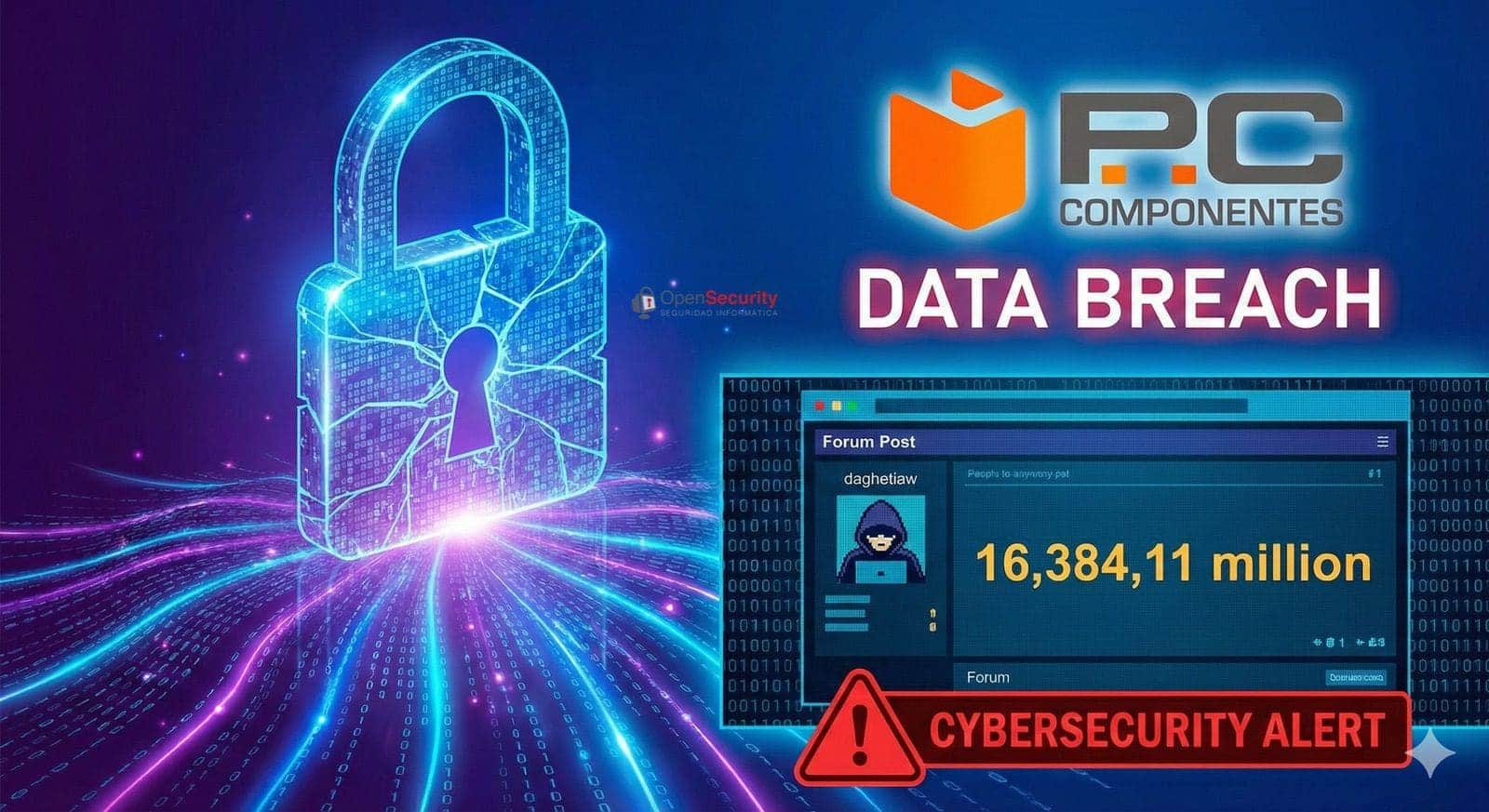
PcComponentes, one of the major references in technological e-commerce in Spain, faces a piece of news no security manager wants to be associated with: the alleged exposure of data linked to 16,384,110 accounts. The information has started circulating in common environments for buying and selling stolen databases, accompanied by a sample, and with an alias identified as the author of the publication. Pending public confirmation from the company, the case remains under verification, but the volume and type of data described elevate this event to a category of reputational and operational crisis.
The figure is impressive, yes. However, what defines the impact is not the number itself but which data might be involved and how they could be used. In ecommerce incidents, the threat rarely limits itself to account access. The actual damage often unfolds afterward: impersonations, document fraud, highly personalized phishing, and extortion.
The “toxic data” of digital retail: when the DNI enters the equation
According to the information released, the set would include data such as name and surname, NIF/DNI/NIE, phone number, email, full address, as well as order history and invoices, and even references to Zendesk tickets (support conversations). Payment information “allegedly” in the form of metadata is also mentioned (card type, expiration, and “other details”), along with IP addresses and internal elements like wish lists.
The critical point is the ID document. In Spain, the DNI greatly amplifies fraud because it acts as a pivot for higher-friction attacks: service enrollments, financing attempts, document duplicates, or impersonations that cannot be resolved simply by “changing the password”.
Adding to this is another underestimated factor: support tickets. An attacker who knows the incident history — or can cite a ticket number, product, and reason for contact — has material to craft almost perfect deception campaigns. The classic message “Your shipment is being held” or “A refund is pending” becomes much more credible when it includes real data.
Why the danger is not “someone buying you a RAM”: it’s fraud based on context
Practically speaking, the described case would enable three especially harmful categories of attacks:
- Contextual phishing with a high success rate
The attacker does not shoot blindly: they personalize with product, date, address, and even previous support conversation. The user lowers their guard because it “matches”. - Identity theft and document fraud
The combination of DNI + name + address is fuel for attempts at contracting services, porting, duplicates, and other abuses that can take weeks to detect. - Chain attacks through credential reuse
If the password (or hashes) are circulated, the next step is to try that same combination on other services. Even without a password, clean email and phone facilitate campaigns like SIM swapping and account access via recovery processes.
In mass incidents, a pattern repeats: after the initial media wave, a quieter second wave ensues, where criminals exploit the informational noise. That is, emails appear imitating “official notices” and link to fake “password reset” pages. The breach thus becomes the bait.
The 72-hour rule and the pressure of “initial communication”
In Spain, when an organization becomes aware of a security breach affecting personal data, a deadline known in the sector comes into play: 72 hours to notify the competent authority (AEPD), with a phased communication if all details are not yet available. And if the breach entails high risk for those affected, it must be clearly communicated to users, avoiding technical jargon and offering actionable recommendations.
In practice, this requires managing two parallel efforts:
- Technical response: containment, forensic analysis, evidence preservation, credential rotation, access audits, and review of third-party integrations (support, logistics, marketing, analytics).
- Trust-building communication: an early message that does not minimize the risk, avoids speculation, and provides concrete measures. Lack of communication fuels the environment for fraud.
“Pending verification”, but the preventive damage already exists
Even when an incident has not yet been officially validated, the user faces an uncomfortable reality: uncertainty already becomes a vector for attack. Cybercriminals exploit this by sending messages such as: “We confirm your data has been leaked, verify here.” The basic recommendation is simple: do not click on links in emails or SMS related to the breach; instead, enter manually on the official website, change your password, and review activity through official channels.
If the leak is confirmed as described, the first “hygiene point” for the consumer would be:
- Change passwords on PcComponentes and any other service where they are reused.
- Enable 2FA where possible (especially for associated email).
- Monitor for fraudulent attempts: fake refunds, “support” calls, “pending delivery” SMS.
- Review bank alerts and transactions (small verification charges are common).
- Be extra cautious with requests for DNI or selfies “to validate identity” received through unofficial channels.
The sector’s takeaway: ecommerce no longer only competes on price, but also on security
There is a fundamental lesson that extends beyond a specific company: today’s ecommerce is a network of integrations. Customer data traverses CRM, support, logistics, payment gateways, anti-fraud systems, analytics, and marketing automation. The more layers involved, the higher the number of failure points, operational credentials, and attack surface.
That’s why mass incidents tend to reveal more structural issues than a “point failure”:
- Excess data retention (keeping more than necessary, for too long).
- Insufficient segmentation (databases and backups accessible from too many environments).
- Improved privilege management (internal accounts with broad permissions and limited auditing).
- Dependence on third parties without robust traceability (support, ticketing, integrators).
For Spanish digital retail, the reputational impact is not only measured in immediate sales loss but also in a slower process: erosion of trust. In a market already saturated with scams, a breach involving DNI and support tickets shifts the bar of expectations.
Frequently Asked Questions
What is the risk if support tickets are leaked along with my personal data?
The risk increases significantly because it enables highly personalized phishing: messages citing real products, incidents, or conversations. It is one of the most effective vectors to deceive even cautious users.
What should I do if I suspect my DNI is included in the leaked database?
Besides changing passwords, it is wise to be extra cautious with requests for document verification, review attempts to create accounts on services, and save evidence of suspicious messages. The DNI combined with the address facilitates impersonations.
Is changing only my PcComponentes password enough?
It’s necessary but not sufficient. You should also change it on any other services where it’s reused and be alert for emails and SMS pretending to be official communications about “security”, “refunds”, or “deliveries”.
How can I detect a scam attempt related to an ecommerce breach?
They often use urgency (expires today), authority (support, bank), and verification links. A key sign: if they ask for sensitive data or request you to download files, or if the link doesn’t match the official domain written manually.
Source: Cybersecurity News