
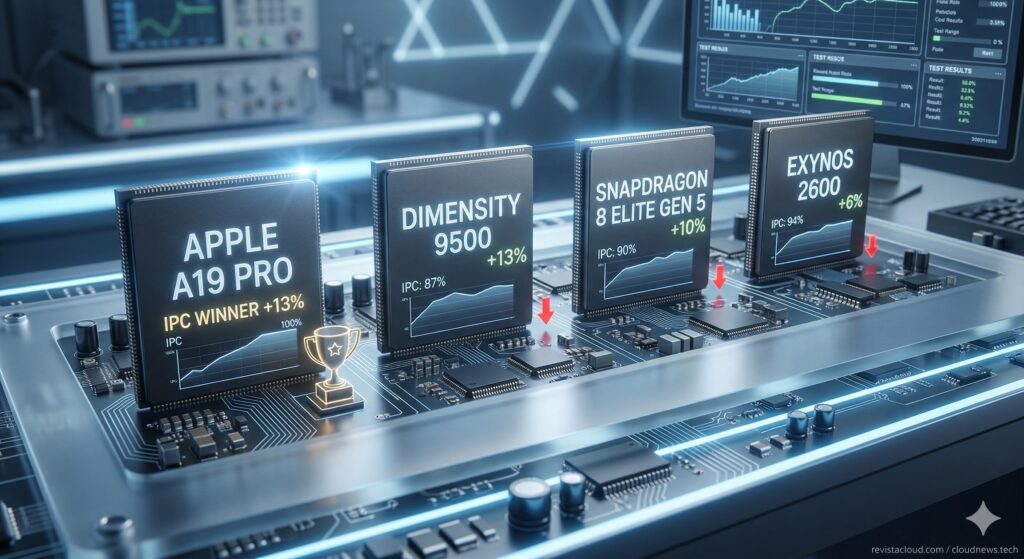
Apple flexes its muscles once again in one of the most significant areas when analyzing the efficiency of a mobile CPU: the IPC, or instructions per cycle. A recent calculation based on the best single-core scores from Geekbench 6 and the maximum clock speed of each chip places the A19 Pro ahead of its three main new-generation Android rivals: the MediaTek Dimensity 9500, the Qualcomm Snapdragon 8 Elite Gen 5, and the Samsung Exynos 2600. According to this estimate, Apple’s SoC would achieve 0.89 instructions per cycle, compared to 0.79 for the Dimensity 9500, 0.80 for the Snapdragon 8 Elite Gen 5, and 0.84 for the Exynos 2600. This translates to an approximate advantage of 13% over MediaTek, 10% over Qualcomm, and 6% over Samsung.
The data aligns with Apple’s official statements, which when introducing the iPhone 17 Pro and iPhone 17 Pro Max, described the A19 Pro as its “most powerful and efficient” chip for iPhone to date. In the same presentation, the company claimed that its 6-core CPU is “the fastest CPU on any smartphone,” adding that the chip delivers up to a 40% sustained performance increase over the previous generation when paired with the new vapor chamber cooling system in the iPhone 17 Pro models.
However, it’s important to put this headline into context. Apple does not officially publish an IPC figure for the A19 Pro or its competitors. The comparison circulating these days isn’t from an official spec sheet but is a third-party estimate based on single-core benchmark results and the maximum speed of the main core. While this makes it a useful reference for discussing architecture and efficiency, it is not an absolute or definitive measure of real-world performance across all scenarios.
What does it really mean that the A19 Pro wins in IPC?
IPC is a particularly valuable metric because it tries to measure how much work a processor can do per clock cycle. When a chip achieves higher IPC, it needs less frequency to perform at the same level as another, or it can deliver more performance at the same frequency. In short, it indicates the architecture quality and how effectively each clock tick is utilized. That’s why Apple has emphasized this aspect for years: it doesn’t always need to run at the highest frequencies on the market to remain top in single-core performance.
This generation’s comparison is especially interesting because all three Android competitors are making strong claims. Qualcomm introduced the Snapdragon 8 Elite Gen 5 as “the world’s fastest mobile SoC,” asserting that its third-generation Oryon CPU is the quickest in its class, with a 20% boost in performance over the previous generation. MediaTek launched the Dimensity 9500 as its most advanced platform so far, with a third-generation all-big-core design and up to a 32% increase in single-core performance compared to the previous model. Meanwhile, Samsung focused on the Exynos 2600’s faster responsiveness thanks to an Arm C1-Ultra core with explicit IPC improvements and a 10-core architecture designed to distribute workloads more efficiently.
This explains why the A19 Pro’s victory in IPC doesn’t automatically mean it will dominate all benchmarks or phone models. Recent comparisons of high-end Android chips show the Snapdragon 8 Elite Gen 5 leading in Geekbench CPU scores within the Android ecosystem, with 3,725 points in single-core versus 3,452 for the Dimensity 9500 and 3,040 for the Exynos 2600. In other words, factors like clock speed, cooling solutions, thermal management, and overall system design still significantly influence real-world performance.
Efficiency is the real key, not just raw figures
This is where Apple maintains one of its greatest competitive edges. If the A19 Pro truly advances in instructions per cycle, it indicates that the company continues refining a formula that combines high single-core performance with very controlled power consumption — especially valuable in premium smartphones where thermal margins are limited. Apple further underscores this approach with the inclusion of a vapor chamber in the iPhone 17 Pro, a rare feature in iPhones that highlights how sustained performance is becoming equally important as peak speed.
An interesting note in the comparison is that the Exynos 2600 performed better than many anticipated. Its IPC calculations place it closer to the A19 Pro than to the Dimensity 9500, and just slightly behind Apple’s chip despite working at a lower maximum clock frequency than MediaTek’s. This suggests Samsung has significantly improved its efficiency per cycle and that its CPU architecture might have seen a real leap this year, though real-world performance outside the lab and under prolonged loads remains to be seen.
What this comparison tells us
The most reasonable conclusion isn’t that the A19 Pro “dominates” all rivals, but rather that Apple continues to set the pace in architectural efficiency per core, even in a generation where Qualcomm, MediaTek, and Samsung have made notable strides. Strictly speaking of IPC, the A19 Pro is ahead. But when considering overall performance, the picture becomes more complex and depends heavily on the device, clock speeds, thermal dissipation, and workload types.
Ultimately, this summarizes the current state of the premium mobile market quite well. Android no longer lags far behind Apple in high-end CPUs, but Apple still holds a notable advantage when microarchitecture details are analyzed. As long as this continues, the A-series will remain the benchmark in the area that most challenges its rivals: doing more with fewer cycles.
Frequently Asked Questions
Has Apple officially published the IPC of the A19 Pro?
No. Apple announced the A19 Pro and claims its CPU is the fastest on any smartphone, but the 0.89 IPC figure is based on third-party estimates from Geekbench 6 results and clock speeds, not an official Apple specification.
Which rivals are being compared to the A19 Pro?
The most cited comparison pits the A19 Pro against the MediaTek Dimensity 9500, the Qualcomm Snapdragon 8 Elite Gen 5, and the Samsung Exynos 2600, all of which are officially announced high-end SoCs from their respective manufacturers.
Does winning in IPC always translate to winning benchmarks?
Not necessarily. IPC measures efficiency per cycle, but final performance also depends on factors such as clock speed, cooling solutions, device design, and workload duration. Therefore, a chip with lower IPC might still perform better in certain scenarios if it compensates with higher frequencies or better thermal management.
Which Android SoC performs best in this generation?
In raw performance among the latest Android chips, the Snapdragon 8 Elite Gen 5 appears very strong in recent benchmarks. However, considering the circulating IPC estimates, the Exynos 2600 surprises by appearing closer to the A19 Pro than the Dimensity 9500 or even the Snapdragon.