
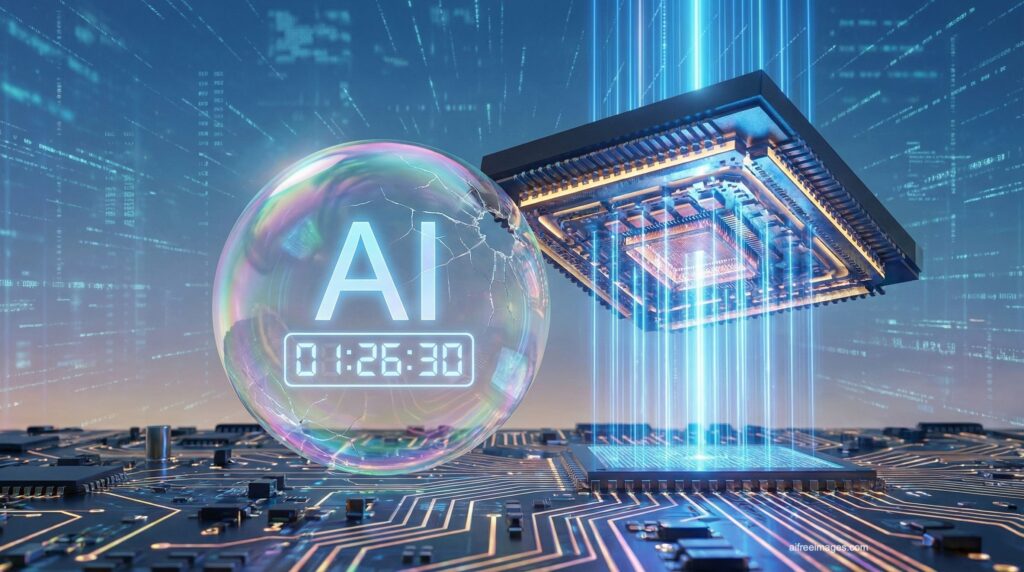
A strange feeling has taken hold in Silicon Valley: everything is better than ever… and, at the same time, everything could blow up before the major players finish assembling their pieces. Recent statements from Pat Gelsinger, the former CEO of Intel, and the analysis published by Xataka about OpenAI’s roadmap paint the same picture: we are in the middle of an AI bubble, and the real issue isn’t whether there’s a bubble, but how long it will last to see some survive when it bursts.
Gelsinger: Quantum computing could “burst” the party in two years
In an interview with Financial Times, Pat Gelsinger shared two ideas that have spread rapidly through the industry:
- Quantum computing could progress much faster than publicly assumed.
- This progress could burst the AI bubble in just a couple of years.
This assertion sharply contrasts with the more cautious discourse of other sector leaders. Jensen Huang, CEO of NVIDIA, speaks of roughly twenty years before quantum computing becomes widespread. Gelsinger, on the other hand, suggests that key milestones could be reached in a much shorter timeframe, enough to challenge the current model based on large-scale GPU and TPU deployments.
If this scenario comes true, the market fueling massive investments in data centers, general-purpose chips, and giant generative AI models could be forced to reconfigure suddenly, with many companies caught halfway through infrastructure projects that take years to recoup.
“Sam Altman is using Microsoft the same way Microsoft used IBM”
Gelsinger’s other remark targets the relationship between OpenAI and Microsoft. The ex-Intel CEO compares Sam Altman’s move to Bill Gates’ historic play against IBM: control the “intellect,” the software, and the value layer, while another provides the platform and distribution.
In this view:
- OpenAI would be the equivalent of Microsoft in the 80s: owner of critical intellectual property (models, products, brand).
- Microsoft would be the “new IBM”: providing cloud services, computing infrastructure, and financial muscle.
The scale now is enormous: we’re talking about tens or hundreds of billions of dollars invested in chips, data centers, and energy, with systemic impacts across the tech chain—from manufacturers like NVIDIA, AMD, and Intel to major cloud providers.
The implicit question: if AI faces a sudden slowdown, who is left holding the bill for infrastructure, and who is resilient enough to survive?
OpenAI: a race against the clock to stop depending on others
Xataka’s analysis of Sam Altman’s internal memo adds context to these concerns. The OpenAI CEO, according to the document, acknowledges that Google is catching up technologically with Gemini 3 in key areas like code generation and automated web design.
But the core problem isn’t just losing the technical lead temporarily; it’s even more fundamental: extreme reliance on third parties.
- OpenAI depends on Microsoft Azure (and now also on agreements with Oracle and other partners) for its data centers.
- It relies on NVIDIA and other manufacturers to secure GPUs in a strained market.
- It depends on external investors to fund a bold bet that involves burning around tens of billions of dollars in R&D and infrastructure over a few years.
The long-term plan is to build its own infrastructure: proprietary chips, data centers, and economies of scale. Only then can it compete on costs with giants like Google, which already has its TPUs and generates billions in revenue annually from established businesses like search and YouTube.
The timing paradox: either you reach the other side of the bridge, or you fall
Xataka’s metaphor is clear: building a bridge. It doesn’t matter how much money is invested if you only go halfway across.
- If AI investment slows down in 2026 or 2027, OpenAI risks being stuck mid-bridge: with plenty of infrastructure in place, but lacking the self-sufficiency needed to compete on costs.
- If the bubble holds until 2029 or beyond, the company could complete that bridge: develop its own chips, deploy large-scale data centers, and significantly lower the marginal cost per query.
In other words: OpenAI isn’t just competing to improve its models; it’s also racing against the AI bubble’s timeline.
Without a “tech moat”: cost as the only refuge
Another key point from the analysis is the lack of a real technological “moat.” In generative AI:
- Every time a lab releases an improvement, others reproduce it within months.
- Leading models today are quickly matched or surpassed after a few iterations by competitors.
This means that sustainable advantage isn’t so much about ideas but about infrastructure:
- Whoever controls chips and data centers controls the cost per token.
- Whoever offers similar quality at a much lower price dominates the medium-term market.
For Google, with a highly profitable core business, it’s easier to sustain aggressive investments through multiple cycles. OpenAI, however, is playing its future on the transition from being a “costly client” of third parties to becoming a “owner of its own value chain.”
What if the bubble bursts early?
The combined vision of Gelsinger and OpenAI’s situation analysis leaves several uncertainties:
- If quantum computing accelerates abruptly, as Gelsinger suggests, it could challenge the current computing model even before many projects fully amortize.
- If AI investment slows due to market saturation, regulation, or unclear returns, some well-funded players (Google, Microsoft, perhaps Amazon) might endure… but others could be left stranded.
Ironically, OpenAI seems caught in a constant tension: inflating the bubble—demonstrating rapid growth—while fearing it might burst too soon, before securing infrastructure independence.
A decisive decade for computing… and the money that fuels it
Gelsinger concludes by talking about a “trinity” of computing: classical, quantum, and artificial intelligence, each playing a role in human well-being. Beyond this almost philosophical view, there’s a concrete message: the rules of the game could change faster than the industry admits publicly.
Meanwhile, OpenAI, Google, Microsoft, NVIDIA, and others continue racing over a still-unfinished landscape. If Gelsinger’s timelines are correct, in a few years we’ll know whether the AI bubble served to build a lasting new layer of infrastructure… or if it was just a costly hollow bridge.
References: FT.com, elchapuzasinformatico, and xataka