
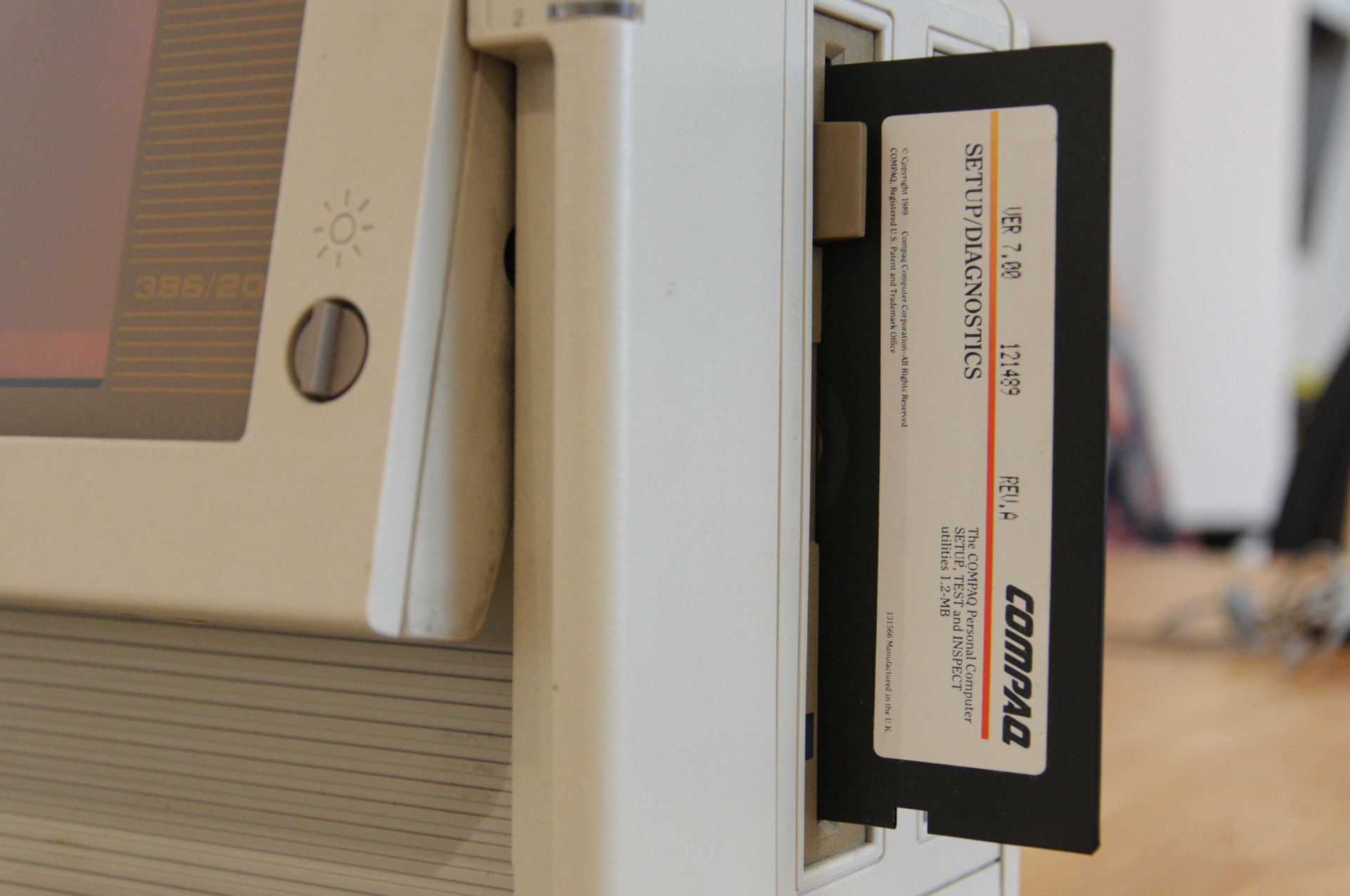
At a time when computers filled entire rooms and software was distributed via punch cards or magnetic tapes, IBM introduced a technology that would transform computing for over three decades. The 8-inch floppy disk, launched in 1971, was not created for users to store documents, but to solve a much more basic problem: quickly and reliably updating the microcode of IBM System/370 mainframes. Unintentionally, that flexible disk became the precursor to modern portable storage and the starting point of an evolution that would lead to USB drives, SSDs, and cloud storage.
The key points of the 8-inch floppy in 20 seconds
- IBM developed the first 8-inch floppy disk in 1971 under the leadership of Alan Shugart.
- Its initial purpose was to distribute microcode for the IBM System/370, not for exchanging files between users.
- The first version stored about 80 KB and was read-only.
- The format evolved into rewritable versions and gave rise to 5¼-inch and 3½-inch floppy disks.
- More than fifty years later, its legacy remains alive in the universal icon for Save.
When discussing digital storage history, the 3½-inch floppy disk, popularized in the 1980s and 1990s, is often remembered. However, the real revolution began a decade earlier, when IBM decided to abandon punch cards and tapes to create a more practical medium.
A firmware problem changed the entire industry
The creation of the floppy disk wasn’t driven by user demand but by IBM’s internal needs.
The company was preparing to launch the IBM System/370 family, introduced in 1970, whose systems required regular microcode loading and updating. Until then, this task was performed with impractical and hard-to-manage media.
The team led by Alan Shugart developed a solution based on a flexible magnetic disk protected by a sleeve. The result was the IBM 23FD, a unit capable of reading an 8-inch (20.32 centimeters) support with around 80 KB of capacity.
It may seem insignificant today, but at the time, it represented a huge improvement in speed, transportability, and ease of use.
From firmware to software distribution
Although the initial goal was to distribute microcode, the industry quickly realized that this medium had much more potential.
Manufacturers began to use it to distribute operating systems, applications, and development tools.
For the first time, it became possible to carry complete programs on a relatively small, reusable support that was much easier to handle than magnetic tapes.
This marked the beginning of a new era.
Software no longer depended solely on the hardware where it was run and started to be sold as an independent product.
It was one of the first steps toward today’s software industry.
Alan Shugart and the birth of a new generation
The story of the floppy disk didn’t end within IBM.
A few years later, Alan Shugart left the company and founded Shugart Associates, which developed the 5¼-inch format, better suited for early personal computers.
That size became the standard in computing throughout much of the 1970s and early 1980s.
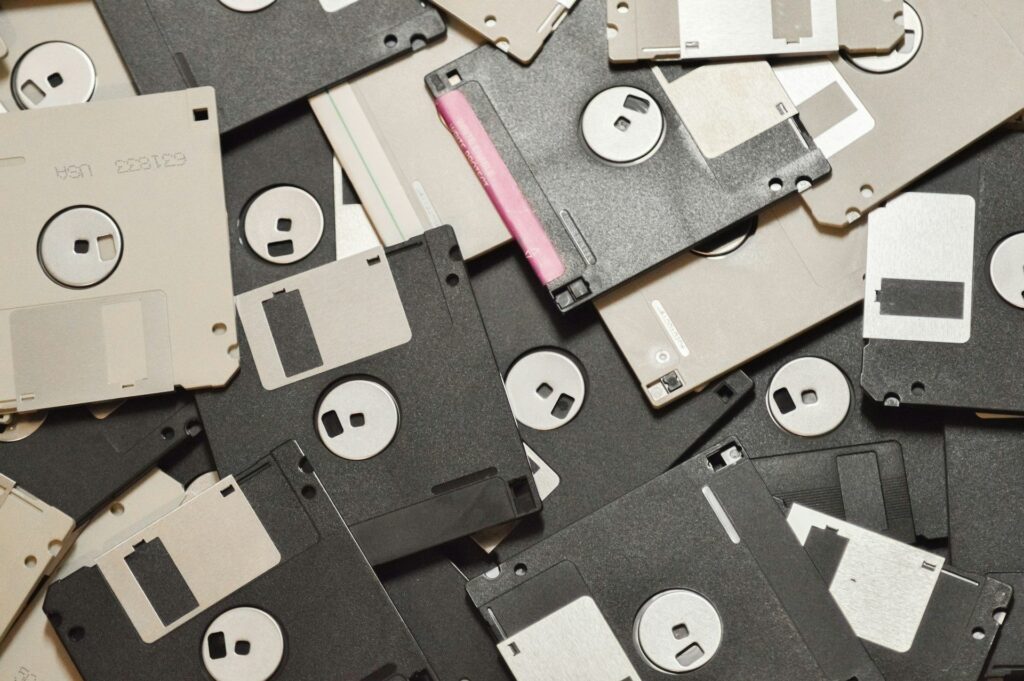
Later, the 3½-inch format emerged, initially developed by Sony and widely adopted by Apple, IBM, and Microsoft.
The rest is history.
The evolution of storage in just five decades
The trajectory of portable storage perfectly reflects how quickly computing has evolved.
| Year | Technology | Approximate Capacity |
|---|---|---|
| 1971 | 8″ Floppy Disk | 80 KB |
| 1976 | 5¼-inch Floppy Disk | 110-360 KB |
| 1982 | 3½-inch Floppy Disk | 720 KB |
| 1987 | 3½-inch HD Floppy Disk | 1.44 MB |
| Late 1990s | CD-ROM | 700 MB |
| 2000s | USB Flash Drive | Multiple GB |
| Present | NVMe SSD | Multiple TB |
The jump has not only been in capacity.
Speed has also improved significantly.
While the first floppy disk took several seconds to access a few kilobytes, a modern PCIe Gen5 SSD can transfer over 14 GB per second.
From storing data to moving artificial intelligence
Interestingly, many current challenges resemble those IBM faced over half a century ago.
In 1971, the problem was how to efficiently distribute firmware.
Today, the challenge is moving AI models that can occupy hundreds of gigabytes or even several terabytes.
Physical supports have mostly disappeared, but the goal remains the same: bringing large volumes of information closer to where they will be executed.
The difference now is that this transport is carried out through high-speed networks, distributed storage, and specialized data centers.
The icon that survived hardware
There’s a detail that shows how much the floppy disk has left its mark.
Millions of people use the Save button daily in applications like Microsoft Office, Photoshop, AutoCAD, or Visual Studio Code.
That symbol represents a 3½-inch floppy disk.
Many users born in the last decade probably never used one physically, but they still recognize its meaning instantly.
Few discontinued technologies can claim to have maintained their presence in interfaces for over thirty years after ceasing production.
Much more than a storage medium
The importance of the 8-inch floppy disk isn’t in its 80 KB capacity.
Its true contribution was demonstrating that information could be physically separated from the computer and easily transported from one machine to another.
That concept transformed software distribution, boosted personal computing, and paved the way for all subsequent generations of portable storage.
From floppies to the cloud, passing through CDs, DVDs, USB drives, and SSDs, all share a single idea that started in an IBM laboratory over fifty years ago.
The medium has changed.
The need to move information quickly and securely remains exactly the same.
Frequently Asked Questions
Who invented the first floppy disk?
The first floppy disk was developed by IBM in 1971 under the leadership of engineer Alan Shugart, as part of the IBM System/370 project.
What was the capacity of the first floppy disk?
The initial commercial version stored approximately 80 KB and was read-only. Rewritable models with larger capacities appeared shortly after.
Why was it so important?
Because it allowed software and firmware to be distributed via a portable, easy-to-use medium that was much more practical than magnetic tapes used until then.
Why does the save icon still look like a floppy disk?
The symbol represents a 3½-inch floppy disk, which for decades was the standard medium for storing documents and programs. Although the hardware disappeared, the icon has persisted as a universal standard in user interfaces.
