
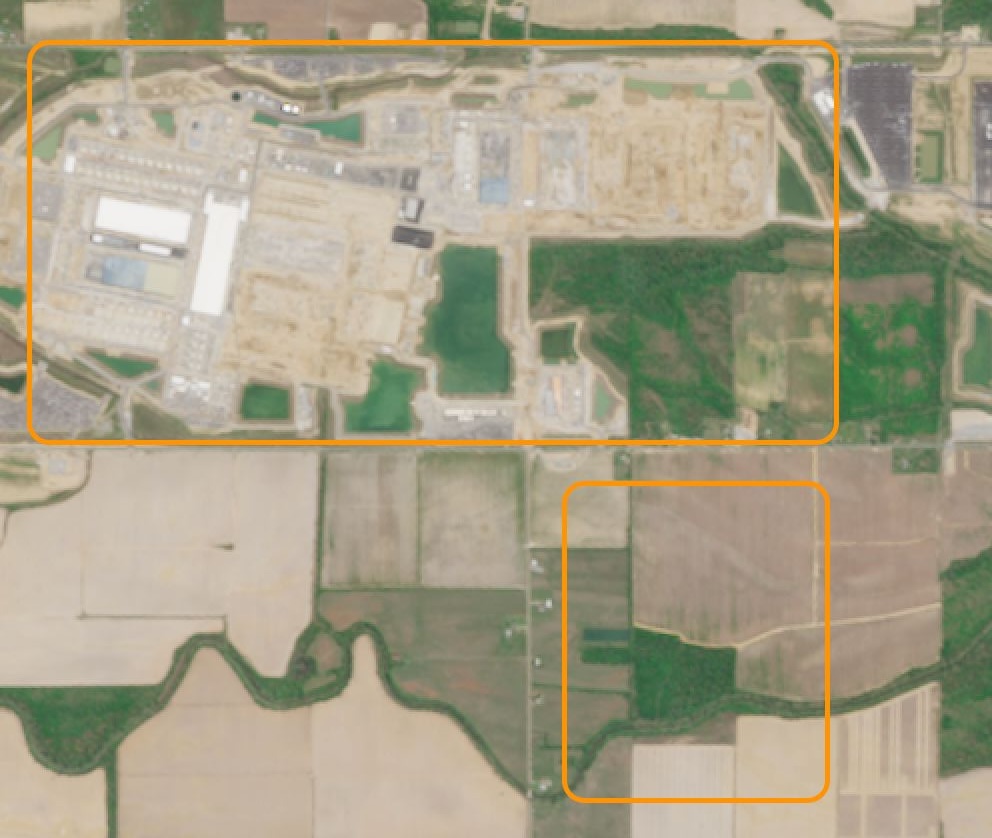
Texas has become one of the leading hubs for the expansion of artificial intelligence data centers in the United States, but its power grid capacity is starting to impose limits. A review of major projects seeking to connect to the ERCOT-managed grid could delay a pipeline amounting to nearly 20% of the planned data centers in the U.S., according to BloombergNEF estimates reported by Data Center Dynamics.
The key points on the slowdown of data centers in Texas in 30 seconds
- Texas is reviewing large data center projects requesting connection to its electrical grid.
- ERCOT reported in June over 438 GW of requests from major consumers, nearly 89% related to data centers.
- BloombergNEF estimates the review impacts about 49.8 GW of projects and could delay 20% of the U.S. pipeline.
- Texas is also assessing impacts on water, communities, and infrastructure.
- New York has already implemented a temporary moratorium on new hyperscale data centers.
This issue doesn’t mean Texas is shutting the door to data center development. The question is how to absorb an electricity demand that has grown much faster than the network’s planning capacity.
The Electric Reliability Council of Texas (ERCOT), responsible for managing about 90% of the state’s electric load, acknowledged on June 18 that it was processing more than 438,000 MW of connection requests from large consumers. Nearly 89% of these are from data centers. ERCOT also warned that not all these requests will turn into actual facilities.
The scale explains why the state is changing its procedures. To put it into perspective, 438 GW of requests does not mean 438 GW of data centers to be built, but rather a backlog of potential projects far exceeding what the grid can support under current conditions.
A review affecting nearly 50 GW of projects
Texas Governor Greg Abbott has asked the Public Utility Commission of Texas (PUCT) and ERCOT to examine the data center projects progressing through the interconnection process.
According to BloombergNEF, the review could impact approximately 49.8 GW of projects seeking grid access. Their analysis estimates that Texas will add about 8.25 GW of data center capacity within ERCOT territory by 2030.
The economic impact wouldn’t be small. BloombergNEF estimates that delays related to this review could surpass $8 billion by the first quarter of 2027, with costs rising if the process is prolonged.
There’s also a sign that projections are shifting. Bloomberg has lowered Texas’s electricity demand growth forecast for next year to around 6%, down from the 14% projected in July.
The review is not limited to the amount of megawatts each project requests. Texas aims to understand how much data centers will bear the costs of infrastructure, whether they will generate part of their own electricity or depend on the grid, and what measures they will take to limit the impact on nearby communities.
Water supply and reuse, impact on neighboring properties, and the ownership and control entities behind the projects are also part of the equation.
The Abbott administration had already clarified some of these requirements. In July, it withdrew a project by Diode near Cedar Creek Lake and explicitly cited the protection of natural resources, the electrical grid, and communities as conditions expected of these developments.
ERCOT changes rules in response to a challenging demand
The debate coincides with ongoing efforts in Texas to alter how large consumers connect to the grid.
On June 18, the PUCT approved a new process called Batch Zero, developed by ERCOT to jointly evaluate requests for facilities of 75 MW or more.
Previously, analyzing project after project became increasingly difficult given the surge in requests. The new system groups projects so ERCOT can assess forecasted demand simultaneously, determine what capacity the grid can support, and locate necessary transmission upgrades.
The timeline indicates that connecting a large new campus is no longer just a matter of finding land and funding. ERCOT expected to announce the classification of projects in Batch Zero by August, with a final transmission plan for this initial group slated for fall 2027. Requests for Batch 1 would begin in summer 2027.
There is also a particularly relevant option for data centers: ERCOT is considering a pathway for large consumers willing to temporarily reduce their consumption when local transmission constraints exist.
Flexible load could become an increasingly important variable in securing new connections.
For data center operators, this alters part of the traditional planning. The availability of fiber, land, water, and energy remains crucial, but physically having generation capacity in a region does not necessarily mean there is enough transmission capacity at the moment and place where a new campus seeks to connect.
The AI race is making this gap more evident than ever.
The debate on data centers expands across the US
Texas is not an isolated case. The rapid growth of digital infrastructure is prompting policy responses in other states due to concerns over grid costs, resource consumption, and who should pay for the necessary new infrastructure.
On July 14, New York took further steps. Governor Kathy Hochul issued an executive order establishing a moratorium of up to one year on certain environmental permits for new hyperscale data centers while the state develops a new regulatory framework.
The New York administration wants to analyze collectively the impacts on energy demand, water use and quality, and emissions. It also aims to prevent the costs of transmission upgrades from being directly passed on to households and businesses.
Other states have debated different initiatives, though legislative proposals or local moratoria do not necessarily mean a complete ban on data center construction.
The fundamental discussion is changing rapidly because the infrastructure needed for AI is increasingly measured in hundreds of megawatts and, in some cases, gigawatts.
Over the past few years, much of the competition has focused on acquiring GPUs, land, and funding. The availability of electricity and, critically, the actual ability to connect it to data centers are becoming additional constraints on growth.
Texas exemplifies this paradox. Its energy availability, electrical market, and investment-friendly environment helped attract numerous projects. Now, the accumulated backlog forces ERCOT to decide which can connect, where, and what upgrades are necessary.
This backlog of hundreds of gigawatts does not mean all these data centers will be built. It highlights something potentially more significant for the next stage of AI: there is far more potential electricity demand than the immediate capacity to supply it.
Frequently Asked Questions
Has Texas banned new data centers?
No. Texas is reviewing major projects seeking to connect to ERCOT’s grid and has changed its procedures for studying new connections. This may cause delays but does not constitute an outright ban on building data centers.
How much power are large projects in Texas requesting?
ERCOT reported in June over 438 GW of requests from large consumers, with nearly 89% related to data centers. The operator also cautions that not all these requests will materialize into actual facilities.
Why do new data centers need so much electricity?
The expansion of cloud computing, particularly AI infrastructure, is leading to the construction of facilities with large concentrations of accelerators and servers. Some new campuses are projected to have electricity demands of hundreds of megawatts.
Are other states limiting data center developments?
Yes. For example, New York introduced a pause in permitting for certain hyperscale data centers in July 2026, while the state develops new regulations. Other states are proposing limits or new conditions, but these do not necessarily mean outright bans.
Sources: datacenterdynamics and BloombergNEF
