
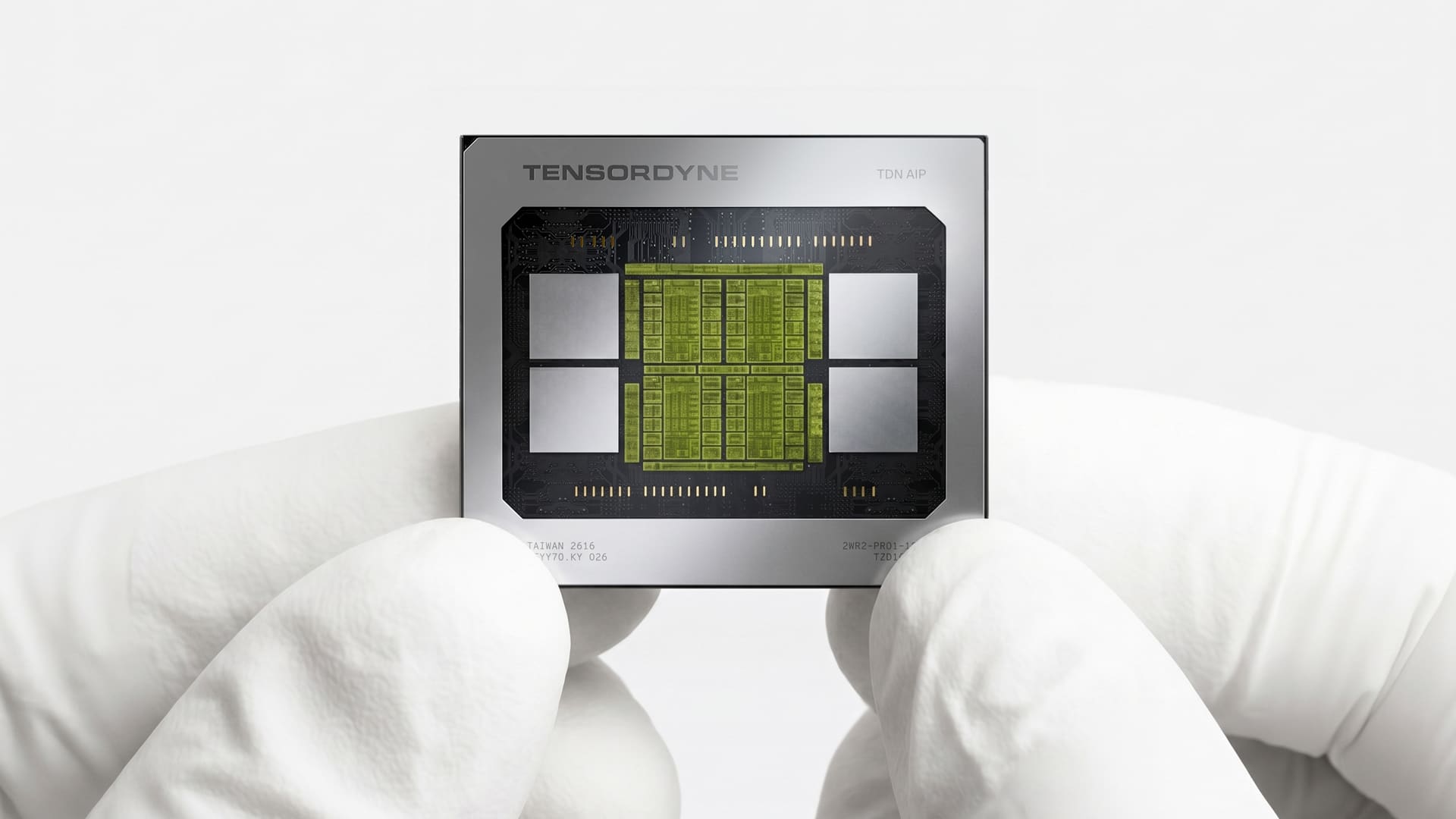
Tensordyne aims to enter the AI inference race through a different route than the usual one. The company announced Napier, a 3 nm chip promising higher performance per watt, lower power consumption, and greater token processing capacity than NVIDIA Blackwell and Rubin platforms. The announcement comes at a time when the cost of serving large-scale models has become one of the industry’s major challenges.
The company is not just proposing another AI accelerator. Its message is more ambitious: redesign how model operations are computed using logarithmic math, an highly integrated memory architecture, and low-latency interconnects designed to scale within racks. The promise is clear, though it still needs independent verification: serving trillion-parameter models with less energy, infrastructure, and greater economic margins for cloud providers, neo-clouds, and enterprises.
According to Tensordyne, Napier has completed tape-out, and the company asserts that the silicon is entering high-volume manufacturing at TSMC facilities. The chip was developed in collaboration with Broadcom and TSMC, and the platform includes integration work with Juniper Networks for internal-scale networking. The company also mentions over $200 million in projected demand for Napier systems, indicating commercial interest, although widespread deployments have not yet been verified.
A 3 nm chip focused on inference
Napier is designed for inference, not to compete broadly across all training and accelerated computing uses. This focus is important. Large model inference is becoming a huge economic burden: more users, more agents, more context, more generated tokens, and higher latency demands. In this scenario, raw performance matters, but performance per watt and per dollar could be even more critical.
Based on publicly available data and technical media coverage, the Napier chip integrates 138 billion transistors, 144 GB of HBM3E memory, 256 MB of SRAM, and achieves 2.1 PFLOPS of dense FP8 compute with a declared power consumption of 300 W per package. These figures are aimed at positioning it against high-end AI accelerators, but its differentiator is not only in the manufacturing node or memory.
| Feature | Tensordyne Napier |
|---|---|
| Manufacturing process | TSMC 3 nm |
| Transistors | 138 billion |
| HBM Memory | 144 GB HBM3E |
| SRAM | 256 MB |
| Declared compute | 2.1 PFLOPS FP8 dense |
| Chip power consumption | 300 W |
| Main focus | Generative model inference |
| Communicated status | Tape-out completed, transitioning to manufacturing |
Much of Tensordyne’s advantage is based on TDN Math, an approach that replaces large-scale multiplication operations with calculations based on sums within a logarithmic number system. Using logarithmic systems isn’t new in computing, but Tensordyne claims to have brought this to specialized hardware and a software stack capable of hiding this complexity from the user.
This last point will be decisive. An AI chip can promise a lot but if it requires retraining models, painful format conversions, or rebuilding pipelines, adoption becomes difficult. Tensordyne ensures their software manages conversions and offers compatibility with familiar tools like PyTorch, Triton, and vLLM. The promise is that customers won’t have to reinvent their models from scratch for a different arithmetic approach.
TDN72: the rack as a unit of competition
Tensordyne presents Napier not as an isolated chip but as part of a system. The main unit is the TDN72 Inference Pod, containing 72 Napier chips. Four pods form a complete rack with 288 chips, 42 TB of HBM3E, 74 GB of SRAM, 608 PFLOPS of dense FP8 compute, and a declared power consumption of 120 kW. The company states each pod is air-cooled and consumes 30 kW.
The choice of 72 chips isn’t accidental. NVIDIA set the NVL72 format as a rack-scale standard, with 72 Blackwell Ultra GPUs and 36 Grace CPUs in the GB300 NVL72 configuration, and a similar setup with 72 Rubin GPUs and 36 Vera CPUs in the Vera Rubin NVL72. Tensordyne aims to facilitate direct comparisons: same number of accelerators per scale domain, but with a different mathematical and energy architecture.
| System | Highlighted configuration | Memory | Declared power |
|---|---|---|---|
| Tensordyne TDN72 Pod | 72 Napier chips | Approximately 10 TB HBM | 30 kW |
| Tensordyne full rack | 4 pods, 288 chips | 42 TB HBM3E | 120 kW |
| NVIDIA GB300 NVL72 | 72 Blackwell Ultra + 36 Grace | 20 TB HBM3E GPU + 17 TB LPDDR5X | No direct public specs |
| NVIDIA Vera Rubin NVL72 | 72 Rubin + 36 Vera | 20.7 TB HBM4 | No direct public specs |
Tensordyne’s comparisons are assertive. The company states Napier can deliver 17 times more tokens per watt and 13 times more tokens per second than NVIDIA Blackwell. They also claim their system can serve models with trillions of parameters at 1,000 tokens per second per user in a single rack, outperforming larger configurations based on Rubin and LPX.
These claims should be viewed critically. There are no widely accepted independent benchmarks yet to verify these ratios against Blackwell, Blackwell Ultra, or Rubin under equal conditions. Additionally, inference performance depends heavily on the specific model, context size, batch, precision, interconnect, software, QoS, memory availability, and actual usage profile.
The bet: changing math, not just adding chips
Most NVIDIA competitors differentiate themselves through cost, availability, specialization, or vertical integration. Tensordyne adds another argument: altering how operations are represented and executed. Their logarithmic approach aims to cut energy consumption and silicon area in key transformer model operations, especially in inference.
This approach is attractive because the industry faces an uncomfortable reality. Increasing GPUs, racks, and megawatts doesn’t scale indefinitely. Energy costs, cooling, HBM memory, networking, space, and power infrastructure are beginning to impose limits on many projects. An architecture that reduces consumption without sacrificing accuracy or compatibility would have immediate value.
| Platform block | Function |
|---|---|
| TDN Math | Logarithmic mathematics for reducing computational cost |
| TDN AIP | Napier AI processor |
| TDN ACT | System compute tray |
| TDN Link | Low-latency scale-up interconnect |
| TDN72 Pod | Inference server with 72 chips |
| TDN Rack | Four pods, 288 chips, 42 TB of HBM3E |
The key question is whether this advantage sustains in real-world production. The history of AI hardware is filled with spectacular promises that struggle with immature software, lack of support, difficulty attracting developers, or inability to maintain an aggressive roadmap compared to NVIDIA. Tensordyne will need to demonstrate not only that their chip is efficient but that their system is reliable, programmable, scalable, and available at volume.
ServeTheHome sums it up well: Napier is interesting because it doesn’t just copy NVIDIA’s format and promise lower costs, but tries to change the math itself. This makes it more technically relevant, but also more demanding. Any fundamental change in numerical representation must prove it preserves quality, accuracy, and stability in real models.
NVIDIA still maintains the ecosystem
Tensordyne’s challenge comes against a rival that doesn’t compete solely with chips. NVIDIA offers a complete platform: GPUs, CPUs, NVLink, InfiniBand and Ethernet networks, software, libraries, rack-scale systems, management tools, and a vast developer community. GB300 NVL72 integrates 72 Blackwell Ultra GPUs and 36 Grace CPUs, with 20 TB of HBM3E for GPU, 17 TB of LPDDR5X for CPU, and 130 TB/s of NVLink bandwidth. Vera Rubin NVL72 takes the lead with 72 Rubin GPUs, 36 Vera CPUs, HBM4 memory, and NVLink 6.
| NVIDIA platform | Highlighted specs |
|---|---|
| GB300 NVL72 | 72 Blackwell Ultra + 36 Grace, 20 TB HBM3E GPU, 130 TB/s NVLink |
| Vera Rubin NVL72 | 72 Rubin + 36 Vera, 20.7 TB HBM4, 260 TB/s NVLink |
| Rubin GPU | 50 PFLOPS NVFP4 per GPU |
| Vera Rubin NVL72 | 3,600 PFLOPS NVFP4 inference |
| NVIDIA focus | Complete AI platform, networking, software, and management |
NVIDIA also claims that Vera Rubin NVL72 reduces the cost per million tokens compared to GB200 NVL72 and increases performance per megawatt in reasoning models. Essentially, NVIDIA is addressing the same challenge as Tensordyne: cheaper, more efficient inference for increasingly large models.
This positions Napier as an interesting but challenging alternative. If the figures are verified, it could appeal to providers seeking higher margins in inference and wishing to avoid complete dependence on NVIDIA’s ecosystem. If the software or availability isn’t up to par, the market might prefer a more mature but more expensive platform.
The shift: focusing on token cost
Napier arrives at an opportune moment. Inference is becoming the main recurring cost in generative AI. Training a model is expensive, but deploying it to millions of users and applications may be even more costly. In this context, metrics like tokens per second, tokens per watt, cost per million tokens, rack memory, user density, and latency per request are gaining importance.
Tensordyne estimates up to $33 million more annual revenue per rack compared to Blackwell, based on commercial projections involving usage assumptions, pricing, and occupancy. While speculative, it indicates where the industry is heading. AI infrastructure is shifting from being sold solely on FLOPS to focusing on operational margins within real services.
For hyperscalers, improving tokens per watt can reduce energy costs, free up electrical capacity, and delay investments in new data centers. For neo-cloud providers, it can improve margins on premium inference. For enterprises, it might make it more feasible to run large models on-premise without complex liquid cooling—assuming promises of compatibility and efficiency hold true.
The question is no longer if NVIDIA will face competition, but how many alternatives will move from promising presentations to deployable, maintainable, and reliable platforms.
Tensordyne has entered this conversation with a bold proposal: less reliance on brute scaling, more on mathematical efficiency and architectures designed for massive models. The next step—proving it outside their own materials with real customers, workloads, and comparisons that stand up to technical scrutiny—remains to be seen.
Frequently Asked Questions
What is Tensordyne Napier?
Napier is a 3 nm AI inference chip based on a logarithmic math architecture developed by Tensordyne.
What does it promise compared to NVIDIA Blackwell?
Tensordyne claims Napier delivers 13 times more tokens per second and 17 times more tokens per watt than Blackwell, though these figures originate from the company and require independent validation.
What makes TDN Math special?
TDN Math uses a logarithmic approach to reduce the computational cost of specific AI model operations, replacing some of the intensive multiplication with sum-based calculations.
Is Napier already available?
Tensordyne states that Napier has completed tape-out and is transitioning to mass production, but commercial deployment and independent benchmarks are still critical to assess its actual impact.
Sources: Tensordyne
