
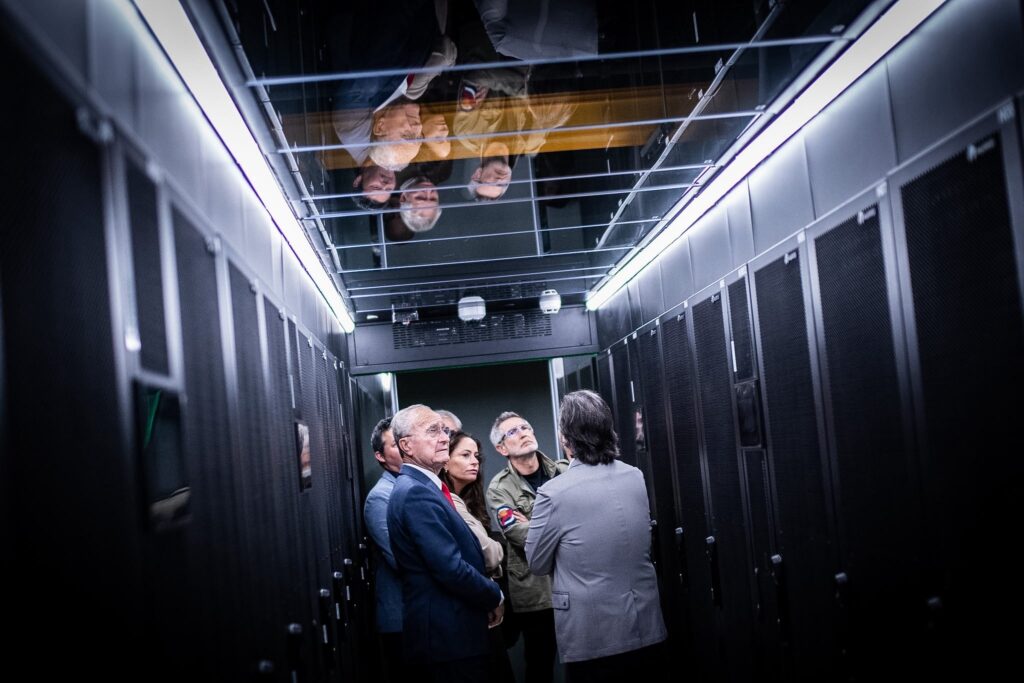
Templus has strengthened its foothold in Catalonia with the opening of a data center campus in the Zona Franca of Barcelona, adding 10 MW of actual installed capacity. The operation combines two facilities separated by about 500 meters, interconnected to function as a single platform for colocation, connectivity, and services designed for high-density loads.
The company has reached this point following two moves in less than a year. In February 2025, it acquired Cellnex’s BitNAP data center in Barcelona, an installation covering over 3,000 m² with 1.7 MW of capacity, with the goal of improving efficiency parameters and doubling its IT capacity. In December, it announced the purchase of nine data centers from AtlasEdge, including another asset in Barcelona, as part of a European deal involving facilities in Madrid, Milan, Zurich, Paris, Amsterdam, London, Leeds, and Copenhagen.
The result in Catalonia is a 10 MW campus that, according to Templus, makes the company the leading colocation provider and the top by operational capacity in the community. The facility already serves over 200 companies and was showcased at an event attended by Cristina Campillo, General Director of Digital Infrastructures of the Generalitat, and Félix de la Fuente, Chief Commercial Officer of Templus.
Two centers operating as one
The campus’s concept is straightforward: increase capacity without treating each data center as an isolated entity. The asset acquired from Cellnex has grown from 1.7 MW to 6 MW, while the one bought from AtlasEdge extends its capacity to 4 MW. Being approximately 500 meters apart, Templus has interconnected them to operate as a single, cohesive platform.
This setup makes sense in a market where proximity is becoming as important as size. Barcelona is competing with major European hubs not just on volume but on its ability to offer infrastructure close to businesses, government agencies, operators, digital services, and loads that don’t always require location in traditional centers like Madrid, Frankfurt, London, Amsterdam, or Paris.
Templus is building its narrative around this idea: a cross-European network of proximity data centers, interconnected and situated where economic activity occurs. In its own corporate communication, the company links its model to four factors: demand for power and density driven by artificial intelligence, latency impact on applications, data sovereignty, and sustainability.
| Asset in Barcelona | Origin | Current Indicated Power | Role within the campus |
|---|---|---|---|
| Center acquired from Cellnex / BitNAP | Purchased announced in February 2025 | 6 MW after expansion | Initial base for development in Catalonia |
| Center from AtlasEdge | Acquisition agreement announced in December 2025 | 4 MW | Capacity and density enhancement |
| Zona Franca campus | Interconnection of both assets | 10 MW | Unified platform for colocation and connectivity |
This approach allows Templus to offer a stronger value proposition for clients requiring continuity, growth, and redundancy within the same metropolitan area. It’s not the same to operate two separate facilities as to transform them into a coordinated campus with a seamless experience for corporate clients, government entities, and technology providers.
Catalonia seeks more digital strength
This development occurs as Catalonia aims to reinforce its role as a technological hub in southern Europe. Barcelona already boasts a significant digital ecosystem, industrial activity, presence of tech companies, international fairs, and growing submarine connectivity. However, to attract more cloud, AI, managed services, edge computing, and data platform loads, it needs available, efficient, and well-connected data center capacity.
This is where the strategic vision of the campus comes into play. A 10 MW data center may not compete in scale with the large hyperscale campuses of tens or hundreds of megawatts, but it can be highly relevant for enterprise colocation, regional connectivity, critical loads, proximity services, and AI deployments requiring density without straying far from the local market.
Félix de la Fuente explained during the presentation with a phrase focused on the local fabric: Templus’s goal is to equip Catalan public entities and companies with connectivity, digitalization, and competitiveness capabilities comparable to Europe’s main interconnection hubs.
The challenge is significant. Companies are transferring more data, using more SaaS solutions, deploying automation, adopting AI, and reevaluating where they host sensitive loads. Simultaneously, governments must meet sovereignty, continuity, security, and energy efficiency requirements. Regional colocation can become more important when it offers a nearby, neutral alternative with multiple operator access.
Efficiency, renewable energy, and AI loads
Templus presents its centers as Tier III infrastructure, carrier-neutral, powered by renewable energy. Its corporate website identifies its Barcelona locations as BCN01 and BCN02, both Tier III, carrier-neutral, and 100% renewable powered, though the power levels shown in publicly available profiles may not always match the actual installed capacity after expansions.
Sustainability is no longer just a marketing argument for data centers. Electricity consumption, cooling, PUE, energy sources, and thermal reuse or efficiency influence project feasibility. In a context where AI increases rack density and power demand, operators aiming to grow must explain not just how much energy they have but how they use it.
The “AI-Ready” component must also be understood precisely. It doesn’t mean all clients will deploy large model training clusters, but the infrastructure must be prepared for denser loads with higher demands for power, cooling, connectivity, and physical security. In colocation, such preparation can be a decisive factor for companies hosting GPUs, inference, advanced analytics, or intensive data platforms.
| Factor | Why It Matters |
|---|---|
| Available Power | Determines how many high-density loads can be hosted |
| Proximity | Reduces latency and brings data closer to businesses and users |
| Carrier-neutral | Allows choosing operators and improves redundancy |
| Tier III | Provides a design framework focused on availability |
| Renewable Energy | Addresses ESG commitments and regulatory pressures |
| AI-Ready | Prepares the environment for GPUs, inference, and intensive loads |
Templus’s growth is also supported by an acquisition strategy. After buying assets from AtlasEdge, the company manages a portfolio of over 60 MW and 750 clients in high-growth colocation markets, according to AtlasEdge’s statement. Its website already lists locations in Madrid, Barcelona, Málaga, Seville, Valencia, Ceuta, Lisbon, Amsterdam, Copenhagen, Leeds, London, Milan, Paris, and Zurich.
The value of being close to the data
The opening of the Barcelona campus underscores a broader European trend: digital infrastructure is spreading beyond traditional hubs. AI, edge computing, data sovereignty, European regulation, and latency reduction are prompting many companies to seek capacity closer to their operational hubs.
This does not diminish the importance of large-scale infrastructure centers. Madrid, Frankfurt, London, Paris, and Amsterdam will remain vital. But the map is no longer solely defined by a few hyper-concentrated centers. Companies are increasingly adopting hybrid architectures, distributing loads across public and private clouds, regional colocation, edge sites, and their own facilities. In this landscape, Barcelona becomes more attractive with sufficient capacity, connectivity, and operators capable of supporting growth.
For Templus, Catalonia is becoming a key part of its pan-European expansion. The company isn’t just increasing megawatts but offering proximity solutions for companies and governments needing to host critical infrastructure close to their operational environment. The challenge will be maintaining efficiency, connectivity, service quality, and scalability amid growing demand and rising energy and regulatory requirements.
The launch of the 10 MW campus in Zona Franca sends a clear message: Barcelona wants a bigger role in European digital infrastructure, and Templus aims to have a visible position in that movement.
Frequently Asked Questions
What has Templus opened in Barcelona?
Templus has inaugurated a data center campus in Zona Franca with 10 MW of actual capacity, resulting from interconnecting two nearby facilities.
Where do the two campus data centers come from?
One originates from the acquisition of BitNAP from Cellnex in February 2025, expanded to 6 MW. The other is part of the AtlasEdge asset purchase, with 4 MW in Barcelona.
Why is this campus important for Catalonia?
Because it enhances local capacity for colocation, connectivity, and infrastructure ready for high-density loads—at a time when AI, cloud, data sovereignty, and digital transformation are accelerating.
What does “AI-Ready” mean for the campus?
It indicates that the infrastructure is prepared for more demanding loads involving GPUs, inference, advanced analytics, or data-intensive platforms, with higher power, cooling, and connectivity needs.
via: LinkedIn
