
Templus has revamped its corporate website during a period of strong activity for the company. The new site is not just an aesthetic update but a way to organize an expansion that has been very rapid: more data centers, new markets, additional services, and a proposal increasingly focused on proximity, interconnection, and AI-ready workloads.
The new site presents Templus as a pan-European proximity and ultra-connected data center platform, with a more direct navigation to its locations, services, carriers, ESG commitments, and operating model. The message is clear: digital infrastructure can no longer rely solely on large centralized hubs, especially when companies seek lower latency, data sovereignty, energy efficiency, and capacity for high-density loads.
A website to explain a company that has grown rapidly
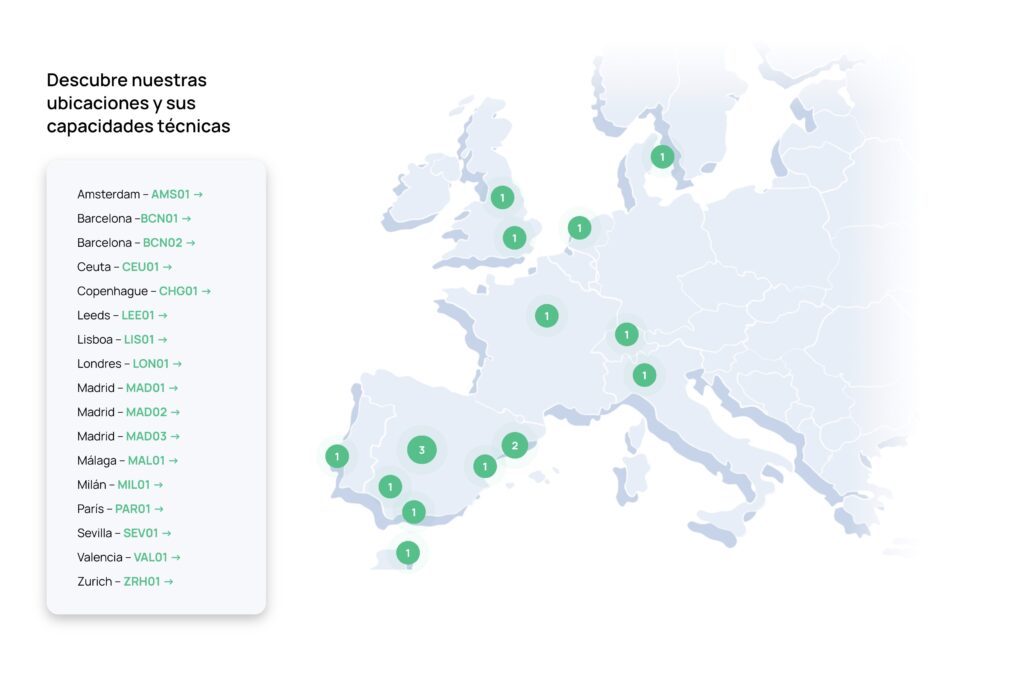
Templus’s digital transformation makes sense considering recent developments. The company has taken operational control of nine data centers from AtlasEdge, located in Amsterdam, Barcelona, Copenhagen, Leeds, London, Madrid, Milan, Paris, and Zurich. Additionally, it has acquired three data centers from Grupo Aire in Lisbon, Madrid, and Valencia, strengthening its presence in the Iberian Peninsula and adding capacity in strategic markets.
With this evolution, Templus now manages a network of 17 data centers across eight countries, with a portfolio exceeding 65 MW of power and around 750 clients, according to data shared during the integration of AtlasEdge assets. The new website aims to turn this complexity into a more understandable experience for enterprise clients, operators, cloud providers, and companies seeking alternatives to traditional infrastructure concentration.
One of the strengths of the new portal is that it does not hide the operational map. The data center section allows users to explore locations such as Madrid, Barcelona, Málaga, Ceuta, Lisbon, London, Paris, Milan, Amsterdam, Copenhagen, Leeds, and Zurich, with profiles focused on technical data such as power, IT surface area, Tier III level, operator neutrality, and renewable energy sources. In a market where many companies talk about future capacity, showcasing operational facilities and specific locations helps ground the conversation.
The commercial focus has also shifted meaningfully. The website presents Templus not just as a colocation provider but as a distributed infrastructure platform. This distinction matters. In today’s market, clients are looking for more than rack space; they want connectivity, access to operators, low latency, technical support, growth capacity, and architecture that can coexist with public cloud, private cloud, and hybrid environments.
Colocation, interconnection, and AI-Ready as core messages
The new website organizes its offerings into four main blocks: colocation, interconnection and connectivity, AI-Ready, and Smart Hands. This straightforward structure aligns with market needs. Colocation remains the foundation: racks, cages, private rooms, power and cooling redundancy, physical security, and operational continuity. However, the emphasis is increasingly on connectivity and readiness for dense workloads.
Interconnection features prominently. Templus emphasizes access to multiple carriers, cloud providers, networks, and exchange points—crucial for companies that do not want to be locked into a single provider. Operator neutrality has become a strong commercial advantage, especially for firms designing hybrid, multicloud, or distributed architectures across multiple sites.
The AI-Ready block is perhaps the most technologically interesting. The website discusses capacity for supporting AI clusters, HPC, and GPU-intensive deployments, referencing high-density configurations, liquid cooling, and advanced energy monitoring. Templus mentions capabilities of up to 120 kW per rack—directly aligning with the emerging workloads arriving at data centers: training, inference, simulation, advanced analytics, and AI-supported automation platforms.
The fourth block, Smart Hands, reinforces operational support. In a distributed network across several countries, local technical support is not a minor addition. Hardware installations, replacements, physical diagnostics, in-rack checks, and quick interventions can make a difference for clients who outsource their infrastructure but need to maintain operational control.
Proximity, sovereignty, and sustainability
Templus’s messaging aligns with broader European market trends. Demand for data centers is not only growing in traditional major nodes but also in cities and regions where companies need to bring infrastructure closer to their users, production sites, corporate headquarters, or regulated markets. Proximity now encompasses not just physical distance but a combination of latency, regulatory compliance, connectivity, and responsiveness.
The new website emphasizes this concept: a distributed network operated under uniform standards. This will be vital for Templus, as its growth has relied on acquisitions and integrating assets with different histories. The challenge is not just adding data centers but unifying them under a single commercial, technical, and operational framework.
Sustainability also has a visible presence. The company highlights renewable electricity, ongoing PUE optimization, location-specific technical design, and initiatives like district cooling. In an industry increasingly under scrutiny for electricity consumption, access to renewable energy and energy efficiency are critical business arguments, not just reputational ones.
The website update comes at a pivotal moment. Templus needs to communicate what it is today and where it aims to go. It is no longer just a Spanish company focusing on regional data centers. Its message is now geared towards a European proximity platform for companies needing infrastructure close to where economic activity happens, with open connectivity and capacity for new digital loads.
How all assets will be integrated, what new locations will be added, and how the market will respond to a proposal that moves away from hyper-concentration in a few large hubs remain to be seen. While the new website does not solve these challenges alone, it offers a clearer picture of the company Templus aspires to be: a European network of data centers prepared for a more distributed, regulated, and energy-conscious digital economy.
Frequently Asked Questions
What has changed in Templus’s new website?
The new site better organizes information about data centers, services, carriers, ESG, and the operating model. It also strengthens Templus’s positioning as a pan-European proximity data center platform.
How many data centers does Templus manage?
Following recent integrations, Templus manages 17 data centers across eight countries, with a portfolio exceeding 65 MW of capacity.
What services does Templus highlight on its new website?
The company structures its offerings into colocation, interconnection and connectivity, AI-Ready infrastructure, and Smart Hands, focusing on neutrality, low latency, operational continuity, and technical support.
Why is proximity data center deployment important?
Because it brings infrastructure closer to users, reduces latency, facilitates regulatory compliance, and enables more distributed architectures compared to reliance on large hubs.
