
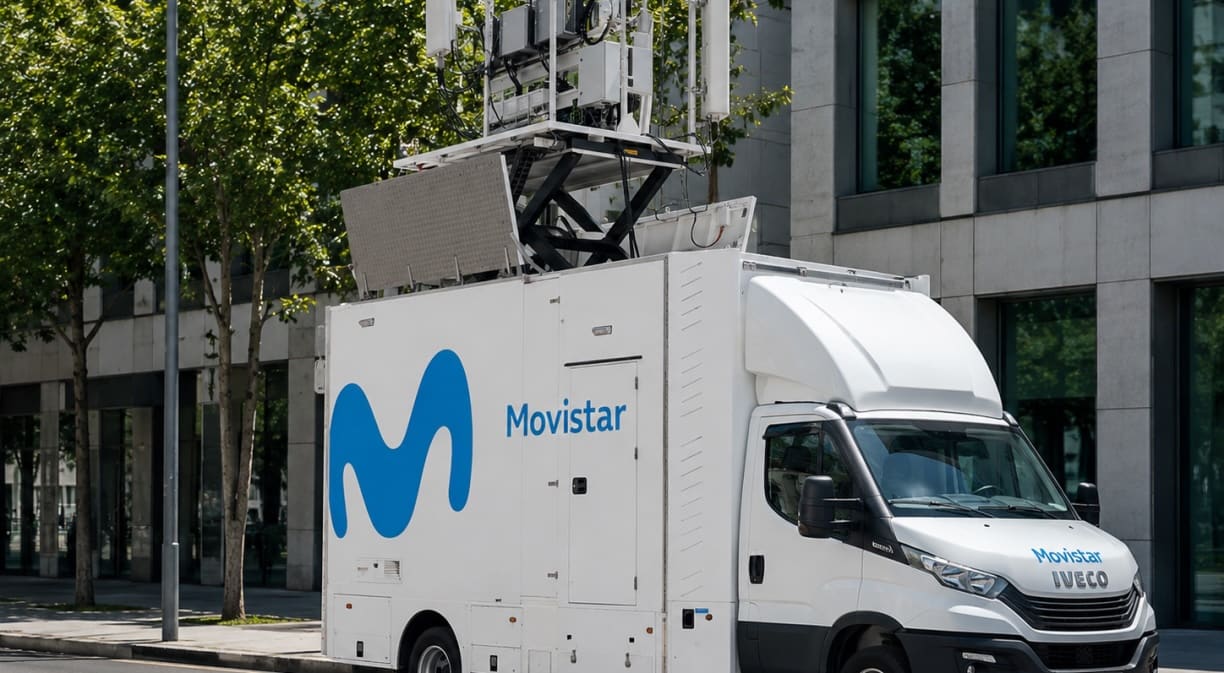
Telefónica is facing one of those weeks when connectivity stops being invisible. The visit of Pope Leo XIV to Spain, scheduled from June 6 to 12, will require the operator to deploy a special network setup in Madrid, Barcelona, and the Canary Islands. Additionally, in the capital, the schedule coincides with several Bad Bunny concerts at the Riyadh Air Metropolitano, part of a musical residency that attracts tens of thousands of people each night.
The company has announced an “unprecedented” network reinforcement to serve as the main communication provider for the papal delegation and the primary technology partner for the visit. The plan includes the optimization of over 1,300 network points, four high-performance 5G mobile units, ten satellite backpacks, and on-site technical support teams 24/7. A team of more than 60 professionals from Telefónica’s National Supervision and Operations Center in Madrid will also monitor the device in real-time.
Beyond the institutional component, this deployment highlights a growing reality for cities: major events are no longer managed solely through security, mobility, and logistics. They now also demand network engineering, capacity planning, backup links, continuous monitoring, and rapid response to concentrated traffic spikes.
When the city becomes a stress test for the network
On a normal day, mobile networks distribute traffic among neighborhoods, offices, homes, stations, shopping centers, and entertainment areas. During large-scale events, this balance collapses. Thousands of people gather in a few streets, plazas, stadiums, or official routes, and nearly all are on their phones simultaneously.
The pressure isn’t only from calls. Much of the challenge involves data: live videos, photos, messaging, maps, social media, mobile payments, digital credentials, transport apps, media coverage, volunteer coordination, and professional communications. At concerts like Bad Bunny’s, upload traffic can be especially intense, as thousands of attendees record and share content simultaneously.
Madrid exemplifies this new complexity. During the papal visit, the city will host official events and public gatherings. Meanwhile, the Bad Bunny concerts at the Riyadh Air Metropolitano will take place on June 6 and 7, with additional dates in the first half of the month. The combination of an international religious event and massive stadium concerts requires viewing the network as a dynamic infrastructure capable of adapting to different zones and time slots.
In these situations, coverage alone isn’t enough. An antenna may show a good signal, but if too many users compete for the same radio resources, the quality degrades. Messages take longer to send, calls may drop, videos won’t upload, and critical applications lose reliability. That’s why operators work beforehand on capacity, backhaul, traffic balancing, and temporary reinforcements.
| Deployment Element | Technological Function |
|---|---|
| More than 1,300 optimized network points | Increase capacity and tune network behavior |
| 5G mobile units | Reinforce high-traffic areas |
| Satellite backpacks | Provide backup connectivity at key points |
| On-site technical support 24/7 | Respond to technical issues in the field |
| Monitoring from CNSO | Track traffic, alarms, and performance in real-time |
| Main operator for the delegation | Ensure stable communications for the organization |
5G, mobile units, and satellite as contingency networks
The deployment announced by Telefónica combines several layers. The mobile 5G units enable adding capacity in locations where existing fixed networks may not handle a temporary spike. These setups are used in concerts, sporting events, international summits, or emergencies, providing targeted reinforcement in high-demand zones.
Satellite backpacks serve another purpose. They don’t replace the mobile network but offer an alternative connectivity route when data needs to be sent from specific locations or a backup communication is required. For media, technical crews, organizers, or support services, access to additional links can be crucial if the terrestrial network saturates or immediate connectivity is needed at a particular point.
5G offers increased capacity and better traffic management, but its actual performance depends on station density, spectrum availability, network transport, and the number of connected users. During large events, improvements come not just from activating 5G but from planning where it’s needed, how traffic is distributed, which transport routes are used, and how the network is monitored throughout.
Security and coordination also play key roles. The papal delegation, public services, accredited media, volunteers, and organizing teams require more predictable communications than typical users. At an international event, connectivity issues can impact information flow, credentials, mobility, live broadcasts, and operational coordination.
Therefore, Telefónica deploys on-the-ground technical staff and maintains centralized surveillance from its operations center. The network is managed as a living infrastructure: alarms, congestion, traffic patterns, zone-specific usage, cell behavior, and potential issues are continuously monitored. If a location begins to saturate, adjustments can be made or reinforcement measures activated.
The mobile phone is now part of the event
Major events have evolved because audiences are no longer just spectators. They broadcast, comment, purchase, share, navigate, and coordinate via their phones. At a Bad Bunny concert, each song can generate thousands of social media videos within minutes. During a papal visit, attendees might follow the schedule, share images, locate access points, or communicate with family in high-density areas.
This makes connectivity an essential part of the experience. A network that functions well allows the event to be felt both inside and outside the venue. A congested network causes frustration and complicates logistics—payments, transportation, emergencies, meeting points, or accessing official information.
For operators, these deployments are also an opportunity to showcase technical capacity. Connectivity during large events is a public resilience test. Users often don’t think about backhaul, radio capacity, or 24/7 monitoring, but they definitely notice if their phone stops responding when they need it most.
Furthermore, Madrid is increasingly establishing itself as a major event city. International concerts, sports finals, fairs, summits, official meetings, and large gatherings all require strengthening a technological layer that was once secondary. The mobile network is becoming a top-tier urban infrastructure, on par with transportation, security, or energy systems.
A glimpse into the future of event management
The case of Telefónica during Pope Leo XIV’s visit, coinciding with major concerts in Madrid, offers a broader lesson. Cities will need to plan events with a more technological perspective. It’s not enough to close streets, boost metro capacity, or deploy police. Mobile traffic management, critical communications, cybersecurity, press points, backup links, and operator coordination must also be accounted for.
The natural evolution points toward more programmable networks, edge computing, real-time traffic analytics, and network APIs for reserving or prioritizing capacity in specific scenarios. In the future, a large event could rely on nearby edge nodes to process video, manage security, enable immersive experiences, or coordinate IoT devices without routing all data to distant data centers.
The challenge will be balancing capacity, privacy, and neutrality. Reinforcing a network for an event is necessary; prioritizing critical uses is reasonable. However, cities and operators must do so transparently, with clear rules and guarantees for citizens, the media, and public services.
Telefónica concludes this week with a comprehensive deployment: over 1,300 network points, mobile 5G units, satellite links, on-site support, and centralized monitoring. The scenario will be real, simultaneous, and visible. The Pope’s visit and Bad Bunny’s residency do not target the same audience but share a fundamental trait: a connected city trying to absorb enormous demand peaks in a very short time.
Connectivity is only missed when it fails. At large events, preventing such failure requires more than coverage—it demands engineering, anticipation, and real-time operation.
Frequently Asked Questions
What network reinforcement will Telefónica deploy during the Pope’s visit?
Telefónica will optimize over 1,300 network points, deploy four mobile 5G units, ten satellite backpacks, and provide 24/7 technical support teams.
Why do large events overload mobile networks?
Because they gather thousands of people in small areas using their phones simultaneously for calls, messaging, videos, social media, payments, and mobility apps.
What role do the 5G mobile units play?
They provide temporary capacity in locations with expected high crowd concentrations or intensive data usage.
Why is the coincidence with Bad Bunny in Madrid significant?
Because the concerts at the Riyadh Air Metropolitano create mobile traffic spikes in the city during the same dates, with tens of thousands sharing videos, photos, and messages in real time.
via: Madrid News
