
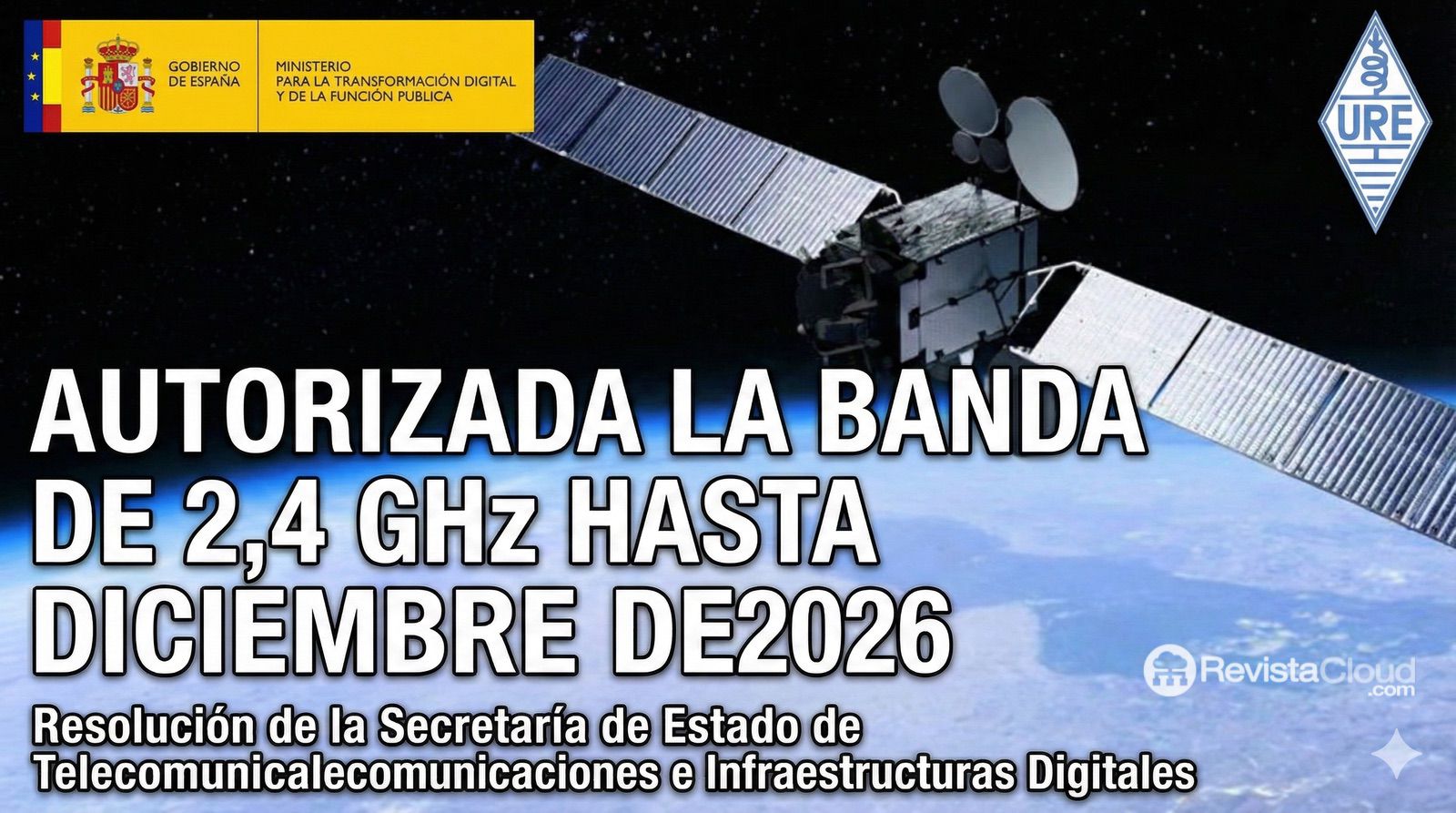
The State Secretariat for Telecommunications and Digital Infrastructure (SETID) has renewed the temporary and experimental authorization that allows Spanish amateur radio operators to transmit in the 2,400 to 2,410 MHz band, a very specific window within the 2.4 GHz spectrum. The extension extends its validity until December 26, 2026, ensuring continued permission that has been recurrently renewed since March 2009. The Spanish Radio Amateur Union (URE) had requested to maintain it for an additional year.
This decision, far from being a mere administrative formality, has practical significance for a community that has been using this portion of spectrum for years as a real-world testing ground for microwave communications, especially satellite. In an era when public discourse about spectrum often revolves around 5G, Wi-Fi, or IoT, these niche authorizations reveal another aspect of the public radio spectrum: controlled experimental use, governed by strict rules and with an educational impact that often precedes widespread dissemination.
A Small Band, Big Conditions
The resolution establishes technical requirements that leave no room for improvisation. Authorized transmissions must be conducted with a maximum equivalent isotropically radiated power (EIRP) of 1,500 watts and with directive antennas whose gain is at least 21.5 dBi. This is not merely a recommendation: it forms the framework that makes it possible to harmonize experimental use with other services sharing the radio environment.
Moreover, the authorization is not a general “for doing radio” in 2.4 GHz. It is specifically targeted at a very precise use case: communications aimed at the QO-100 satellite, located at the orbital position 25.9º East in geostationary orbit. In other words, the band is enabled with a specific technical goal, which influences station engineering: orientation, gain, planning, and, above all, operational discipline.
Another relevant detail is the geographic scope: SETID permits these transmissions from licensed amateur radio stations anywhere within the national territory. For many operators, this flexibility is key, as it opens the door to distributed experimentation without the need for “special” enclaves, provided the technical and regulatory framework is followed.
“No Interference and No Protection”: The Red Line
As with experimental authorizations in shared bands, the resolution emphasizes a core principle that defines operational limits: the regime of no interference and no protection. In practice, this means the amateur must ensure they do not cause harmful interference to authorized services, and if such interference occurs, emissions must cease immediately. At the same time, the licensee cannot demand protection if they face interference from services with priority rights or compatible uses.
SETID supports compatibility through technical reports which, according to the text itself, have confirmed that during the authorized period, no adverse impact on radio stations or authorized services has been observed. This positive record has been instrumental in allowing the authorization to be renewed annually.
An Explicit Legal Framework for Regulatory Compliance
The resolution does not merely “authorize” but situates itself within the current legal framework. References are made to laws such as Ley 11/2022, General Telecommunications Law, Royal Decree 123/2017 concerning the use of radio spectrum, regulations specific to amateur radio (including its regulations), as well as the National Frequency Allocation Table (CNAF) and its recent amendments.
Practically, this matters for two reasons. First, it affirms that the 2.400–2.410 MHz band is assigned on a secondary basis to amateur services (among others), and that the experimental authorization relies on SETID’s capacity to grant temporary or experimental uses that do not interfere with licensed stations. Second, it reinforces that the permit is a regulated exception, not a permanent “owned right.”
Antennas, Installations, and Responsibilities
The resolution also includes a reminder that often goes unnoticed until antenna setup outside the building is necessary: if operating under these conditions requires modifying external antenna installations or related equipment, the provisions of Article 20 of the applicable amateur radio regulations must be followed. This is significant because in microwave and satellite operations, the difference between “it works” and “it doesn’t work” often hinges on mechanical factors: supports, stability, fine orientation, cable losses, and safety of installation.
Additionally, the authorization clarifies that it does not grant any rights over satellite infrastructure. Users must obtain any relevant permits or authorizations for satellite access if required. While the administration permits on-ground spectrum use under certain conditions, it does not “guarantee” access to space infrastructure.
A Technical Announcement with Strategic Implications
For URE, the renewal is good news because it signifies continuity for technical and experimental activities in microwave and satellite communications—an especially valuable area for learning about advanced radiofrequency, propagation, station design, and responsible spectrum management.
For the broader technological ecosystem, these resolutions serve as a useful reminder: innovation in communications does not always originate from large commercial deployments. Often, it begins with experimental stations operating under strict rules, traceability, and a technical culture focused on avoiding harm to the rest of the system.
Frequently Asked Questions
What exactly does the 2.400 to 2.410 MHz authorization for amateur radio in Spain permit?
It allows temporary and experimental transmissions within that segment of the 2.4 GHz band under strict technical conditions (EIRP, directive antenna, satellite objective), with the obligation to cease transmissions if harmful interference occurs.
Why is a directive antenna of at least 21.5 dBi and a maximum EIRP of 1,500 W required?
Because satellite links require concentrating energy toward a specific point and limiting unwanted radiation, reducing interference risks to other services and improving link efficiency.
Until when is the extension valid, and since when has this permission been renewed?
The extension is valid until December 26, 2026, and this type of authorization has been continuously granted since March 2009.
What does operating under “no interference and no protection” regime mean in this band?
It means operators cannot cause harmful interference to authorized services (and must stop if they do), and they do not have the right to claim protection if they receive interference from those services.