
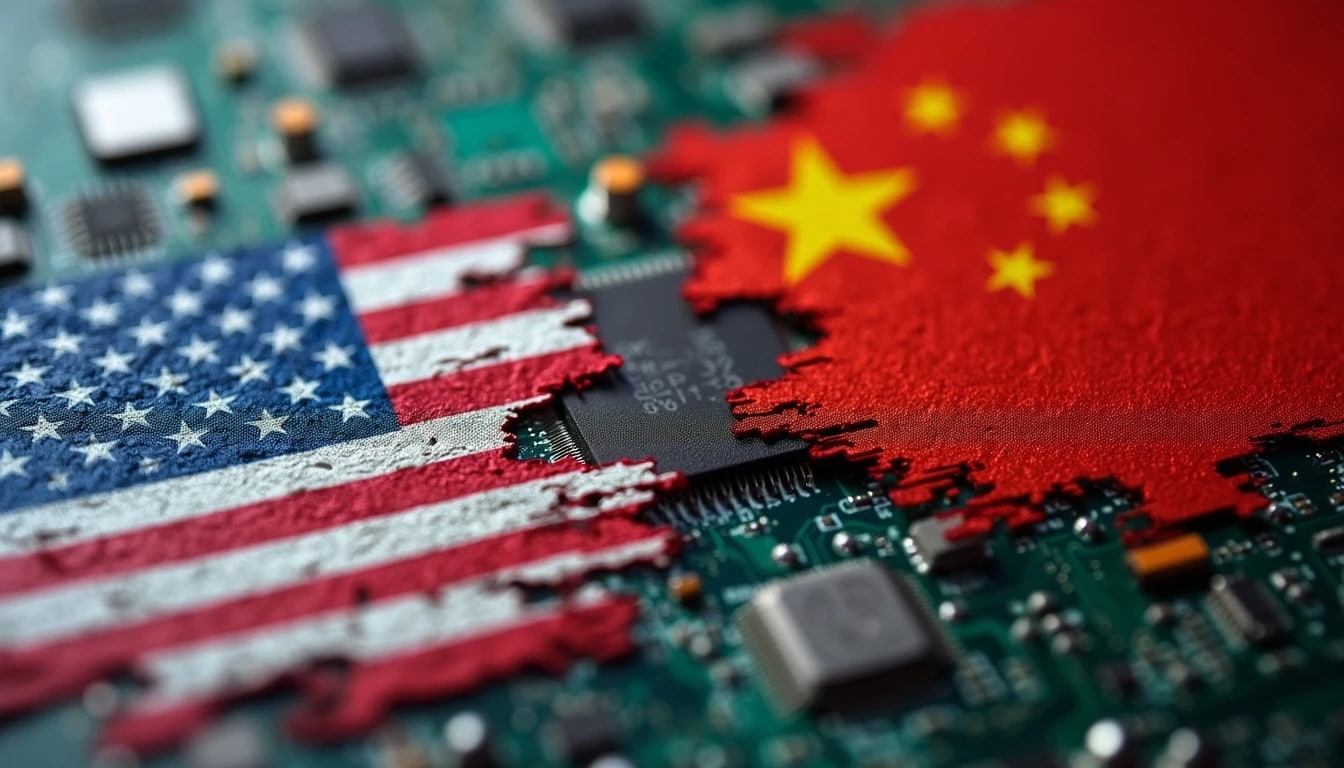
Taiwan is reportedly considering new restrictions on the export of AI chips and servers to China, in a move that could bring its technology policy even closer to that of the United States. According to international media reports, Taiwanese authorities are evaluating measures to restrict the sale of advanced hardware to all Chinese companies, not just those on blacklist lists such as Huawei or SMIC.
If approved, this measure could significantly impact the global AI supply chain. Taiwan is not only the country where many of the world’s most advanced chips are manufactured but also home to numerous suppliers that integrate NVIDIA processors in AI servers. These systems are deployed in data centers and cloud platforms. Tightening controls would affect not only Chinese manufacturers but also assemblers, distributors, cloud clients, and operators relying on that supply chain.
From targeting specific companies to controlling an entire market
Until now, Taiwan could warn its companies that certain exports might violate U.S. regulations, especially when related to sanctioned or controlled-listed Chinese companies. The proposed change would go further: granting Taiwanese authorities a statutory basis to require prior approval and impose criminal sanctions if chips or AI systems are exported to China without permission.
This distinction is critical. It would not only mean indirectly following U.S. regulations but also incorporating national legal tools to block or penalize unauthorized operations. Practically, Taiwan would shift from a focus on specific companies to a broader system where any Chinese customer could be subject to restrictions.
The most sensitive material would be AI servers equipped with advanced chips, including systems based on NVIDIA processors. These are essential for training language models, conducting large-scale inference, building AI clouds, and developing capabilities in sectors such as defense, industry, research, or digital services.
| Affected Element | Current Situation | Potential Change |
|---|---|---|
| Exports to Huawei and SMIC | Already subject to strict controls and restrictions | Would maintain stringent restrictions |
| Non-sanctioned Chinese clients | May face warnings or case-by-case analysis | Could require prior approval |
| Servers with NVIDIA chips | Central part of Taiwan’s AI supply chain | Would fall under the new control scope |
| Taiwanese authorities | Limited capacity to impose sanctions under their own regulations | Legal basis for penalties on unauthorized exports could be established |
| Assembly companies | Operate within a highly interconnected global chain | Would need to review contracts, destinations, and traceability | China | Already criticizing Taiwan’s alignment with Washington | May respond with political or commercial pressure |
Washington’s pressure extends into Taiwan’s supply chain
The background of this move is rooted in trade and tech negotiations with the United States. Washington has been tightening controls on the export of advanced chips, manufacturing equipment, and AI-related technologies to China for years. The declared goal is to limit Beijing’s access to capabilities that could be used in military applications, advanced surveillance, or supercomputing development.
Taiwan is in a delicate position within this strategy. On one hand, it is a key partner for the U.S. in semiconductors. On the other, its industry maintains commercial ties with China and is part of an interconnected Asian supply chain. Any additional restrictions must balance security interests, diplomatic pressure, economic considerations, and risk of retaliation.
This potential tightening also comes at a time when AI has become a central front in geopolitical competition. AI chips are not just technological products; they form the foundation for training models, automating industrial processes, modernizing armies, accelerating research, and developing digital services. Controlling access to such hardware directly influences a country’s capacity to develop advanced computational infrastructure.
The U.S. has already restricted sales of certain GPUs and accelerators to China. However, chips do not always travel as loose components—they can be integrated into servers, complete systems, or infrastructures assembled by third parties. This is where Taiwan becomes crucial: many Taiwanese companies are involved in the design, manufacturing, and assembly of these systems.
A potential blow to the AI server industry
Taiwanese industry could be forced to scrutinize its operations more carefully if restrictions expand. The country hosts a significant portion of the manufacturing and assembly of hardware for AI data centers. Beyond the advanced chips produced by TSMC, there is an entire ecosystem of manufacturers of boards, servers, cooling systems, integration, testing, and logistics.
For Taiwanese firms, the risk extends beyond losing direct sales to Chinese customers. Compliance complexity would increase, requiring verification of final destinations, intermediaries, contracts, hardware configurations, and re-exports. In a market where demand rapidly grows and supply chains are global, this traceability can become a substantial operational burden.
The impact would depend on how the rule is written. An outright ban on all Chinese companies would have a far greater effect than a case-by-case licensing approach. It also matters whether restrictions focus only on servers with high-end chips or include a broader range of accelerators, components, and systems.
China’s reaction would also be a factor. Beijing already criticized Taiwan harshly last year when it blacklisted Huawei and SMIC. A broader tightening could be seen as a deeper alignment with Washington, prompting diplomatic, commercial, or regulatory responses.
Beyond NVIDIA: the battle for complete hardware systems
The discussion isn’t limited to NVIDIA, although its chips are the most visible symbol of AI infrastructure. The new phase of tech controls is shifting from individual chips to entire systems. An AI server includes accelerators, CPUs, memory, networking, storage, boards, firmware, management software, and cooling solutions. Each component can become a route to restrict or enable access to computational capacity.
Regulators see this shift as logical. If a country bans the sale of an advanced chip but allows the sale of pre-assembled servers with that chip, control efforts weaken. Consequently, the U.S. and allies are broadening focus to systems, associated components, cloud services, total computational capacity, and indirect access channels.
For China, this increases the urgency to develop domestic alternatives. U.S. restrictions have already prompted Chinese companies to invest more in local accelerators, memory, packaging, AI software, and internal supply chains. If Taiwan also tightens its standards, this self-sufficiency strategy will gain even more traction.
The outcome could be a deeper fragmentation of the global AI market—led by a supply chain dominated by the U.S., Taiwan, Japan, South Korea, and Europe for certain critical components, alongside a Chinese ecosystem seeking to reduce dependence and substitute restricted technologies with national solutions. This will likely lead to increased duplication, reduced efficiency, and greater uncertainty for multinational companies.
Taiwan navigates between security and business interests
Taiwan’s position is particularly complex. Its semiconductor industry is a strategic advantage but also a source of pressure. The U.S. wants Taiwan to support its controls to block AI hardware access routes. Meanwhile, China remains a vast market and a significant actor capable of political and economic responses.
For Taiwanese companies, the message is clear: selling AI hardware will no longer be just a commercial decision. Each transaction could involve regulatory, geopolitical, and reputational considerations. In a sector where demand outstrips supply in many segments, losing Chinese clients may matter less than in other cycles, but it remains a sensitive choice.
This potential move underscores a broader trend: technological controls are no longer limited to the most advanced chips or a few sanctioned companies. They now extend to complete servers, assembly chains, cloud capacities, and export flows. AI has made hardware a strategic asset, and Taiwan is at the heart of this tension.
If the plan progresses, Taiwanese companies will need to adapt to a new reality: manufacturing and assembling systems that power global AI also involve deciding who can purchase them. Increasingly, this decision will no longer be solely market-driven.
Frequently Asked Questions
What is Taiwan studying?
Taiwan is analyzing new restrictions on the export of AI chips and servers to all Chinese companies, not just those already sanctioned.
Why does this matter?
Because Taiwan is a key player in manufacturing and assembling AI chips and servers. Regulatory changes could impact the global supply chain.
Which products might be affected?
Mainly advanced AI hardware, including servers with NVIDIA chips and other components used in data centers and model training.
How might China react?
It is likely that Beijing will criticize the move if implemented, viewing it as a closer alignment with U.S. tech policies.
via: sedaily
