
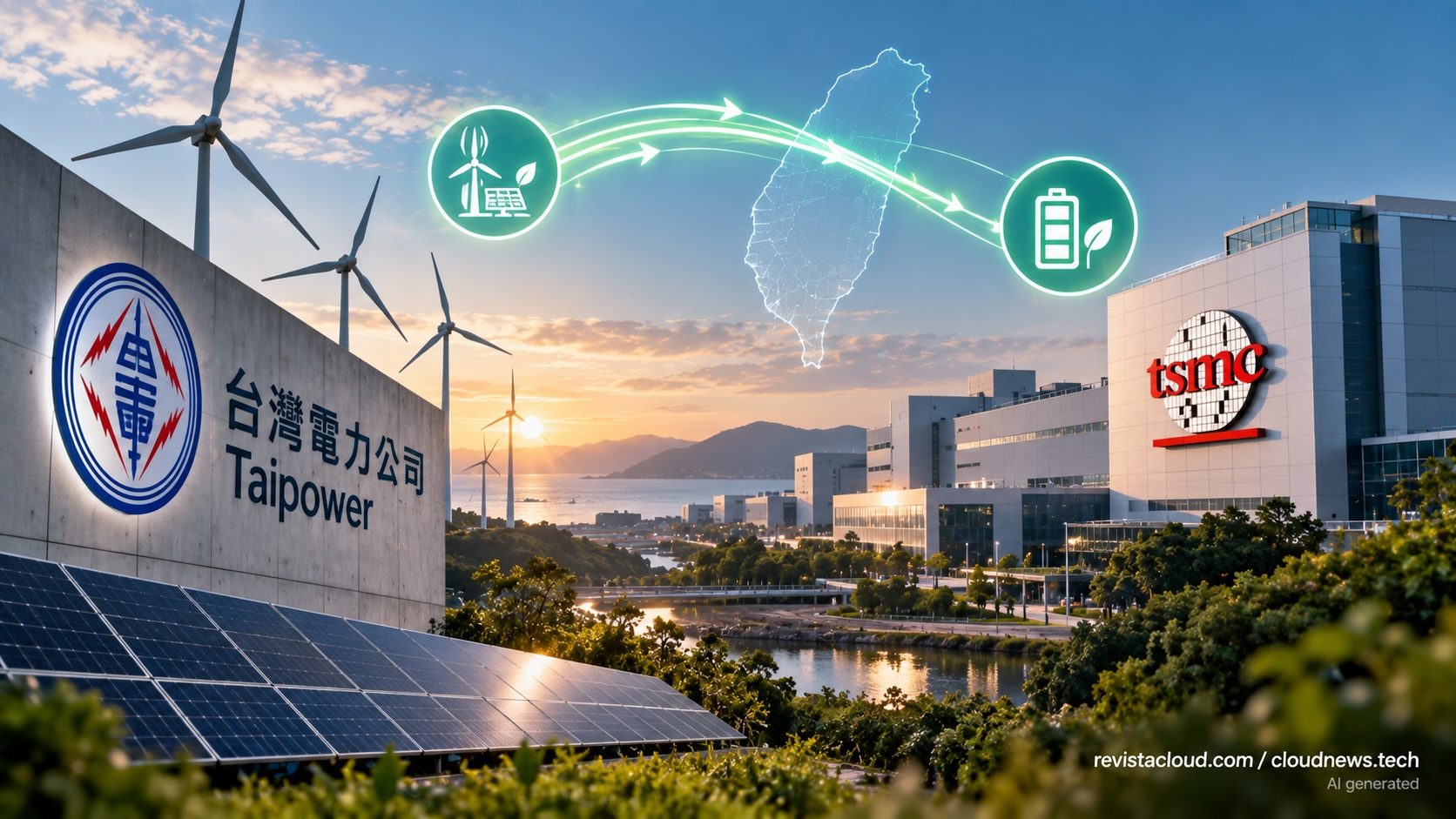
Taiwan Power Company (Taipower) is preparing a new version of its experimental renewable electricity allocation system for 10/01/2026 that could ease one of TSMC’s less visible problems: holding large green energy contracts while still being unable to use all of that electricity at the time and facility where it’s actually needed. The so-called sandbox 3.0 will combine 15-minute allocations with a second monthly settlement and, according to sources cited by DIGITIMES, could cut the renewable surplus currently affecting the chipmaker by around 80%.
The key points of the new green power sandbox in 30 seconds
- Taipower plans to launch sandbox 3.0 on 10/01/2026, with TSMC among the two participating companies.
- The system will let renewable electricity be redistributed across different factories every 15 minutes, followed by a monthly settlement.
- The goal is to reduce the contracted energy a company fails to match to its actual consumption.
- TSMC aims to reach 60% renewables by 2030 and 100% by 2040.
- The problem will become more visible once the 920 MW Greater Changhua 2b and 4 wind farm reaches full operation.
The situation can look paradoxical. TSMC is one of Taiwan’s largest private electricity consumers and has spent years signing renewable supply contracts to cut its emissions. Yet having a lot of contracted green power doesn’t necessarily mean being able to use all of it.
Wind and solar output changes constantly, while a chip fab’s consumption follows different patterns. If a wind farm generates more electricity than the associated facilities can consume within a given interval, a contractual surplus appears that can’t always be easily reassigned.
That problem could grow over the coming months. Ørsted has just completed the main construction work on its Greater Changhua 2b and 4 offshore wind farms, with a combined capacity of 920 MW from 66 Siemens Gamesa turbines rated at 14 MW each. The company expects to reach full commercial operation by the end of the third quarter of 2026.
The electricity generated by the project is tied to a corporate power purchase agreement signed with TSMC. DIGITIMES notes that the 920 MW will end up supplying green electricity to the chipmaker right as strong winds tied to the northeast monsoon could boost output during the fourth quarter.
The problem isn’t buying green electricity, it’s matching it
Taiwan uses a system in which renewable generation and consumption have to be matched in time for the electricity to be correctly attributed to the buyer.
Taipower explains that its electricity transfer system compares available renewable generation against the corresponding consumption every 15 minutes. This model better reflects when the energy is actually produced and when it’s consumed, but it also exposes the gaps between the two profiles.
A wind farm might produce a lot of electricity in the middle of the night, for instance, while certain industrial facilities need more energy during other time windows. Even a company as consumption-intensive as TSMC can find moments where its contracted output exceeds the electricity it can allocate to its factories.
The table below summarizes how Taipower’s mechanisms have evolved:
| System | How it works | Goal |
|---|---|---|
| Sandbox 1.0 | Allocation with monthly settlement | Reduce surpluses across a single company’s facilities |
| Sandbox 2.0 | Flexible allocation every 15 minutes | Match generation and consumption more precisely |
| Sandbox 3.0 | 15-minute allocation plus monthly settlement | Combine time precision with greater capacity to absorb surpluses |
The original sandbox let a company with multiple facilities redistribute its contracted renewable energy among its different consumption points. Taipower later developed a more precise system based on 15-minute intervals. The version set to begin testing in October aims to combine both approaches.
TSMC already took part in 2025 in the flexible distribution program promoted by the Ministry of Economic Affairs and Taipower. According to information published by the utility, the model allows grouping different consumption points of the same company and distributing electricity purchased from renewable generators and retailers among them within each 15-minute interval.
Why a surplus can end up costing TSMC money
The problem also has an economic dimension.
Large corporate power purchase agreements, known as Corporate Power Purchase Agreements (CPPAs), can include long-term purchase commitments. DIGITIMES notes that some of these contracts operate under conditions similar to take-or-pay terms: the buyer commits to paying for the agreed energy even if it can’t consume or allocate all of the output at any given time.
Taipower can buy back certain surpluses, but the price it pays doesn’t necessarily match the cost the company contracted for.
Taiwan’s Ministry of Economic Affairs set a price of NT$2.29 per kWh in 2026, within the new selection mechanism for future offshore wind projects, for buying back surplus green electricity, calculated based on Taipower’s average avoided cost.
The combination of long-term contracts, variable output, and strict timing rules gives reducing the surplus direct economic value for companies like TSMC.
Sandbox 3.0 is precisely an attempt to widen the allocation possibilities before that electricity ends up classified as surplus.
According to information obtained by DIGITIMES, the new mechanism could solve roughly 80% of TSMC’s surplus problem. That’s an estimate from sources familiar with the project rather than a proven result, since the trial won’t begin until October.
TSMC used 20.1% renewables in 2025
The experiment arrives as TSMC accelerates its climate targets.
The company has committed to getting 60% of the electricity used across its global operations from renewable sources by 2030 and reaching 100% by 2040. Its ultimate goal is net-zero emissions by 2050.
In 2024, renewables accounted for 14.1% of its global consumption, equivalent to 3,610 GWh.
2025 figures, compiled by DIGITIMES from the company’s latest sustainability report, push that share up to 20.1%.
TSMC’s renewable electricity use
| Indicator | 2024 | 2025 |
|---|---|---|
| Renewables as share of global consumption | 14.1% | 20.1% |
| Renewable electricity used | 3,610 GWh | 5,780 GWh |
| 2030 target | — | 60% |
| 2040 target | — | 100% |
At its Taiwanese facilities, TSMC used about 2,940 GWh of renewable electricity during 2025, equivalent to 11.4% of its electricity consumption on the island. The company reached total global renewable consumption of 5,780 GWh.
The reported mix for that year also shows wind’s growing weight.
| TSMC renewable source in 2025 | Consumption | Approximate share |
|---|---|---|
| Wind | 2,370 GWh | 41.0% |
| Solar | 1,930 GWh | 33.4% |
| Hydro | 1,430 GWh | 24.8% |
| Biomass | 50 GWh | 0.9% |
| Total | 5,780 GWh | ~100% |
The full commissioning of Greater Changhua 2b and 4 will push wind’s weight even higher.
920 MW of offshore wind make finding a solution more urgent
Ørsted marked the completion of the main construction work on Greater Changhua 2b and 4 on 09/01/2026.
The complex sits between 35 and 60 kilometers off the coast of Changhua County and uses 66 turbines rated at 14 MW, for a total capacity of 920 MW. With its addition, the combined capacity of Ørsted’s Greater Changhua projects reaches 1.82 GW.
The project is especially notable because it’s one of the first large offshore wind farms in Asia-Pacific built around a corporate power supply contract.
Its output, however, still can’t adapt to TSMC’s needs either.
When the wind blows, the turbines produce. The factory can vary its consumption, but it doesn’t have the same flexibility to adapt critical industrial loads to every weather swing.
The ability to contractually move that electricity between different plants is therefore becoming increasingly important.
The next problem is moving electricity between different moments in time
Sandbox 3.0 won’t solve every limitation either.
The main remaining challenge is reassigning energy across different time periods.
The system can improve distribution across facilities, but a quantity of energy generated overnight can’t automatically turn into renewable electricity consumed during the afternoon peak.
That gap brings another piece into the debate: energy storage.
A battery can physically store energy when there’s a generation surplus and release it back to the grid later. Taipower’s distribution mechanisms, by contrast, mainly work on how electricity is accounted for and allocated within the market’s rules.
Taiwan is also studying additional mechanisms. In May 2026, it emerged that the country plans to develop a green power spot market, potentially by late 2026 or early 2027, aimed at improving renewable allocation and reducing surpluses.
The need will keep growing. The Ministry of Economic Affairs estimates that Taiwan’s electricity demand will grow by an average of around 2.5% per year between 2026 and 2035, driven in part by the expansion of the semiconductor industry, data centers, and artificial intelligence.
TSMC’s case thus illustrates a second phase of big tech’s energy transition.
The first challenge was finding enough renewable electricity. The next one is making sure that electricity is available in the right place at the right time.
If sandbox 3.0 really manages to cut TSMC’s surpluses by close to 80%, Taipower will have found a regulatory fix for a significant part of the problem without needing to build new generation capacity.
But the harder question will remain: how to move renewable energy from the hours when there’s too much of it to the hours when it’s actually needed.
Frequently asked questions
What is Taipower’s sandbox 3.0?
It’s an experimental program for flexibly distributing renewable electricity that Taipower plans to launch on 10/01/2026. It will combine allocations between facilities every 15 minutes with a subsequent monthly settlement.
Why can TSMC end up with surplus renewable electricity?
Because wind or solar output doesn’t always line up with what its factories are consuming. If the energy generated under a contract exceeds the amount that can be allocated to the relevant facilities at a given moment, a surplus appears.
How much renewable energy does TSMC want to use?
The company’s target is to reach 60% renewable electricity across its global operations by 2030 and 100% by 2040.
How much capacity will the new wind farm supplying TSMC have?
Ørsted’s Greater Changhua 2b and 4 wind farms total 920 MW across 66 turbines rated at 14 MW each. Full commercial operation is expected by the end of the third quarter of 2026.
Sources:
- DIGITIMES, Exclusive: Taipower’s new green power sandbox could ease TSMC’s surplus electricity problem, 09/07/2026.
- Taiwan Power Company (Taipower), documentation on the green power market’s flexible distribution program.
