
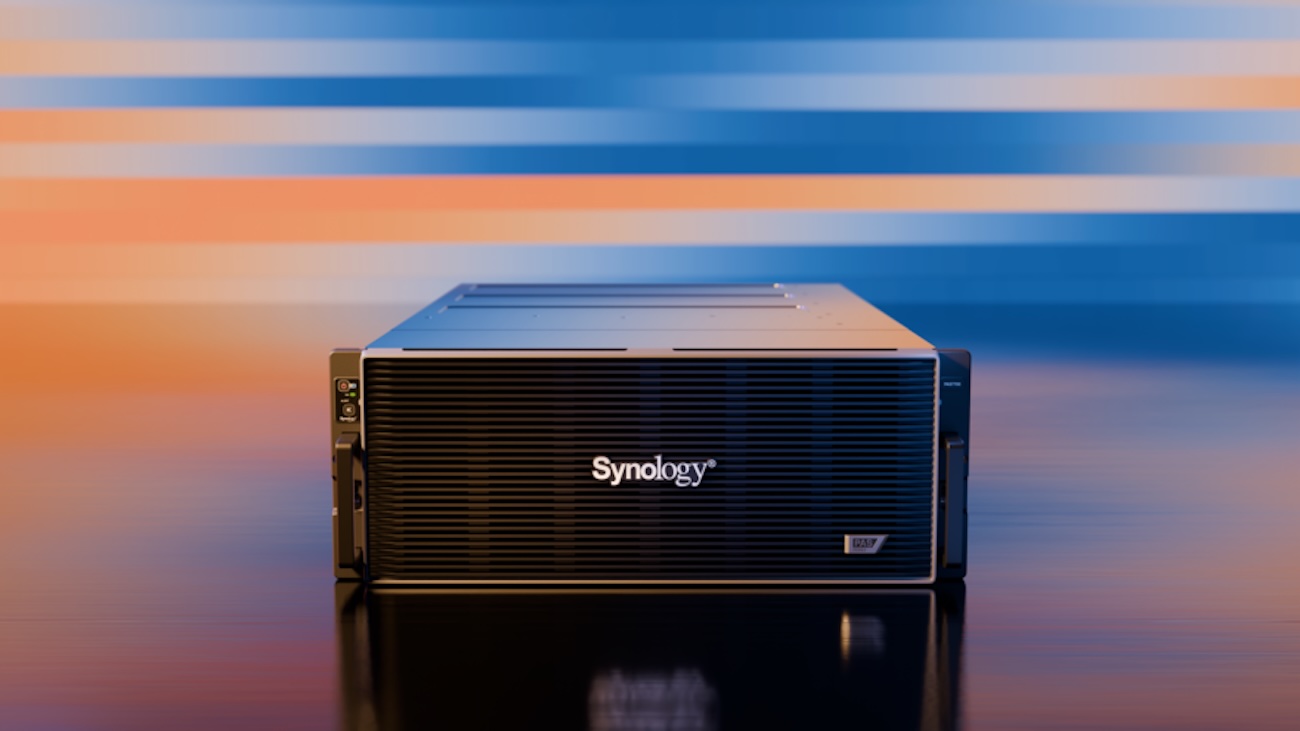
Synology has officially announced the PAS7700, its first all-flash NVMe storage system with active-active architecture. The launch marks a significant move for a company long known for its strength in NAS, backup, and data management solutions for SMBs, professionals, and IT departments. Now, Synology aims to make a stronger entry into the primary storage market for critical enterprise workloads.
The PAS7700 is not a typical high-end NAS. It is a 4U platform with dual controllers, 48 NVMe bays, and support for block and file protocols. Designed for environments where low latency, uptime, and scalability matter more than raw capacity, this system targets use cases such as databases, virtualization, VDI, enterprise applications, analytics, and services that cannot afford downtime.
Active-active and NVMe for critical workloads
The most notable feature of the PAS7700 is its active-active architecture. Instead of having one active controller and a standby, both controllers can serve data simultaneously. This design aims to distribute workload, reduce single points of failure, and ensure continuous operation during incidents, updates, or maintenance tasks.
According to Synology, the system incorporates 48 NVMe SSD bays in a 4U chassis and can scale up to 1.65 PB of raw capacity with up to seven expansion units. The platform supports NVMe-oF, iSCSI, Fibre Channel, SMB, and NFS, allowing both block and file workloads within a single enclosure.
Performance figures also clearly target the enterprise segment: up to 2 million IOPS, sub-millisecond latency, and throughput of up to 30 GB/s, with 100GbE connectivity and up to 2,048 GB of total system memory. Synology notes in their documentation that these results are from internal testing; actual performance will depend on configuration, disks, workload type, and network environment.
| Feature | Synology PAS7700 |
|---|---|
| Form factor | 4U |
| Architecture | Dual active-active controllers |
| Primary bays | 48 NVMe SSDs |
| Max raw capacity | Up to 1.65 PB with expansions |
| Expansion units | Up to 7 |
| Max memory | 2,048 GB total |
| Network | 100GbE |
| Declared performance | Up to 2 million IOPS |
| Declared throughput | Up to 30 GB/s |
| Protocols | NVMe-oF, iSCSI, Fibre Channel, SMB, NFS |
Multiprotocol support is essential. Many organizations prefer a single system that handles multiple workloads—need block for databases or virtualization, NFS for Linux environments, SMB for corporate file shares, and NVMe-oF for low latency. The PAS7700 aims to cover this spectrum without requiring separate silos.
Resilience, immutable snapshots, and data protection
Synology designed the PAS7700 with a clear focus: speed alone isn’t sufficient. In enterprise storage, availability and data integrity are just as important as IOPS. That’s why the platform includes multiple layers of protection: triple-parity RAID, synchronized write protection in memory, IP failover, and protocol-level failover.
The company also incorporates familiar features from its ecosystem, such as self-encrypting drives (SED), WORM (Write Once Read Many), immutable snapshots, Snapshot Replication, and Hyper Backup. As ransomware, human error, and rapid recovery times become critical concerns, these capabilities are now essential requirements for many organizations.
An interesting aspect is that Synology is attempting to bring its well-known ease of management and integrated data protection into the enterprise realm. Many customers associate the brand with NAS and backup solutions. The challenge will be demonstrating that this philosophy can support mission-critical primary workloads with the level of support, validation, compatibility, and trust expected by large infrastructure departments.
| Business Need | Key Features of the PAS7700 |
|---|---|
| High availability | Active-active architecture, IP failover, protocol failover |
| Failure protection | Triple-parity RAID and memory write protection |
| Ransomware defense | Immutable snapshots and WORM |
| Recovery capabilities | Snapshot Replication and Hyper Backup |
| Data security | Support for Self-Encrypting Drives |
| Efficiency | Advanced deduplication and future Synology Tiering |
Deduplication is also part of the proposition. In environments with virtual machines, virtual desktops, similar databases, or large repetitive repositories, reducing duplicated data can lower costs. Synology also previews future support for Synology Tiering, a feature designed to move cold data to more economical storage based on configurable policies, reserving NVMe for active workloads.
Synology steps into a more demanding arena
The PAS7700 enters a segment dominated by long-established players like Dell, NetApp, HPE, Pure Storage, IBM, and Hitachi Vantara. Synology isn’t starting from zero, but it’s engaging in a different conversation. In this market, technical specs aren’t enough. Support around the clock, hypervisor certifications, integration with enterprise environments, spare parts availability, customer references, firmware reliability, and channel trust are crucial.
The company aims to distinguish itself through a mix of performance, operational simplicity, and total cost of ownership. Bie-i Chu, EVP of Synology’s NAS group, stated that the PAS7700 reflects 25 years of experience in storage and collaboration with enterprise clients to meet high availability, performance, and scalability requirements.
Market trends also help explain this launch. Companies generate more data, deploy more virtualization, accelerate AI initiatives, and strengthen their disaster recovery plans. Meanwhile, many seek more cost-effective alternatives to traditional enterprise platforms. Synology may find opportunities among those needing higher performance and availability than a standard NAS, but without the complexity or cost of the most established storage arrays.
Support for NVMe-oF is especially relevant. As workloads demand lower latency, NVMe-based storage isn’t just an internal disk upgrade; it’s extending into the network layer. For databases, intensive virtualization, or latency-sensitive applications, this distinction can be significant.
A maturity test for the Synology ecosystem
The PAS7700 launch also serves as a maturity test for Synology. The brand has a broad community, recognizable interface, and a solid product lineup in NAS, backup, collaboration, surveillance, and data management. But competing in enterprise primary storage requires another level of rigor.
Customers won’t just compare the price per terabyte or maximum IOPS. They’ll look at support response times, compatibility with VMware, Hyper-V, Kubernetes, or backup platforms, failure behavior, non-disruptive updates, integration with Fibre Channel and Ethernet networks, monitoring, security, SSD lifespan, and warranties.
The PAS7700 could represent an opportunity for Synology if it maintains its core strengths—simplicity and seamless feature integration—without falling short on the demanding requirements of large enterprises. Its value proposition will appeal to organizations seeking NVMe performance, high availability, and built-in protection without layered software complexity.
The storage market is becoming polarized. Cloud is absorbing many secondary workloads and cold data, while organizations retain on-prem or private cloud environments for workloads that need low latency, control, security, predictable costs, or data sovereignty. In this space, an active-active NVMe platform with block and file protocols makes sense.
Synology isn’t just introducing another NAS. It’s making a statement: it aims to compete higher up the value chain in enterprise storage. The PAS7700 will need to prove in real-world use that its metrics translate into actual reliability, but the message is clear: the company wants to move from a backup/departamental storage option to a critical data center player.
Frequently Asked Questions
What is the Synology PAS7700?
An enterprise all-flash NVMe storage system with dual active-active controllers, 48 NVMe bays in a 4U chassis, supporting block and file protocols.
What performance does the PAS7700 deliver?
Synology states up to 2 million IOPS, sub-millisecond latency, and up to 30 GB/s throughput, based on internal testing.
Which protocols does it support?
NVMe-oF, iSCSI, Fibre Channel, SMB, and NFS, allowing diverse workloads.
Who is it designed for?
Organizations with critical workloads needing high availability, low latency, NVMe storage, data protection, and scalability in data centers.
via: synology
