
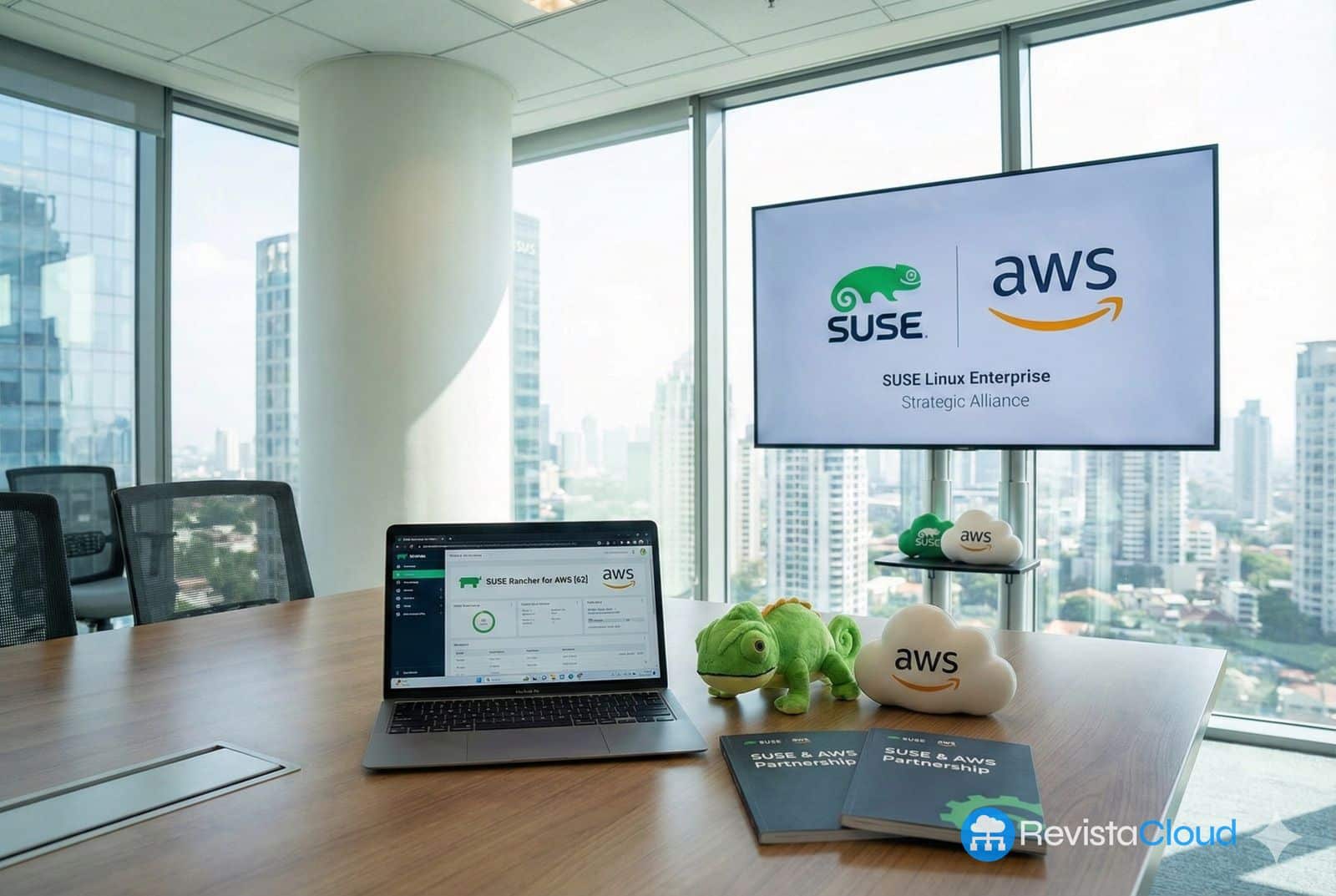
SUITE took advantage of the AWS re:Invent 2025 showcase in Las Vegas to announce SUSE Rancher for AWS, a new SaaS version of its well-known container management platform, specifically designed for Amazon Elastic Kubernetes Service (Amazon EKS) environments, now available on AWS Marketplace.
This announcement comes at a time when many companies are trying to implement their AI strategies without getting overwhelmed by Kubernetes complexity, infrastructure costs, or tool fragmentation.
An “AI-ready” platform on Amazon EKS
SUITE defines Rancher for AWS as a cloud-native container management platform ready for AI, built resilient by design and optimized to leverage native AWS services, including Amazon Q and Amazon Bedrock.
In practice, this means development teams can:
- Run and scale cloud-native workloads on Amazon EKS.
- Unify management, security, and observability from a single dashboard.
- Leverage integrated AI assistants to operate complex clusters more smoothly.
Peter Smails, SVP and General Manager of Cloud Native at SUITE, summarizes the approach clearly: it’s not just about operational efficiency, but about “maximizing the value of AWS services” and transforming AI infrastructure management into a strategic advantage for the business.
Built-in AI Assistant: fewer tickets, less technical debt
One of SUITE Rancher for AWS’s differentiators is its Integrated AI Assistant, powered by Amazon Q and Amazon Bedrock.
From the Rancher Manager console itself, teams can:
- Receive real-time insights on cluster and workload status.
- Follow guided workflows for routine operational tasks.
- Apply contextual remediation for incidents, with AI-generated recommendations.
SUITE promises that this approach helps to:
- Detect issues before they impact production.
- Reduce Kubernetes skills gaps across teams.
- Lower technical debt by standardizing best security and operational practices.
This strategy aligns with the company’s broader vision, which in recent months has incorporated AI capabilities into products like SUSE Linux Enterprise Server 16 (with MCP components), SUSE AI Universal Proxy, and the new AI agent in Rancher Prime.
Unified governance for all EKS clusters
Another key strength of Rancher for AWS is its centralized control. The platform enables management of all Amazon EKS clusters within an organization—regardless of region or account—from a single governance dashboard.
From this global view, IT teams can:
- Define and enforce security and compliance policies consistently.
- Manage identities and access (IAM) from a centralized point.
- Standardize cluster lifecycle management (creation, updates, decommissioning).
In organizations with dozens or hundreds of clusters across multiple AWS accounts, this governance layer is essential to maintain consistent security status and prevent configurations that are difficult to audit.
Observability and cost optimization as key aspects
The other major component of the solution is TCO (total cost of ownership). SUITE Rancher for AWS relies on SUITE Observability and spot instance optimization mechanisms to help keep costs under control.
With these capabilities, organizations can:
- Gain detailed understanding of which workloads are resource-intensive.
- Adjust cluster and node sizing based on actual demand.
- Combine on-demand and spot nodes to reduce costs without sacrificing reliability.
In environments where AI workloads are particularly compute- and memory-intensive, these observability and optimization tools are critical to avoid costly surprises at month’s end.
AWS’s triple competency and cloud-native focus
SUITE enters this launch with the backing of achieving the Triple AWS Competency, indicating formal recognition from Amazon of its technical expertise, proven success cases, and security standards in specific areas.
With Rancher for AWS, the company offers a comprehensive proposition that encompasses:
- Secure deployment of Amazon EKS clusters.
- Automated scaling of cloud-native workloads.
- Layers of security, observability, and centralized governance.
For organizations already committed to AWS as their main platform, the release of a SaaS version of Rancher tailored specifically for this environment provides a straightforward way to adopt Kubernetes without sacrificing enterprise controls or advanced AI capabilities.
Implications for companies aiming for production AI
In summary, SUSE Rancher for AWS positions itself as an appealing option for companies that:
- Are consolidating their Kubernetes clusters on Amazon EKS.
- Want to industrialize their AI and MLOps projects without increasing complexity.
- Need to demonstrate governance, compliance, and cost control to leadership, auditors, or regulators.
Rather than adding more tools to the puzzle, SUITE’s approach is to provide a platform that consolidates management, security, observability, and AI assistance on the AWS infrastructure many companies already use.
It remains to be seen how many organizations will leverage this approach to move from AI pilots to critical production environments, where Kubernetes, cloud costs, and operational risks are scrutinized closely.
Frequently Asked Questions about SUSE Rancher for AWS
What exactly is SUSE Rancher for AWS?
It is a SaaS, Amazon EKS-specific version of the SUITE Rancher container management platform. It is installed and consumed via AWS Marketplace and offers unified management, security, observability, and cost optimization for EKS clusters.
How does it differ from using Amazon EKS alone?
Amazon EKS provides the managed Kubernetes service, while SUITE Rancher for AWS adds centralized multi-account and multi-region governance, an integrated AI assistant, unified security policies, and observability and cost tools—all from a single dashboard.
Why is it considered an “AI-ready” platform?
Because it integrates AI capabilities from AWS such as Amazon Q and Amazon Bedrock to assist in daily operations, and is designed to support demanding AI workloads (training and inference) with a focus on scalability, security, and resource efficiency.
What advantages does it offer DevOps teams and platforms?
It reduces tool fragmentation, simplifies the operation of multiple EKS clusters, helps detect and resolve incidents faster with the AI assistant, and provides detailed visibility into costs and resource consumption—key factors in managing AI project budgets.