
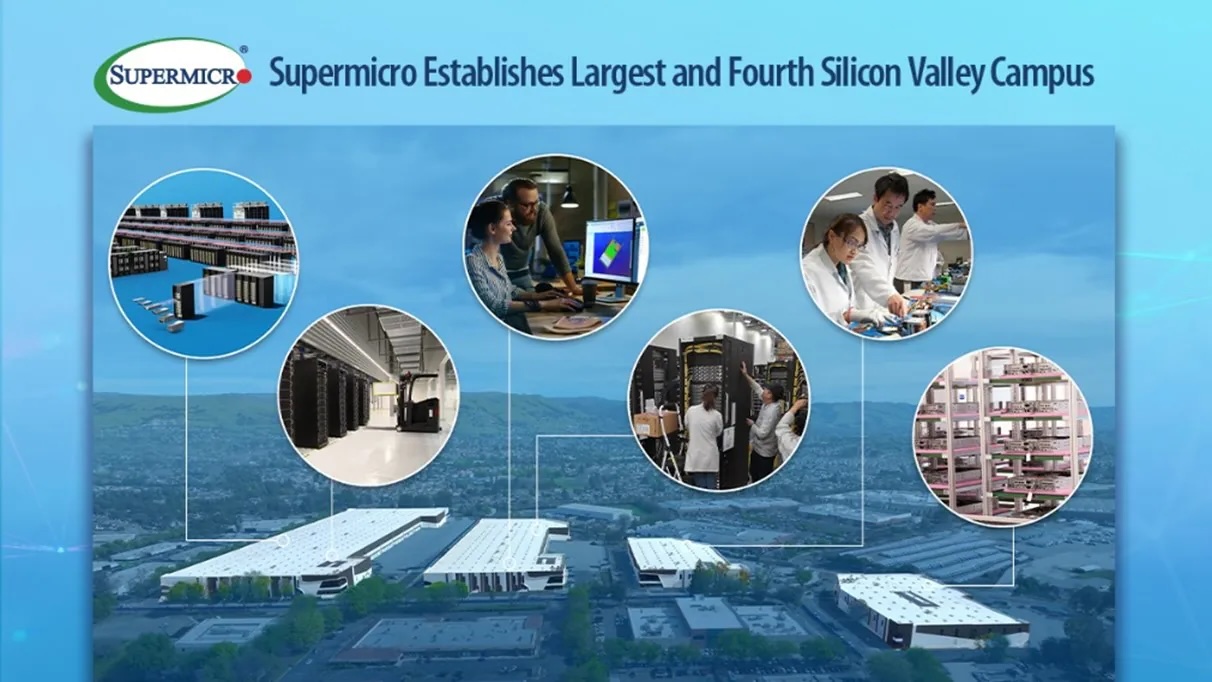
Supermicro has announced the opening of its largest campus in the United States, a new facility in San Jose, California, aimed at expanding domestic infrastructure production for artificial intelligence data centers. The complex, located near its headquarters, spans approximately 32.8 acres and totals over 714,000 square feet, making this expansion the company’s fourth location in the San Francisco Bay Area.
The announcement comes amidst a rush to deploy AI compute capacity. Cloud providers, hyperscalers, service providers, model labs, and large corporations need servers, racks, networking, cooling, integration, and support at a pace that is difficult to sustain with fragmented supply chains. Supermicro aims to strengthen its position precisely here: by manufacturing and assembling complete systems near its design, testing, and operations centers.
A Campus to Accelerate AI Data Centers
The new campus is part of the DCBBS strategy, which stands for Data Center Building Block Solutions—Supermicro’s modular approach to packaging servers, GPUs, networking, racks, management software, professional services, and related infrastructure for data centers. The company claims this approach allows for faster deployment of AI systems, improved energy efficiency, and a reduced total cost of ownership for next-generation facilities.
The expansion will increase Supermicro’s regional presence in Silicon Valley to nearly 4 million square feet. The facilities will encompass advanced system design, domestic manufacturing, testing, service, and global distribution of DCBBS solutions for AI infrastructure. It is also expected to create hundreds of jobs in engineering, manufacturing, and corporate functions.
Charles Liang, President and CEO of Supermicro, has emphasized this direction. The company presents this investment as a commitment to American manufacturing and the ability to deliver AI infrastructure at scale from San Jose. In a market where deployment times have become critical, proximity between design, integration, testing, and manufacturing offers a tangible advantage.
AI centers don’t just require standalone servers; they need rack-level integration, component validation, thermal management, cabling, high-speed networks, liquid cooling, and operational support. A single error in this chain delays the rollout of capacity that many companies already have committed to for training models, inference, or launching agent-based services.
Localized Manufacturing in a Tense Market
This announcement aligns with a broader trend: some of the technology manufacturing is returning to the U.S., or at least strengthening local capabilities. The production of AI infrastructure relies on GPUs, CPUs, memory, storage, power supplies, boards, racks, and cooling systems that are part of a global supply chain vulnerable to bottlenecks, trade restrictions, and geopolitical pressures.
Supermicro doesn’t produce the most advanced chips, but it holds a prominent position in the layer that transforms these components into ready-to-deploy data center systems. In AI, this layer is increasingly important. It’s not enough to have accelerators available; they must be integrated into servers, racks, and complete solutions capable of stable, efficient, and maintainable operation.
The new campus can help the company respond more quickly to enterprise, cloud, and hyperscale customers building what the industry is starting to call “AI factories.” These facilities house massive compute resources for training, tuning, and serving models, requiring solutions designed for high density, advanced cooling, and rapid deployment.
San Jose Mayor Matt Mahan linked this expansion to the city’s role in the global AI economy, highlighting the increased manufacturing, testing, distribution capacity, and the creation of skilled jobs. It’s an economic argument but also a political one: Silicon Valley aims to retain a tangible part of the new technological infrastructure—not just software and venture capital.
The Value of Rack-Level Integration
Supermicro’s strategy relies on a simple idea: the more complex the data center, the greater its value to deliver validated blocks. In an AI deployment, a rack is not just a metal frame with servers. It includes accelerators, CPUs, storage, networking, power supplies, management, cooling, and a thermal design that must operate under demanding loads.
This level of integration can shorten the time to operational status—what Supermicro calls Time-to-Online. In a market where customers want to deploy capacity quickly, reducing weeks or months from deployment can have significant economic impacts. It also minimizes configuration errors, improves efficiency, and simplifies support.
The focus on DCBBS aligns with the evolution of data centers toward more industrialized systems. For years, many organizations purchased servers, networking, and storage separately and integrated them with their own teams or vendors. In AI, the high power density, liquid cooling, and component shortages make ready-made, tested, and closed systems increasingly attractive.
This trend benefits manufacturers that can combine system engineering, logistics, manufacturing, testing, and servicing. It also increases competition: Dell, HPE, Lenovo, Cisco, Asian ODM suppliers, and new AI-focused integrators are all vying for this space. Supermicro has a known advantage: a broad portfolio of optimized systems for specific workloads and a culture of rapid modular design. However, maintaining quality, availability, and support in a more demanding market will be essential.
A Strategic Perspective on Expansion
The campus opening is not merely real estate news; it’s a sign of where AI infrastructure is headed. Compute capacity is increasingly measured by how quickly chips are transformed into complete, efficient systems. In this race, manufacturing, integration, and testing are gaining renewed focus.
For customers, increased Supermicro capacity in the U.S. can mean more supply options, less dependence on international flows, and faster support for local projects. For the U.S. industry, it strengthens an important part of the AI tech supply chain—high-performance server and rack manufacturing.
Supermicro also aims to strengthen its position after several years of rapid growth driven by demand for accelerated servers. While this demand benefits the company, it also brings operational pressures: more orders, stricter delivery timelines, capital needs, financial scrutiny, and increased competition. Expanding capacity in Silicon Valley is a way to prepare for sustained growth.
It remains to be seen how this expansion will translate into actual production, delivery timelines, and market share. A 714,000-square-foot campus alone doesn’t resolve GPU, HBM memory, or advanced networking bottlenecks, but it does improve the ability to turn critical components into ready-to-deploy infrastructure.
Supermicro is betting that future AI advancements will also hinge on physical infrastructure—factories, assembly lines, rack validation, cooling, and distribution. In an industry accustomed to focusing on chips and models, this layer might seem less glamorous. Yet, without it, AI can’t reach the data center.
Frequently Asked Questions
Where is Supermicro’s new campus?
It’s in San Jose, California, near the company’s headquarters, and will be its fourth location in the San Francisco Bay Area.
What size is the new facility?
The campus covers approximately 32.8 acres and over 714,000 square feet. With this expansion, Supermicro’s regional footprint in Silicon Valley will approach 4 million square feet.
What is the purpose of the new campus?
It will support advanced system design, domestic manufacturing, testing, service, and global distribution of DCBBS solutions for AI data centers.
What is DCBBS?
Data Center Building Block Solutions—Supermicro’s modular approach to delivering complete AI infrastructure, from components and servers to racks, networking, management software, and services.
via: supermicro
