
Retail has been chasing a promise for years: understanding what happens in-store with the same precision that a website measures every click. By 2026, this ambition is no longer marketed as futurism but as infrastructure. Super Micro Computer (Supermicro) has announced a collaboration with a wide range of technology partners to deploy “production-ready” AI solutions in brick-and-mortar stores, with use cases spanning from loss prevention and digital twins to AI agents and customer analytics. The announcement was made at NRF: Retail’s Big Show in New York, from January 11 to 13.
The core message is clear: if a store wants to react in “subseconds,” intelligence can’t live only in the cloud. It must execute close to where things happen: cameras, checkout counters, aisles, warehouses, and sensors. Supermicro presents this approach as a way to turn video and operational data into quick (and actionable) decisions without depending on variable latencies or sending all the data to a data center.
From theory to store: why “edge AI” has become essential
Applied AI in retail often falls into a common mistake: trying to solve everything with post-analysis. But the real issues in a store don’t wait for Monday reports. Theft happens now. Stockouts are detected too late if no one sees it in time. And a self-service incident can turn into queues within minutes.
That’s why Supermicro’s approach centers on processing data at the edge: running inferences near cameras and daily operations to act instantly. The company claims many “retail-centric” applications require responses within less than a second, which only scales if computing happens directly at the edge.
This shift coincides with a particularly receptive market climate. According to a study published by NVIDIA in early January, 89% of respondents in retail and fast-moving consumer goods say AI is helping increase annual revenue, and 95% say it contributes to reducing costs.
Infrastructure: from “fanless” to discrete GPUs for demanding workloads
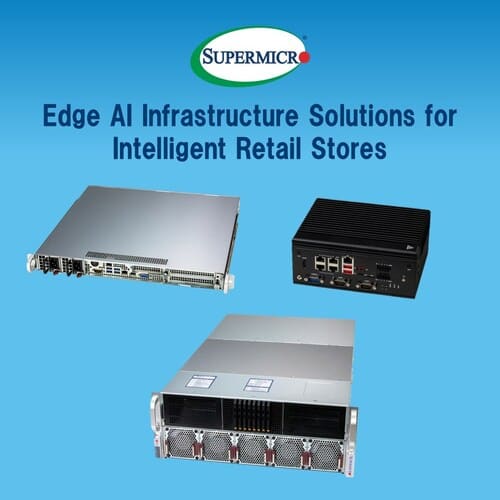
Supermicro doesn’t just talk; it grounds its messaging in specific product lines. For “tough” scenarios (without climate-controlled rooms), it cites its fanless E103 series, designed to bring processing power where it was previously unfeasible. For compact formats with ventilation, it points to the E300 series. And when workloads are heavy—such as computer vision on multiple cameras or advanced analytics—it highlights systems capable of housing discrete GPUs, from 1U “short-depth” to 4U chassis.
In the latter category, NVIDIA pairing appears: Supermicro’s solutions are tied to accelerated platforms with RTX PRO and the new RTX PRO Blackwell generation to tailor solutions to each case.
Most impactful use cases: losses, digital twins, and operational agents
The list of partners in the announcement clearly shows where the sector is headed: fewer showy presentations and more tools that directly impact the bottom line.
- Loss prevention and checkout efficiency (Everseen / Evercheck): computer vision to detect undesirable behaviors at checkout and reduce shrinkage, focusing on the point where many incidents happen: the payment.
- Video agents for physical spaces (WobotAI): transforming existing CCTV into systems that observe and generate continuous insights on operational frictions, patterns, and decisions.
- In-store service agents (LiveX AI): deploying “agents” as an interaction layer, placed in kiosks or physical experiences, to bring the immediacy of digital channels to the point of sale.
- Digital twins (Kinetic Vision + ALLSIDES): simulation and optimization of complex processes—from supply chain to checkout stations—with a high-fidelity 3D layer for training and validation.
- Search and incident summarization over camera networks (Superb AI, VSS): subjective reasoning, natural language search, and incident summaries for video surveillance.
- Autonomous KPI analytics (Aible): agents that explain changes in metrics (like average ticket size or number of transactions) and suggest actions, with business review.
Behind each application lies a common thesis: retail is moving toward a model where AI is not just a “project” but a permanent layer of operation, similar to what ERP or POS systems once were.
The uncomfortable part: when “smart stores” look too much like “watched stores”
This brings up a debate many press releases flirt with but don’t fully address: a large part of the promised value relies on video and continuous telemetry. This raises inevitable questions about privacy, data governance, biases, and limits of use: What exactly is analyzed? How long is data retained? Who has access? How are customers and employees informed?
The promise of edge computing can help alleviate some of these concerns: local processing reduces the need to send raw data elsewhere. But it doesn’t eliminate the dilemma: a store optimized for queues and loss reduction with AI could also become a space where everything is measured, labeled, and scored.
The challenge for the sector is not only technical but cultural: defining what practices are reasonable to improve experience without crossing red lines that erode trust.
NRF demonstrations and the real message behind the announcement
Supermicro and its partners will showcase these solutions at NRF: Retail’s Big Show in New York (January 11–13), with demos and an exhibit at booth #5281.
Apart from the specific names, the overall takeaway is that retail is entering a phase of “industrialization” of AI. Fewer isolated pilots, more repeatable deployments. Less generic cloud reliance, more edge solutions sized for each store, camera, and flow of operations.
Frequently Asked Questions
What is “Edge AI” in retail, and why is it used in brick-and-mortar stores?
It’s the use of AI run near where data is generated (cameras, cash registers, sensors) to deliver responses in real time with low latency. It’s used because many decisions (fraud detection, queues, stockouts) can’t wait for post-analysis.
Does in-store AI only prevent theft?
No. Loss prevention is a common case, but AI also supports visitor analytics, staff optimization, incident detection at checkout, stock replenishment, failure prediction, and process improvements with digital twins.
What is a digital twin applied to retail?
It’s a virtual (sometimes 3D) representation of store processes, spaces, or supply chain flows. It allows simulation of changes (layout, checkout, logistics) and measurement of impact before implementation.
How does in-store AI affect customer and employee privacy?
It depends on what data is captured, how it’s processed, and how long it’s retained. Edge processing can reduce data transfer needs, but establishing clear policies, transparency, and controls is essential to prevent invasive or disproportionate use.