
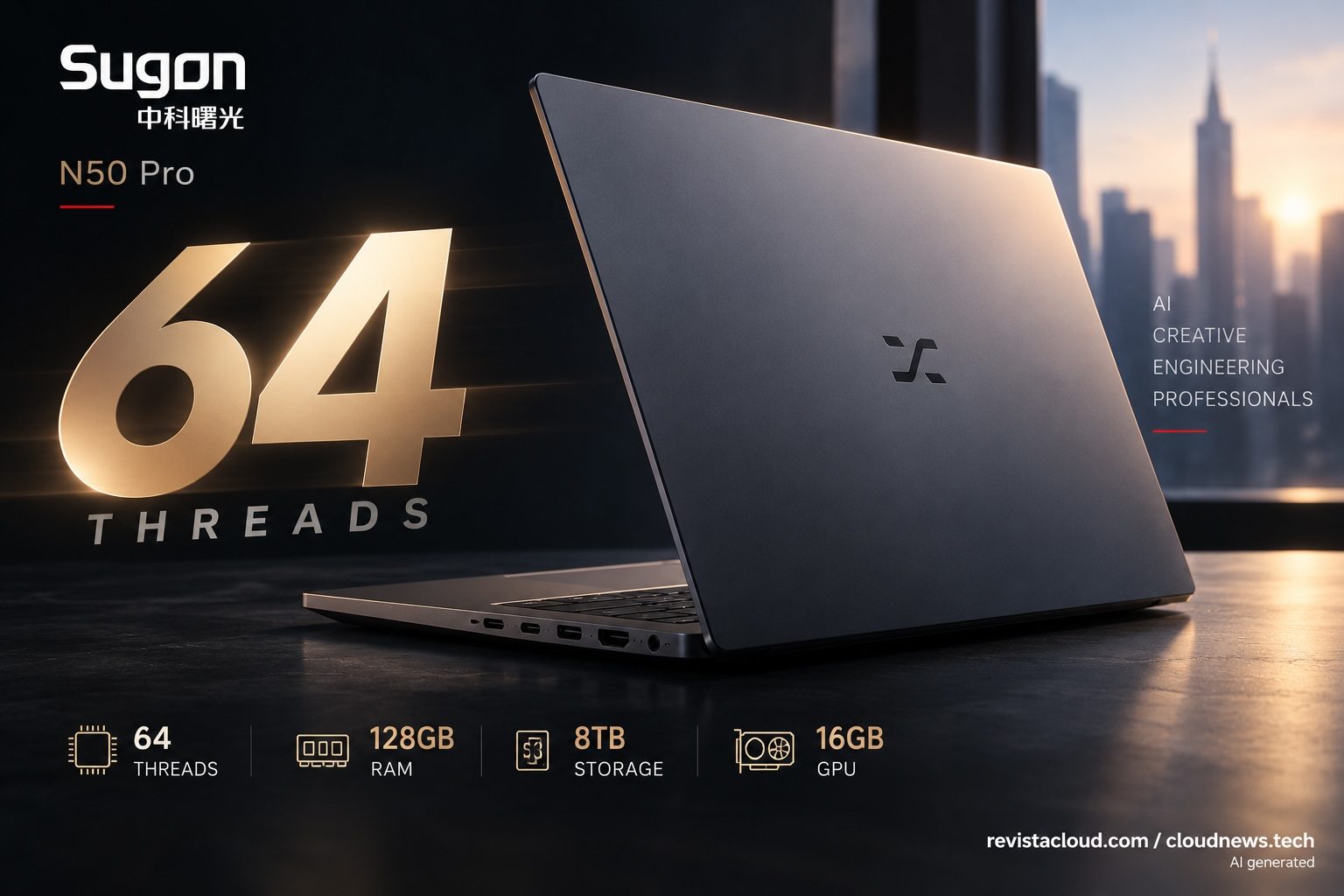
Chinese company Sugon has unveiled the N50 Pro, a mobile workstation it bills as the world’s first with a processor capable of running 64 threads. The machine pairs that still-unidentified CPU with a dedicated GPU carrying 16 GB of memory, up to 128 GB of RAM, and 8 TB of storage, all inside a chassis just 16.9 mm thick and weighing 1.69 kg. The manufacturer is targeting engineering, content creation, and artificial intelligence professionals directly.
The Sugon N50 Pro in 20 seconds
- Sugon presents the N50 Pro as the first mobile workstation with a 64-thread CPU.
- The exact processor and GPU models have not been made public.
- It supports up to 128 GB of RAM, 8 TB of storage, and a GPU with 16 GB of memory.
- Sugon claims up to 50 tokens/s running a 35B-parameter MoE model locally.
- There is still no price or firm release date.
The 64-thread figure is especially striking next to current Western mobile processors. Intel’s Core Ultra 9 290HX Plus, launched in 2026, packs 24 cores, while its predecessor, the Core Ultra 9 285HX, has 24 cores and 24 threads. Intel dropped Hyper-Threading from this family, so each core runs a single thread.
But thread count alone doesn’t tell you whether the N50 Pro is actually faster. Architecture, sustained clock speed, power draw, cooling, memory, and per-core performance all weigh heavily on the final result — and those are precisely the details Sugon is keeping under wraps.
The 64-thread processor remains the big unknown
Sugon confirms a peak clock speed of 4.30 GHz on single-thread loads, but has not publicly identified the processor it uses.
Reports around the launch point toward Hygon, a Chinese company technologically linked to Sugon, but pinning a specific model on the laptop remains speculative. One possibility mentioned is the Hygon C86 family, including the C86-5G chips, which incorporate technologies aimed at boosting parallelism. Without confirmation from the manufacturer, it’s also impossible to say how many physical cores sit behind those 64 threads.
That distinction matters. A 32-core processor with two threads per core and a 16-core processor with four threads per core can both advertise 64 threads, yet behave very differently depending on the workload.
Sugon does offer its own benchmark to illustrate performance. According to the company, a fluid dynamics simulation that would normally take about 2.4 hours can be completed in roughly one hour on the N50 Pro. That’s a promotional comparison from the manufacturer, and details about the reference hardware used are missing, so it can’t be treated as an independent benchmark.
The same caution applies to the “world’s first 64-thread mobile workstation” label. That’s the description Sugon uses for the product and the one picked up in coverage of its launch, but there still isn’t enough independent technical information to verify every condition behind that claim.
A 16 GB GPU for running AI models locally
The CPU is only part of the pitch. The N50 Pro packs a dedicated GPU with 16 GB of video memory, though Sugon hasn’t disclosed which graphics processor it uses either.
The manufacturer cites a base clock of 3.3 GHz and uses the local execution of a 35-billion-parameter Mixture of Experts (MoE) model as its example, claiming performance above 50 tokens per second.
Again, there isn’t enough information to compare that figure against NVIDIA, AMD, or Intel GPUs: Sugon hasn’t publicly specified quantization, precision, software used, the effective size of the loaded model, or the test configuration. So the 50 tokens/s figure should be read as a number Sugon reported, not an independently measured one.
Even so, the choice of 16 GB of VRAM makes the product’s direction fairly clear. The N50 Pro wants to work as a workstation capable of running certain AI workloads locally, on top of rendering, engineering, and audiovisual creation.
Sugon backs that up with up to 128 GB of expandable RAM and storage upgradable to 8 TB. The company hasn’t detailed the exact memory type used yet. The fact that it’s expandable suggests replaceable memory, but that alone doesn’t confirm SO-DIMM modules.
The display also targets the professional segment: a 4K panel at 120 Hz, a 93% screen-to-body ratio, and color accuracy advertised as Delta E below 1.
Connectivity includes two USB-C ports, three USB-A ports, HDMI, a 3.5 mm audio jack, and a dedicated power connector. Sugon also promotes support for working across multiple 4K displays.
China is looking to compete in mobile workstations too
Beyond its specs, the N50 Pro is interesting because of where its components come from.
China has spent years trying to reduce its dependence on foreign processors and accelerators, especially in high-performance and AI systems. A mobile workstation built around domestic components fits that push, though Sugon still needs to clarify exactly which CPU and GPU it’s using.
The form factor is also a surprise. High-performance mobile workstations usually sacrifice thinness and weight to fit cooling systems capable of keeping the CPU and GPU running under sustained load.
Sugon claims 16.9 mm of thickness and 1.69 kg of weight. Those numbers are typical of many mainstream premium laptops and raise a question the published specs still can’t answer: what power draw the 64-thread processor can sustain under a prolonged load.
That figure will matter a great deal when evaluating the machine. Having 64 threads available doesn’t guarantee all of them can run at high clock speeds sustainably inside such a thin chassis.
It’s also worth putting the Intel comparison in perspective. The Core Ultra 9 285HX has a 55 W base power draw and can reach 160 W in turbo mode, with 24 cores and 24 threads. Intel also allows up to 256 GB of DDR5-6400 on that processor.
The N50 Pro therefore offers a far higher thread count, but essential data is still missing to know what that advantage actually means under real workloads.
For now, price, an exact launch date, and commercial configurations remain unknown. Available reports place the product initially in the Chinese market.
Those unknowns are precisely what keep an eye-catching spec sheet from becoming a victory over AMD or Intel. Sugon has grabbed attention with 64 threads, 128 GB of RAM, 8 TB of storage, and a 16 GB GPU packed into a 1.69 kg laptop. What’s left to find out is what silicon is actually inside — and, above all, how those 64 threads behave when they’re all working at once.
Frequently asked questions
What processor does the Sugon N50 Pro use?
Sugon hasn’t revealed the exact model yet. Available reports point to a Chinese processor related to Hygon, but it’s unconfirmed which family it belongs to or how many physical cores it packs.
How much memory does the Sugon N50 Pro have?
The workstation supports up to 128 GB of RAM and 8 TB of storage. Its dedicated GPU also carries 16 GB of video memory.
Can it run artificial intelligence models locally?
Yes, that’s one of the applications Sugon promotes. The company claims to have surpassed 50 tokens per second with a 35B-parameter MoE model, though the test still lacks independent verification.
How much does the Sugon N50 Pro cost?
Sugon hasn’t announced a price or a firm availability date yet. The launch is initially planned for the Chinese market.
