
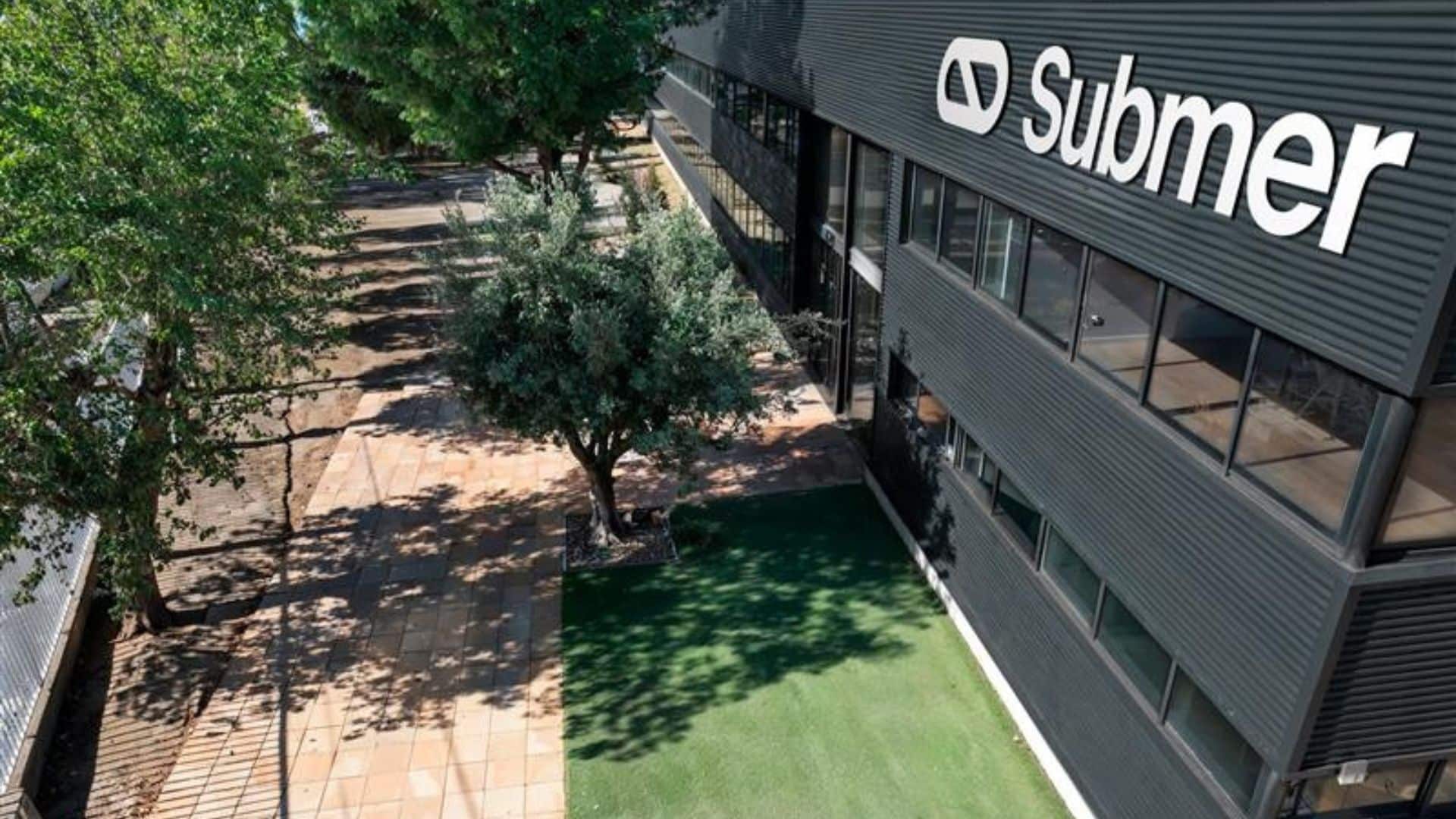
Submer Group has chosen the historic Ercros chemical plant in Flix, located in the Tarragona region of Ribera d’Ebre, to establish a data center specialized in artificial intelligence. The announced investment exceeds €1 billion, transforming the repurposing of a closed industrial site into one of Spain’s largest digital infrastructure projects.
The campus will be developed and operated by Rubix Data Centers, a company within Submer Group. The project will be executed in two phases, with initial construction expected to begin in late 2027. When completed, it could generate up to 150 permanent jobs in operations, maintenance, critical facility engineering, security, and auxiliary services.
Key facts about Submer’s Flix data center
- The announced investment exceeds €1 billion.
- Located on the site of the former Ercros plant.
- Rubix Data Centers will develop and operate the infrastructure.
- The project will be built in two phases.
- Development is scheduled to commence in late 2027.
- Up to 150 permanent jobs are expected to be created.
- The design will utilize liquid cooling to support high-density servers.
- Submer ensures the operation will not require water for cooling.
- The site has existing electrical infrastructure of 85–90 MW.
- No long-term client has been identified to occupy the facility.
The official presentation took place on July 11, with participation from Generalitat President Salvador Illa and Minister of Business and Employment Miquel Sàmper. The agreement is part of reindustrialization efforts aimed at finding new uses for industrial plants that have closed or reduced production.
This announcement is significant both for its economic scale and for land use transformation. Flix has historically been linked to the chemical industry. Now, it aims to repurpose part of that legacy—particularly the land, electrical connections, and industrial experience— to host an activity that demands large amounts of energy and high technical expertise.
From chemical plant to AI infrastructure
AI-focused data centers have different requirements than conventional facilities. Servers that train or run advanced models incorporate accelerators with significantly higher power consumption and heat emissions than typical web hosting, database, or enterprise storage equipment.
A single AI server rack may concentrate tens or even hundreds of kilowatts. This high density makes air cooling insufficient or inefficient in certain deployments, as liquid cooling allows heat removal closer to processors and can transport greater thermal energy in less space.
Submer was founded in Barcelona in 2015 around liquid and immersion cooling technologies. Since then, it has expanded into designing, building, and operating data centers, as well as GPU computing services. The company reports participation in over 500 MW of liquid-cooled infrastructure and over 8 GW of capacity ready for future deployments across the Americas, Europe, Middle East, Africa, and Asia-Pacific. These figures represent its global portfolio, not yet confirmed power for Flix.
Rubix is responsible for site selection, ensuring electrical power, obtaining permits, constructing facilities, and maintaining operations. Its model involves not only developing assets for sale but also maintaining operational responsibility throughout the project’s lifespan.
In Flix, the company has indicated it will build and manage the center under agreed service levels with a long-term client, yet that client has not been disclosed. The type of GPU, computational capacity, whether it will be a cloud platform, model laboratory, government, or large tech group, remains unknown.
This lack of specific information is common in early project phases. Contracts often include confidentiality clauses and can be finalized well before infrastructure becomes operational. Consequently, it’s unclear what portion of the over €1 billion will go toward buildings and electrical systems versus IT hardware.
| Announced Data | Current Status |
|---|---|
| Investment | Over €1 billion |
| Promoter & Operator | Rubix Data Centers, part of Submer Group |
| Location | Former Ercros plant in Flix |
| Development | Two phases |
| Start date | Late 2027 |
| Permanent jobs | Up to 150 |
| Cooling system | Liquid cooling; no water consumption during operation, per Submer |
| Existing electrical capacity | 85–90 MW |
| Final IT capacity | Not communicated |
| Client | Not communicated |
| Operational date | Not specified |
| PUE forecast | Not communicated |
The electrical infrastructure of 85–90 MW, highlighted during the presentation, is one of the site’s main attractions. However, it should not be automatically equated with the final IT load. The total capacity includes servers, cooling, storage, networking, lighting, security, and electrical losses. The project may also require reinforcement, new substations, or future expansions.
Waterless cooling to be closely watched
Submer claims that the facility will not require water consumption during operation, thanks to high-efficiency liquid cooling. This is especially relevant in Catalonia, where data center water use has become a sensitive issue following several extended drought periods.
Many conventional centers use evaporative cooling systems that reduce electrical consumption at the expense of water use. Dry or closed-circuit architectures can avoid evaporation but may entail other trade-offs, such as higher electrical demand during certain times or the need for large heat dissipators.
In precise terms, Submer promises to avoid water consumption associated with cooling during operation. Nonetheless, the project may still need water for sanitation, cleaning, fire safety, or other building services.
The overall efficiency cannot yet be evaluated without the published PUE forecast. This indicator measures total energy used by the center relative to the energy delivered directly to IT equipment. Values closer to 1 indicate lower overhead for cooling, power conversion, and other systems.
Electricity source will also be a key factor. A data center consuming tens of megawatts can match the energy use of a sizable town. Liquid cooling reduces some of this demand but doesn’t eliminate processor energy consumption.
Environmental impact will thus depend on the power mix, the availability of renewable generation, backup needs, and the grid’s capacity to meet demand without displacing other industrial or residential uses.
Reindustrialization with fewer jobs than a traditional factory
The 150 permanent jobs announced are valuable for Flix, but they also highlight a characteristic of data centers: huge investments are required, yet they generate less direct employment than many traditional industries.
A chemical plant, car factory, or assembly plant can sustain much larger workforces with comparable investment. Data centers spend a significant portion of their budget on land, electrical connections, transformers, generators, batteries, cooling, servers, and networking.
During construction, hundreds or thousands of workers can be mobilized, although Submer has not provided an estimate of temporary jobs. Once operational, the campus will need electrical and mechanical engineers, network technicians, cooling specialists, security and maintenance staff, though many computing tasks can be managed remotely.
Economic impact will also depend on whether software companies, technical suppliers, training centers, or research projects emerge nearby. A building full of servers adds less regional value if it remains an isolated infrastructure rather than serving as a hub for technological activity and innovation.
The Generalitat links the project to its goal of transforming southern Catalonia into a digital hub. In March, the government identified 26 new data center projects totaling over 2,000 MW, compared to the 122 MW from 17 operational centers, mostly in Barcelona. Several new developments are planned for Tarragona and other areas with more available land and electrical capacity.
Flix could also benefit from its proximity to the Barcelona Supercomputing Center and Catalonia’s bid for a major European AI manufacturing facility. However, both initiatives are separate, and the Submer center’s arrival does not confirm the selection of a European gigafactory.
A commitment to sovereign AI infrastructure
Submer presents the campus as part of Europe’s effort to develop sovereign AI capabilities. This means that companies and governments can run models on infrastructure subject to European jurisdiction, with control over data location, providers, and operations.
Sovereignty depends not just on the building being in Spain but also on the cloud operator’s nationality, the hardware’s origin, the software used, support contracts, and applicable laws for each entity.
The Flix center could supply land, energy, and cooling within the European Union. A full assessment will require knowing the client, who will control the cloud platform, and what service models will be offered.
Overall, the project illustrates how AI’s evolution is reshaping data center geography. Facilities are no longer confined to major capitals or key telecom nodes. Power availability now weighs as heavily as proximity to users, especially for training tasks that can be performed in remote regions without significant latency impacts.
Flix offers an industrial site, energy infrastructure, and room for growth. Submer contributes expertise in cooling and a corporate structure handling everything from physical development to GPU computing.
Final permits, full schedule, IT capacity, client details, and energy commitments are still pending. Until these are settled, the over €1 billion figure should be viewed as the planned total investment, not already disbursed capital.
The old Ercros plant will not become an AI hub overnight. The announcement initiates a multi-year process involving land decontamination or adaptation, permitting, ensuring electrical capacity, and constructing a facility capable of supporting rapidly evolving technology.
Frequently Asked Questions
How much will Submer invest in the Flix data center?
The company has announced a total investment exceeding €1 billion for the full development of the project, split into two phases.
What will be the electrical capacity of the site?
The site has existing electrical infrastructure of 85–90 MW, but Submer has not yet disclosed the final IT load.
Will water be used to cool the servers?
Submer states that its liquid cooling design will not require water consumption during operation, though other auxiliary uses within the facility may still need water.
When will it start operating?
Development is scheduled from late 2027, but no specific date has been announced for the first phase’s commissioning.
