
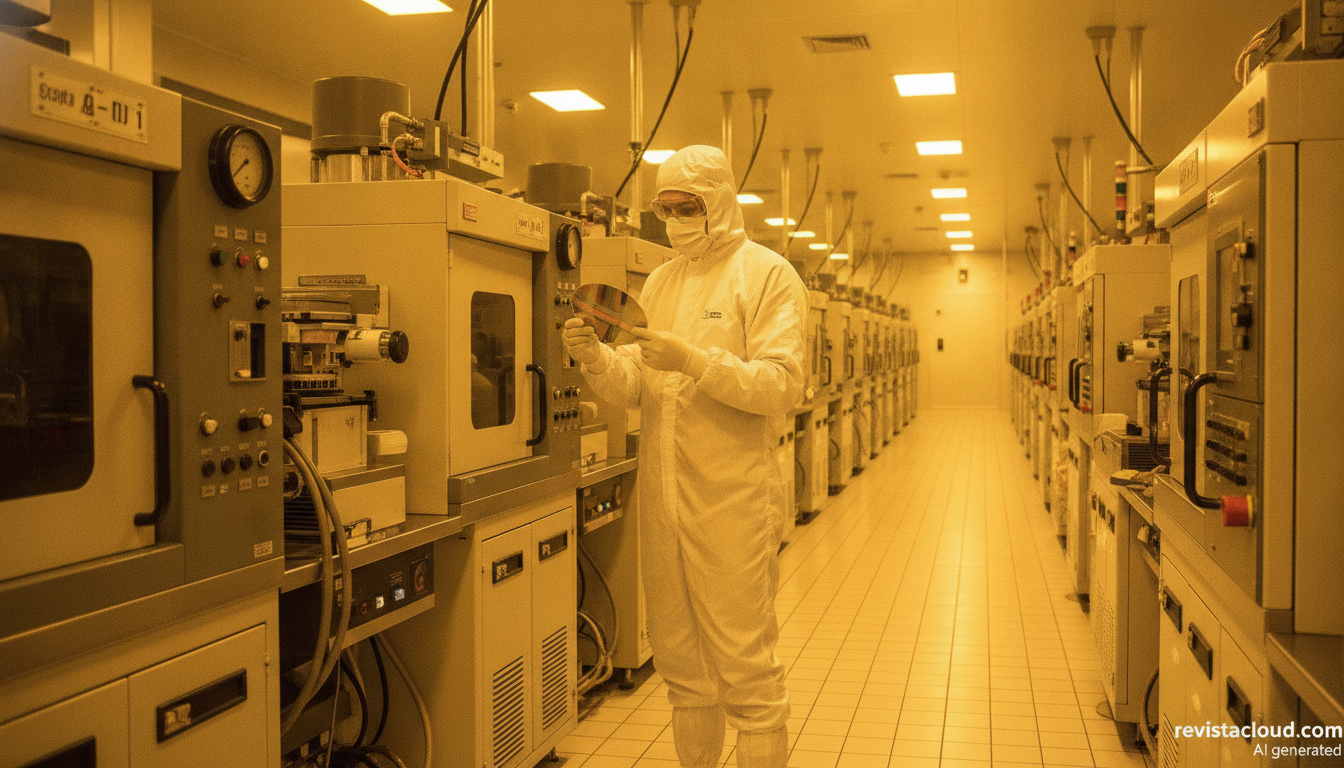
Russia is exploring buying stakes in Chinese semiconductor factories to secure chip production capacity. According to a report published by the Russian newspaper Kommersant on September 28, 2026, the Unified Microelectronics Company (OMK, its Russian acronym), the body created to pool the sector’s resources, is looking at taking an equity position in “small and low-prestige” Chinese foundries that serve the local market as well as Russia. The idea comes as Russia’s chip industry still cannot mass-produce anything below 90 nanometers.
Russia’s plan to buy into Chinese chip factories in 30 seconds
- OMK is exploring taking an equity stake in one or several small Chinese foundries, according to three sources cited by Kommersant.
- The goal is to guarantee space on their production lines, not to buy technology.
- The Russian state could allocate up to 750 billion rubles to OMK, whose strategy through 2030 is expected to be approved this year.
- Experts consulted warn that being a shareholder doesn’t grant access to patents and that Beijing can reject a sanctioned partner.
For now, it’s an option under study, not a decision. Kommersant’s sources, a person familiar with OMK’s strategy and two participants in the internal discussions, say the plan still doesn’t specify the investment amount or the number of deals. Kommersant sought comment from the Ministry of Industry and Trade and from the Element Group, Russia’s largest microelectronics manufacturer, which would be folded into the new company.
A Spot in the Production Queue
The logic behind the plan is simple. Russia has no factories capable of producing modern chips and depends on third parties, China above all, to manufacture what it designs. If OMK takes an equity position in a foundry, it would have an easier time securing capacity when it needs it. According to one source, the size of the stake isn’t what matters, because “an agreement can be reached for one or several production lines to work for Russia’s needs.” That same source says some Chinese manufacturers have already proposed a similar arrangement.
Alexei Ershov, deputy director of a research center affiliated with Bauman Moscow State Technical University, sums it up in one line: “For a shareholder, it’s easier to secure quotas and a clear price.” He also notes that several Russian processor designers, including Baikal, Module and Elvis, already manufacture their chips in China, and that holding a stake in a Chinese factory doesn’t change the score the Ministry of Industry uses to consider a product Russian-made, since that score depends on the stages of work actually done in Russia.
The practice isn’t unusual in the industry either. Ershov points to Sony and Denso, which hold stakes in TSMC’s factory in Japan, and to Bosch, Infineon and NXP in the Dresden project. Even so, he suggests Russia should consider buying an entire factory and relocating it, since appearing on a shareholder registry could complicate that factory’s relationship with its Western equipment suppliers.
A Stake Doesn’t Buy the Technology
Experts consulted by Kommersant agree the plan has clear limits. Maxim Slugin, a partner at the law firm Jinshi, explains that a stake can strengthen the relationship, allow participation in management and provide access to some internal information, but it doesn’t grant free access to patents, technical know-how or technology documentation. That requires separate agreements, so it can’t be seen as a way to “freely” acquire technology.
The second problem is political. Slugin adds that Chinese factories aren’t barred from accepting Russian money, but they can reject an investor, especially one tied to the state or under sanctions. Konstantin Pozdniakov, an advisor to the rector of the Russian State Social University, calculates that genuinely influencing how capacity is allocated would require a blocking stake of 25% or a majority. “Beijing is now more interested in attracting foreign capital and technology than in sharing management of its own factories, especially with a sanctioned partner,” he warns.
It’s also worth keeping in mind that China’s own chip sector is under pressure. Its large foundries, such as SMIC, are running at the limits of their capacity, as CloudNews has already reported: SMIC Gains Foreign Orders Amid TSMC and Samsung Saturation. That OMK is targeting small factories also reflects how unlikely it is that the larger ones would want a Russian shareholder.
An Industry Still Stuck at 90nm
The context explains the urgency. Mikron, based in Zelenograd, is Russia’s leading chipmaker, and its most advanced process in production is still 90nm, which it licensed in 2010 and brought online around 2012-2013. It managed to produce experimental 65nm samples in 2013, but has never mass-produced at that node. For comparison, TSMC is already manufacturing at 2nm, and in China, SMIC is producing chips in the 7nm class and closing in on 5nm without EUV lithography.
Sanctions have made the situation worse. Before 2022, Russia’s most advanced processors, such as the Elbrus and Baikal lines, were manufactured at TSMC. After sanctions hit, that route closed, and part of production shifted back to Mikron’s 90nm lines or moved to China. Russia has plans to move to 65nm and then 28nm, with 2028 as the horizon in some forecasts, and it’s developing its own lithography equipment, though the first machines work at resolutions from decades ago.
OMK is the government’s bet to bring order to the sector. According to First Deputy Prime Minister Denis Manturov, its tasks are to pool resources, build a full-cycle microelectronics complex and train personnel. The state could allocate it up to 750 billion rubles, and its strategy through 2030 is expected to be approved this year. Buying a piece of a Chinese factory wouldn’t bring Russia closer to manufacturing advanced chips on its own, but it could secure supply while it keeps trying. Dependence on China is already a feature of its tech strategy, as seen in the case of GigaChat and Chinese hardware.
Frequently Asked Questions
What is OMK?
The Unified Microelectronics Company is the Russian body created to pool the resources and production capacity of the semiconductor sector. The state could allocate it up to 750 billion rubles.
Which Chinese factories does Russia want to invest in?
No names have been given. Kommersant’s sources describe “small and low-prestige” foundries that serve the local market and Russia, and the plan still doesn’t specify amounts.
What manufacturing process does Russia currently master?
Its most advanced process in production is Mikron’s 90nm node. 65nm has only been tested experimentally.
Would the investment grant access to Chinese technology?
Not necessarily. Experts note that being a shareholder doesn’t grant access to patents or technical documentation, which require separate agreements.
Sources:
