
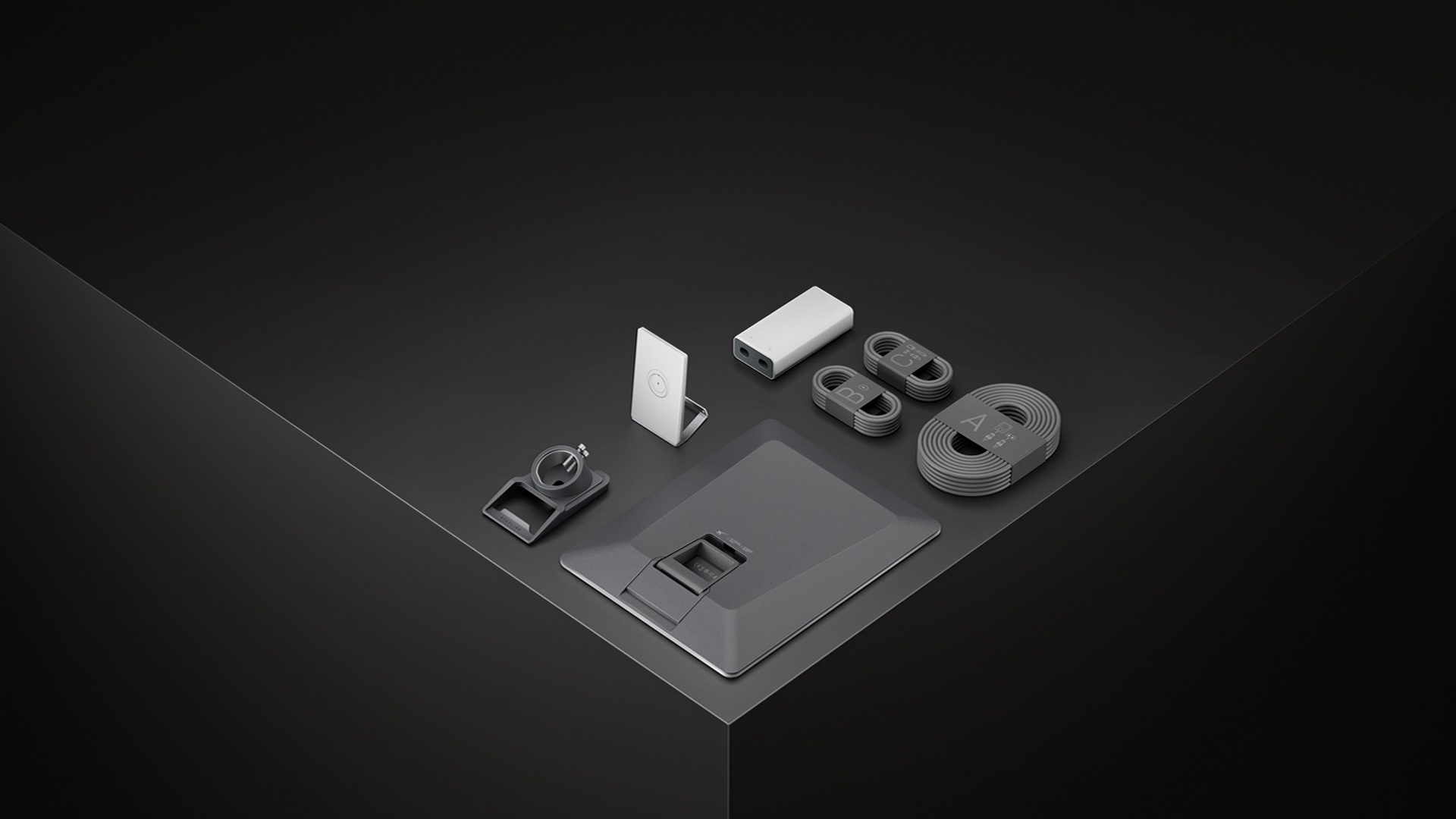
Starlink has started distributing its new V5 residential antenna, a terminal that weighs 62% less and has almost half the frontal surface area compared to the previous generation. The update isn’t aimed at increasing maximum speeds—which have decreased slightly from over 400 Mbps to over 375 Mbps—but rather at reducing power consumption, simplifying installation, and preparing a more portable home kit.
The key points of the Starlink V5 in 20 seconds
- The antenna weighs 1.1 kg, compared to 2.9 kg for the V4.
- Its power consumption drops from 75-100 W to 35-50 W.
- The advertised maximum speed decreases from more than 400 Mbps to more than 375 Mbps.
- Amazon Leo Pro promises up to 400 Mbps but does not yet offer widespread residential service.
The V5 is initially available in selected areas. SpaceX plans to expand it to more markets as production increases, but has not published a detailed timeline per country nor confirmed that all new residential customers will receive it from the start.
An efficiency-focused update
The new antenna measures 38.4 × 30.6 × 3.4 centimeters, compared to 59.4 × 38.3 × 3.97 centimeters for the V4. The reduction in frontal surface area is around 48%, although none of the individual dimensions have been cut exactly in half.
Weight reduces from 2.9 kg to 1.1 kg. This makes mounting on walls, masts, and lightweight structures easier, while also reducing the effort needed to transport the equipment to rural homes, farms, or temporary setups.
| Feature | Starlink V4 | Starlink V5 | Change |
|---|---|---|---|
| Dimensions | 59.4 × 38.3 × 3.97 cm | 38.4 × 30.6 × 3.4 cm | 48% less frontal surface area |
| Antennas weight | 2.9 kg | 1.1 kg | 62% less |
| Average Power Consumption | 75-100 W | 35-50 W | Approximately half |
| Max advertised speed | Over 400 Mbps | Over 375 Mbps | 6.3% less |
| Field of view | 110 degrees | 110 degrees | No change |
| Environmental protection | IP67 Type 4 | IP67 Type 4 | No change |
| Operating temperature | -30 to 50°C | -30 to 50°C | No change |
| Orientation | Manual with software assistance | Manual with software assistance | No change |
Energy efficiency improvements may be more significant than size reduction. A V5 antenna running 24 hours a day would theoretically consume between 307 and 438 kWh annually. In comparison, the V4 would use between 657 and 876 kWh based on Starlink’s reported ranges.
The potential savings could be between 350 and 438 kWh per year when comparing the extremes. This is a theoretical estimate; actual consumption depends on connection activity, temperature, snow-melting heating, and reception conditions.
This reduction is especially relevant for battery-powered setups. A V5 operating at 50 W for ten hours would need about 500 Wh—excluding inverter, router, and power supply losses. The same operation for a V4 at the high end would require about 1 kWh.
The antenna maintains a 110-degree field of view, IP67 Type 4 environmental protection, and an operational temperature range from -30°C to 50°C. Starlink also states that it can withstand wind speeds up to 265 km/h when properly mounted, and can melt up to 40 mm of snow per hour. Final resistance depends on the mount, mast, and anchoring used.
The kit includes an independent power supply, a 15-meter Starlink cable, a 2-meter Ethernet cable, mounting support, mast adapter, and the Mini Router. Power is transmitted through the network cable, eliminating the need for a second external power line.
The Mini Router supports dual-band Wi-Fi 6 with MU-MIMO 2×2 and has two 1 Gbps Ethernet ports. Starlink claims coverage of up to 204 m² and connection for up to 235 devices—these numbers depend on home layout, interference, and obstacles. The equipment is intended solely for indoor use.
Starlink V5 vs. V4 and Amazon Leo
The closest competitor in architecture is Amazon Leo, formerly known as Project Kuiper. Amazon is preparing a family of low Earth orbit (LEO) terminals called Leo Nano, Leo Pro, and Leo Ultra.
Leo Pro is the model expected to directly compete with the residential Starlink. Amazon assigns speeds of up to 400 Mbps, an antenna roughly 28 centimeters per side, and a weight near 2.4 kg. Leo Nano reduces size to about 18 centimeters and prioritizes portability, with a maximum advertised speed of 100 Mbps.
A key limitation is that Starlink already operates a mature commercial network, whereas Amazon expects to launch Leo service in the second half of 2026. As of early July, Amazon had about 400 satellites operational or in orbit, versus a much larger Starlink constellation.
| Terminal | Network | Advertised Speed | Approximate Dimensions | Weight | Power Consumption | Commercial Status |
|---|---|---|---|---|---|---|
| Starlink V5 | LEO | Over 375 Mbps | 38.4 × 30.6 × 3.4 cm | 1.1 kg | 35-50 W | Available in selected areas |
| Starlink V4 | LEO | Over 400 Mbps | 59.4 × 38.3 × 3.97 cm | 2.9 kg | 75-100 W | Large installed base |
| Amazon Leo Pro | LEO | Up to 400 Mbps | Around 28 × 28 cm | About 2.4 kg | Not published | Service expected in 2026 |
| Amazon Leo Nano | LEO | Up to 100 Mbps | About 18 × 18 cm | Just over 1 kg | Not published | Service expected in 2026 |
| Amazon Leo Ultra | LEO | Up to 1 Gbps download and 400 Mbps upload | Around 51 × 76 cm | Approximately 19.5 kg | Not published | Targeted at enterprise and government |
Amazon Leo Pro is more compact frontally than Starlink V5 but weighs more than twice as much according to announced figures. Power consumption has not yet been published, so it’s unclear if it will match the 35-50 W efficiency of SpaceX.
Maximum speeds claimed for V5 and Leo Pro are similar on paper. The actual performance depends on constellation capacity, user density, ground stations, routing, and coverage in each area. The 400 Mbps Amazon states is a manufacturer forecast, not a sustained real-world figure for an open residential service.
Leo Ultra serves a different market. Its target customers include businesses, governments, energy, transportation, and large sites that require more bandwidth. Amazon advertises up to 1 Gbps download and 400 Mbps upload, plus private connections with Amazon Web Services. It’s not an equivalent alternative to the home V5 kit in terms of size, weight, or market focus.
HughesNet and Viasat continue operating primarily satellite networks based on geostationary satellites. They can cover large territories with fewer satellites, but the higher orbital distance results in greater latency than LEO constellations. HughesNet offers speeds up to around 100-110 Mbps in areas covered by JUPITER 3, while Viasat’s performance depends on the market, satellite, and plan. They are less about terminal size and more about providing connectivity in rural areas where terrestrial networks are unavailable.
Implications for homes and remote deployments
The V5 doesn’t represent a generational leap in speed; in fact, its maximum speed is slightly lower than V4’s. Its advantages lie in needing less surface area, weighing less, and consuming less power.
For a home continually connected to the grid, energy savings could translate into lower annual costs. In cabins, emergency setups, or off-grid locations with solar panels, it can also reduce battery capacity needs or extend operation hours.
The reduced weight simplifies transport, but the V5 isn’t designed for use while a vehicle is moving. SpaceX maintains products for mobility and is developing a new generation of Starlink Mini. The V5 can be moved between locations when permitted by the service plan, provided it’s reinstalled with a clear sky view.
The maximum speed of over 375 Mbps shouldn’t be confused with a guarantee. Starlink warns that performance depends on the plan, time, available capacity, and local congestion. Experiences can vary between homes even using the same terminal.
The arrival of Amazon Leo will increase competitive pressure, but success won’t be based solely on antenna specifications. Amazon needs to deploy enough satellites, obtain approvals, install ground stations, and demonstrate coverage and capacity with thousands of users online.
Starlink has an advantage with its existing deployed network and experience in residential installations. The V5 reinforces that position without aiming for headline-grabbing speed increases: it offers nearly the same service with a smaller terminal and about half the power consumption.
Frequently Asked Questions
Is the Starlink V5 faster than the V4?
Not according to the maximum announced figures. V5 reaches over 375 Mbps, while V4 is listed at over 400 Mbps. Actual speeds depend on network conditions and the plan.
How much electricity does V5 save?
Starlink reduces average power consumption from 75-100 W to 35-50 W. Continuous operation could theoretically save between 350 and 438 kWh per year.
Will Amazon Leo Pro be better than Starlink V5?
Amazon claims up to 400 Mbps and a smaller size, but power consumption and actual performance are not yet published. Its real-world performance will be clearer once the network launches commercially.
Will all new customers receive the V5 antenna now?
Not necessarily. Starlink initially distributes it in selected zones and will expand availability as production increases.
