
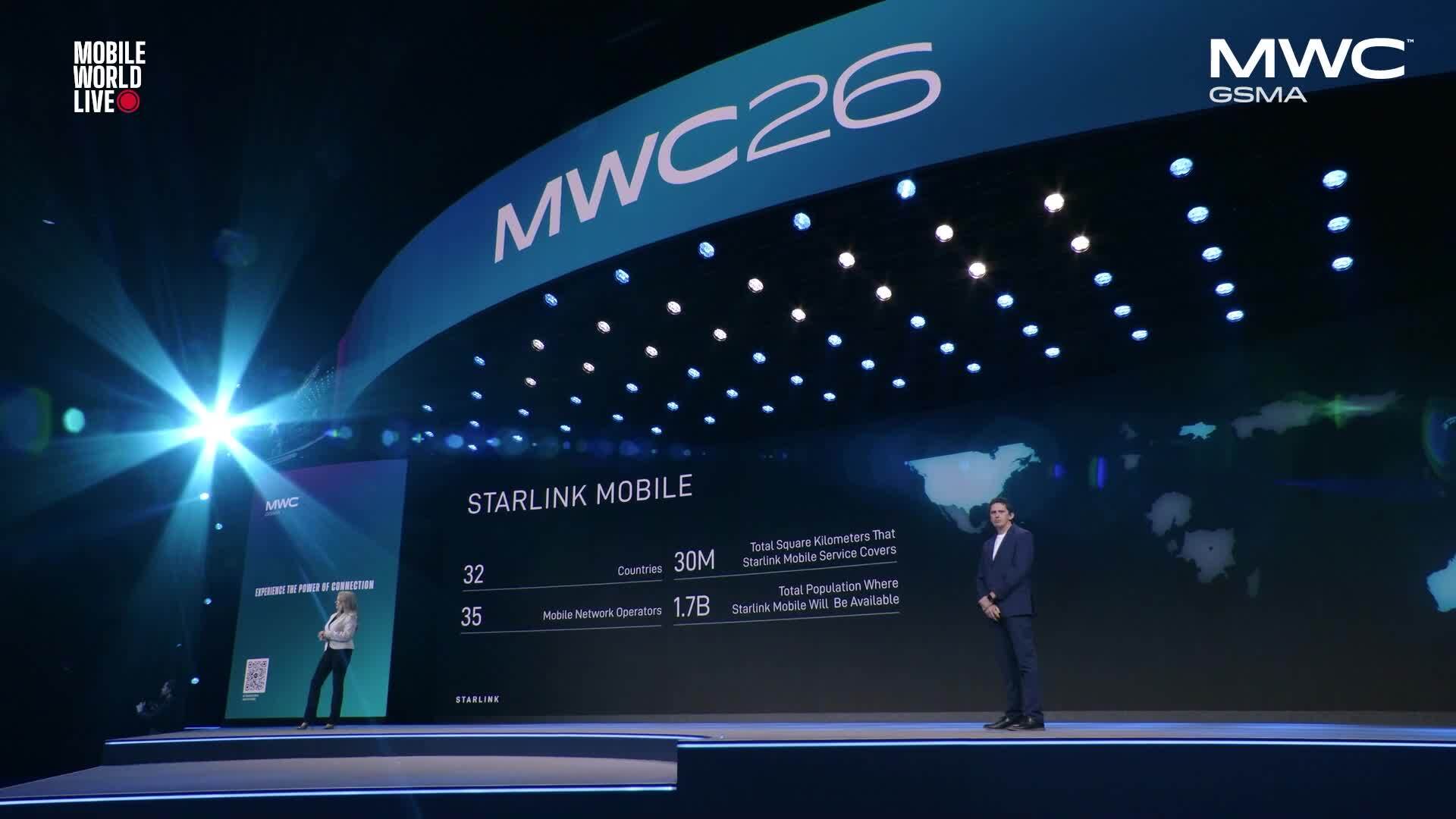
The Mobile World Congress (MWC) 2026 sent a clear message: mobile connectivity is no longer defined solely from land. SpaceX took advantage of Barcelona’s showcase to rebrand its Direct-to-Cell initiative as Starlink Mobile and, in doing so, set the calendar for the next big step: a second generation (V2) aiming to offer an “Earth-like” experience supported by 5G NTN (Non-Terrestrial Networks) and satellite spectrum in 2 GHz.
Behind the name change lies a broader strategy. The first generation of Direct-to-Cell was conceived as an emergency layer for coverage gaps, enabling a conventional mobile phone—without external antennas or accessories—to send messages and, to a limited extent, use data. The 2026 update is that Starlink intends to turn this “last resort coverage” into a true network supplement: increased capacity, more services, and, most importantly, a technical foundation aligned with 3GPP standards for non-terrestrial networks.
From pilot to European roadmap: Deutsche Telekom and the 2028 horizon
In Europe, the most significant announcement is the partnership with Deutsche Telekom, which openly talks about a launch in 2028 across several of the group’s markets. The declared goal is to close “whitespots”—areas where deploying towers is difficult due to terrain, costs, or environmental restrictions—and to improve resilience in disaster scenarios or prolonged power outages. The approach is explicit: not to replace the mobile network, but to add a satellite layer that activates when terrestrial signals are lost.
This hybrid approach aligns with physical realities: satellites do not compete in density with urban 5G networks, but they can cover areas where traditional deployment is delayed or unfeasible for years.
Spain joins the map with MasOrange and a pilot in Valladolid
Meanwhile, Spain emerges as a testing ground with the agreement between MasOrange and Starlink to execute a technical pilot in Valladolid. The operator explained that the trial has regulatory approval and will utilize part of the spectrum allocated to MasOrange to evaluate direct satellite-to-mobile connectivity as a complement to its 5G infrastructure. MasOrange emphasizes that the intended use is to maintain basic services and data for specific applications in coverage-scarce areas, especially remote or hard-to-reach locations.
These pilots are crucial because they bring the debate into practical focus: beyond technological promises, the decisive factors are regulatory (which bands can be used, under what conditions, and in coordination with operators) and compatibility (which mobiles will connect and at what performance).
Key technical piece: 5G NTN and the n256 band in 2 GHz
To understand why Starlink emphasizes the “second generation,” it’s essential to look at the standard. 3GPP already includes non-terrestrial networks in sub-6 GHz bands, including the n256 band (S-band), within the 2 GHz range (approx. 1,980–2,010 MHz / 2,170–2,200 MHz in FDD duplex). This band is significant because, unlike proprietary satellite solutions, it brings satellites closer to the logic of mobile networks: devices, modems, and ecosystems can evolve within a common framework.
At MWC, chipset ecosystems also aimed to jump in. MediaTek announced a demo of satellite emergency alert services with Starlink Mobile using their M90 modem, highlighting the practical value: wireless alerts and critical messages when terrestrial infrastructure fails.
What Starlink Mobile V2 promises: larger satellites and a leap from “light data” to broadband
SpaceX’s narrative at Barcelona points to a scale-up. According to what was shared during the event and reported by sector media, V2 will rely on:
- Much larger satellites, equipped with phased array antennas several times bigger than those of the first generation.
- Much higher link performance, designed to transition from messaging and “light data” (limited app use) to services with greater ambition: voice and data with a “terrestrial-like” experience in good conditions.
- A timeline targeting launch of this generation around mid-2027, with enough deployment to support the European commercial leap in 2028.
The key caveat remains: “under ideal conditions.” The satellite performs best with an unobstructed sky view; its actual performance will depend on congestion, geometry, and total capacity per beam. Nevertheless, the promise to bridge coverage gaps—and enhance emergency communication—explains why telecom providers are willing to explore these partnerships without abandoning their main networks.
Summary table: Starlink Mobile today vs. the planned V2 generation
| Element | Starlink Mobile (Gen 1 / Direct-to-Cell) | Starlink Mobile V2 (planned) |
|---|---|---|
| Approach | Complementary coverage and emergency use | Network complement with a more 5G-like experience |
| Typical services | Messaging and limited/selected data | Data, voice, and higher bandwidth services (aim) |
| Technical foundation | Integration with operators; limited capabilities | 5G NTN (standards-aligned) |
| Spectrum | In pilots, using operator’s spectrum | Greater use of satellite spectrum in 2 GHz (n256 / MSS) |
| Devices | Many existing mobiles can work in specific cases | Requires more specific compatibility; gradual growth | Calendar | Active service expanding across countries | Launches from 2027; commercial deployment in Europe by 2028 |
Frequently Asked Questions
What is 5G NTN and why is it important for Starlink Mobile?
5G NTN extends the 5G standard to non-terrestrial networks (satellites). It’s important because it allows mobiles and networks to evolve with common specifications, improving compatibility and scalability.
Will Starlink Mobile replace traditional mobile operators?
The strategy announced by partners in Europe points to the opposite: it is designed as a complementary layer to fill coverage gaps and boost resilience, not as a replacement for terrestrial networks.
Which phones will be compatible with 5G-like satellite coverage in 2028?
Compatibility will depend on the modem and support for NTN bands like n256. Industry (chipset and device manufacturers) are fast-tracking integration, but universal support from launch is not expected.
What is the significance of pilots like MasOrange and Starlink in Valladolid?
They provide technical and regulatory validation: testing how satellite connectivity performs using operator spectrum, which services work best, and identifying real-world limitations.
via: MWC 2026