
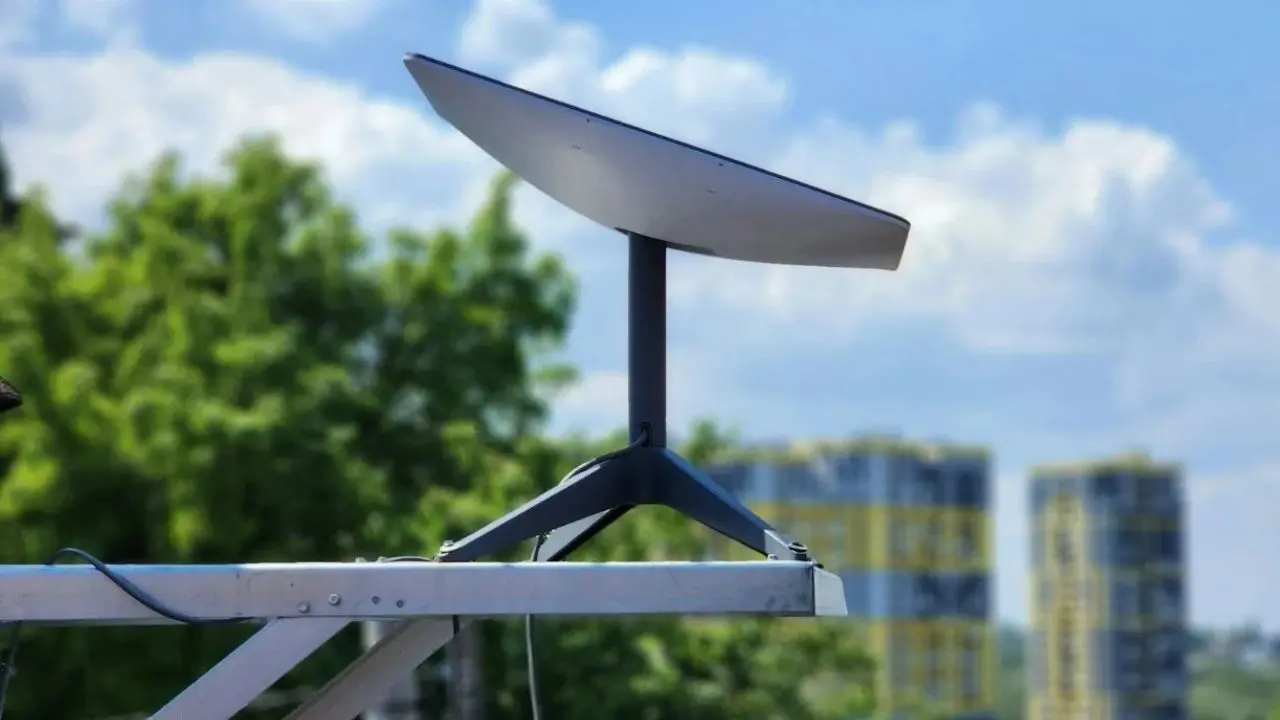
The low Earth orbit (LEO) is becoming the “new airspace” of the 21st century: an increasingly busy highway where miscoordination can lead to a serious incident. Against this backdrop, SpaceX has decided to take action with its Starlink constellation: in 2026, it will lower approximately 4,400 satellites from around 550 km to approximately 480 km, with the explicit goal of “enhancing space safety” and reducing collision risks.
The move comes after episodes that have heightened tensions in orbital traffic management. Recent months have seen reports of a near-collision with a Chinese satellite and of satellite deployments from China without clear coordination with other operators—situations that require evasive maneuvers and put pressure on collision detection and avoidance systems.
Why lowering from 550 km to 480 km can reduce risk
At first glance, lowering the orbit might sound counterintuitive: being closer to the atmosphere means more drag and more corrections. And that’s true. But in space safety, the key is not just “avoiding a crash today,” but also reducing the time an inoperable or dead satellite remains a projectile. At lower altitude, atmospheric friction increases and reentry speeds up: if something fails, the satellite falls sooner, clearing the environment faster.
SpaceX has also provided another practical reason: below 500 km, there is generally less tracked debris and fewer “mega-constellations” planned compared to slightly higher layers. Lowering the “shell” involves operating in an area with lower future traffic pressure, which decreases the number of dangerous conjunctions to manage.
LEO is no longer a “vacuum”: the congestion context is real
To understand why a 70 km adjustment is newsworthy, just consider this figure: the European Space Agency (ESA) recently estimated around 14,200 active satellites in orbit. In this scenario, each operator relies on two pillars:
- space surveillance (catalogs and trajectory predictions), and
- operational discipline (notices, coordination, and maneuvers).
The problem is that LEO has become critical global infrastructure. Starlink is not the only constellation involved: the “appetite” to fill orbits with thousands of satellites is soaring, with multiple public and private projects competing over frequencies, orbital planes, and launch windows.
The hidden cost: more “drag,” more fuel, less margin
The trade-off of lowering is clear: at around 480 km, atmospheric drag is higher. This means more fuel consumption for maintaining the orbit (station-keeping) and potentially a shorter lifespan if the propellant budget runs out sooner. Researchers in China have highlighted this point: at lower altitude, daily orbital decay is more pronounced, and satellites must continuously compensate to stay in their designated “layer.”
In other words: lowering the orbit improves the “degraded mode” (if something goes wrong, the satellite falls sooner), but increases the cost of “normal operation” (more thrust needed to stay put). SpaceX seems to accept this trade-off as part of the price of operating a massive constellation in an increasingly congested environment.
Coordination: it’s not just about the maneuver, but the protocol
An important detail in the announcement is the emphasis on that the movement will be coordinated with other operators, regulators, and USSPACECOM (the U.S. Space Command). In practice, that phrase points to the real challenge: in LEO, having the technical capability to perform maneuvers is not enough; operational governance is needed so that everyone knows what each is doing, when, and why.
This is where “near-misses” matter greatly. An extremely close approach—on the order of hundreds of meters—does not necessarily result in collision, but it does reveal friction between tracking ecosystems (military, civil, commercial) and highlights the importance of transparency and international coordination.
What could change for the end user (latency, service, resilience)
For satellite internet customers, the headline “lowering the orbit” may sound like a risk. However, in terms of performance, operating slightly lower can even benefit latency (signal travels a shorter distance) and maintain very similar coverage if the network is designed accordingly. The actual impact is usually operational: more maneuvers, more fleet management, and higher reliability demands.
And here, an interesting lesson emerges—also applicable to digital infrastructure: security is not a product, but a process. In cloud computing, we talk about fault domains, redundancy, and “time to recover.” In orbit, the philosophy is similar: reducing the window in which a failed satellite can become a systemic problem. Lowering to 480 km doesn’t eliminate the risk, but shortens the time a dead satellite can pose a danger to all.
Frequently Asked Questions
Why does lowering the orbit reduce collision risk?
Because it increases atmospheric friction: if a satellite loses control, it tends to re-enter sooner. Additionally, SpaceX argues that below 500 km, there is less traffic and debris pressure compared to higher layers.
Will this make Starlink faster?
Lowering can slightly improve latency due to shorter signal travel distance, but the main effect is operational (safety and fleet management).
What is the “technical cost” of operating at 480 km?
More drag means more orbit corrections and higher propellant consumption, which could affect satellite lifespan if more fuel is needed to stay in its layer.
Who coordinates these maneuvers globally?
SpaceX mentions coordination with operators, regulators, and USSPACECOM, which is a key player in tracking and conjunction management in LEO.
via: scmp