
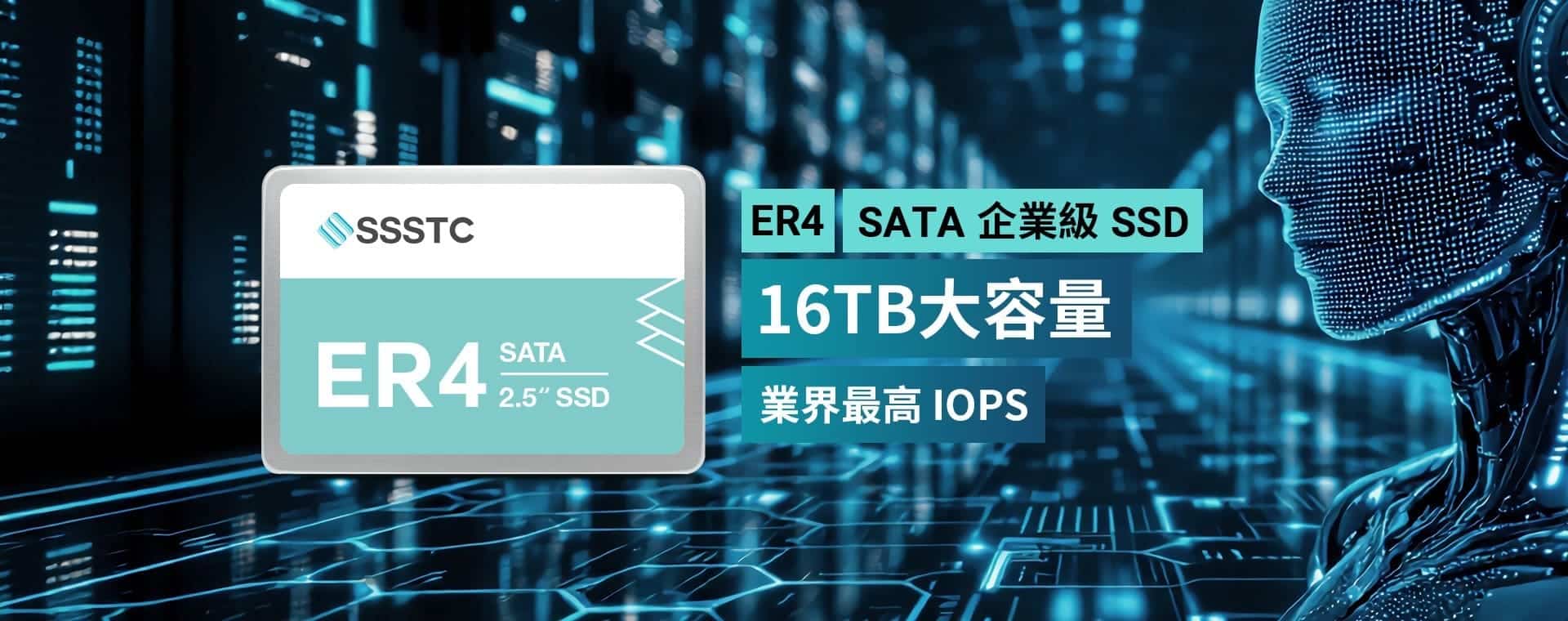
Solid State Storage Technology Corporation (SSSTC), a subsidiary of the memory giant Kioxia, has unveiled its new ER4 series of enterprise SSDs, offering capacities of up to 16 TB in 2.5-inch SATA format. With this release, the company joins a select group of manufacturers providing high-density SATA drives, tailored for AI servers, cloud platforms, and real-time data analytics environments.
16 TB SATA: More Capacity Without Infrastructure Changes
The ER4 series employs a 6 Gb/s SATA interface in a standard 2.5-inch form factor, supporting hot-swap functionality. This allows direct replacement of traditional HDDs in racks and existing servers. For many data centers, this detail is crucial: they can increase capacity and performance without upgrading backplanes, controllers, or chassis.
The lineup initially launches with two models:
- 16 TB (15.36 TB usable)
- 8 TB (7.68 TB usable)
Both achieve sequential speeds of up to 550 MB/s read and 530 MB/s write, which is the practical limit of the SATA interface, maximizing available bandwidth.
Where these SSDs stand out significantly compared to HDDs is in random performance. The ER4 series delivers up to 98,000 IOPS on random read, while random writes reach 30,000 IOPS for the 16 TB model and up to 55,000 IOPS for the 8 TB variant. This is especially relevant for workloads with intensive small operations, such as transactional databases.
Designed for AI, OLTP, and Real-Time Analytics
SSSTC positions the ER4 series as an ideal solution for modern workloads that combine low latency, high parallelism, and large data volumes, including:
- AI inference, where ultra-fast response times are needed for pre-trained models.
- OLTP (Online Transaction Processing), typical in banking, e-commerce, or booking systems.
- Real-time analytics and big data, involving large datasets with intensive random access.
- Cloud and virtualization, with multiple virtual machines competing for I/O on the same host.
- Enterprise NAS, backups, and video surveillance, scenarios where capacity and reliability are prioritized.
With compatibility for SATA and the standard 2.5-inch format, these SSDs can be deployed in next-generation servers or existing infrastructure that lacks NVMe support but needs a performance boost over HDDs.
Enterprise-Grade Data Protection
Beyond capacity and performance, the ER4 series incorporates a comprehensive set of data protection features suited for critical environments:
- End-to-end protection, ensuring data integrity from host to NAND memory.
- PLP (Power-Loss Protection), capacitors and internal logic to complete ongoing operations and prevent data corruption during power outages.
- Secure erase, facilitating sanitization when decommissioning or repurposing units.
- 256-bit AES encryption, with optional TCG Enterprise support, targeting stricter corporate security policies.
These features enable ER4 drives to be used in regulated or sensitive sectors—such as finance, healthcare, and government—where safeguarding data in transit and at rest is essential.
Long-Term Reliability for 24/7 Operations
As expected from a product aimed at data centers and servers, SSSTC designed the ER4 series with a focus on reliability:
- MTBF of 3 million hours
- Unrecoverable Bit Error Rate (UBER) of 10-17
- 5-year warranty
These figures place the ER4 within the typical range for enterprise SSDs operating continuously in high-density transaction environments. The combination of optimized firmware, high-performance controllers, and advanced error correction techniques helps ensure stable operation even under sustained loads.
SATA Remains Relevant in the NVMe Era
While headlines often focus on high-performance PCIe NVMe drives, SATA remains a key component in thousands of data centers:
- Many production servers only support SATA/SAS and cannot leverage NVMe without extensive hardware upgrades.
- For certain workloads, bottlenecks are not bandwidth-limited but rather due to latency and IOPS constraints compared to HDDs. In such cases, a SATA SSD provides a substantial performance leap.
- The ability to reuse existing infrastructure makes these SSDs a cost-effective way to increase capacity and performance without migrating entire platforms to NVMe.
Against this backdrop, an SSD like the ER4, offering up to 16 TB per bay with enterprise features, is especially attractive for organizations seeking density and reliability without transitioning immediately to NVMe architectures.
Beyond Capacity: Operational Efficiency
In addition to raw performance, SSDs typically provide benefits in power consumption, thermal management, and maintenance compared to mechanical disks. Although SSSTC has not specified power metrics for the ER4, it’s reasonable to infer that, at equal capacities, replacing HDDs with SSDs will:
- Lower energy use per terabyte stored
- Reduce thermal load in densely packed racks
- Minimize mechanical failures and replacement times
For data center operators and cloud providers, these improvements translate into lower operational costs and better rack space utilization—especially as data demands surge driven by AI and digital services.
Advancing SSSTC’s Enterprise Strategy
As a subsidiary of Kioxia, SSSTC reinforces its role as a provider of storage solutions for the enterprise segment with the ER4 series. The company has indicated ongoing plans to expand its data center SSD portfolio and continue investing in high-speed storage and data security technologies. Its goal is to support organizations in their digital transformation and deployment of intelligent infrastructures.
In a market dominated by AI model proliferation and data growth, intermediate solutions like this 16 TB SATA SSD enable many companies to buy time and flexibility: approaching flash performance without fully abandoning their existing platforms.

via: ssstc