
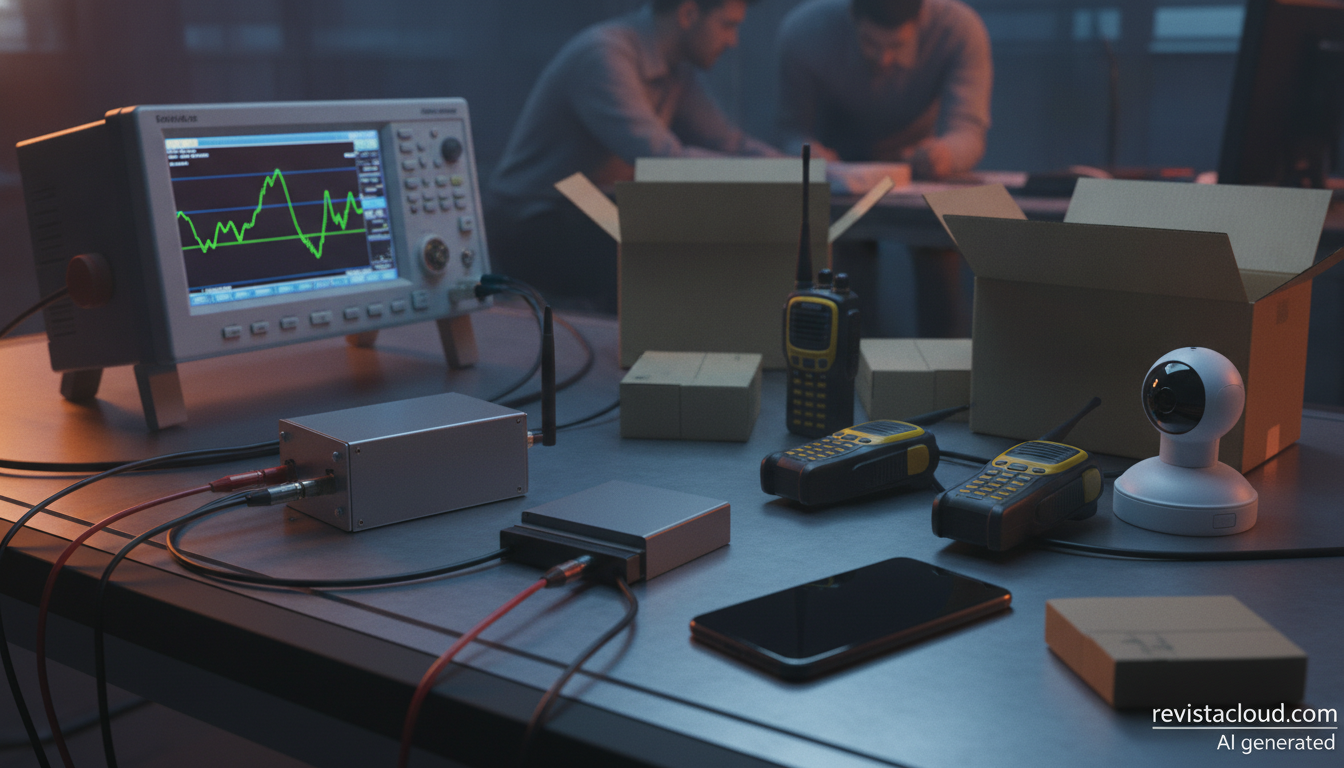
Most radio equipment bought online from outside the European Union and intercepted by Spain’s Tax Agency at customs in 2025 failed to comply with the rules: 96% had no EU declaration of conformity, 67% lacked correct CE marking, and 40% of the units subjected to electrical testing showed inadequate insulation. These are the results of a market surveillance campaign run by Spain’s State Tax Administration Agency (AEAT) and the State Secretariat for Telecommunications and Digital Infrastructure (SETELECO) between spring and the end of 2025, which the Ministry for Digital Transformation has just published in an information notice.
The customs campaign on imported electronics in 30 seconds
- What was done: AEAT selected low-value e-commerce packages containing radio equipment at the border, and SETELECO analyzed them in its lab.
- What equipment: mainly walkie-talkies, phones, Wi-Fi repeaters and mobile signal repeaters.
- Documentation: 96% had no declaration of conformity and 67% lacked correct CE marking or instructions in Spanish.
- Risks: electrical insulation failures in 40% of the units tested, and spectrum-use violations in 86%.
The campaign falls under a European Union Priority Control Area, a coordinated action among member states that temporarily tightens customs checks on a specific issue. In this case, e-commerce packages worth under €150 — exactly the kind that has surged with platforms like Temu, Shein and AliExpress, and the kind that, since November 1, carries a €2 handling fee per item. What’s new this time is that inspectors didn’t just review the product listing online, as in previous SETELECO campaigns, but physical units held at customs.
From the border to the lab
According to the Ministry’s notice, AEAT selected products at border control points during short windows — two or three days a month over roughly six months — and sent them to SETELECO’s lab. The collaboration involved three separate rounds of inspection. Lower-risk equipment underwent a documentary and visual check of the device, its packaging and its paperwork; higher-risk equipment, such as walkie-talkies (PMR equipment) and mobile signal repeaters, also went through technical testing under the EU Radio Equipment Directive (RED) and its Spanish transposition, Royal Decree 188/2016.
Walkie-talkies were the largest group, at 22.2% of the equipment, followed by phones and Wi-Fi repeaters at 14.8% each, and mobile signal repeaters at 11.1%. There were also camera-equipped baby monitors, security cameras, radio receivers, weather stations, motorcycle intercoms, remote controls and active DTT antennas. The report doesn’t say how many units were analyzed in total, though the breakdown by type fits a small sample, around 27 units, so it’s best read as an indicative snapshot rather than a statistic for the market as a whole.
No manufacturer, no CE marking, no instructions
The documentary review turned up violations in every category. 96% of the equipment had no EU declaration of conformity, the document in which the manufacturer declares, under its own responsibility, that the product meets the regulations. 70% failed to properly identify the manufacturer or importer, 67% either lacked the CE marking or displayed it incorrectly (mostly on the device itself, at 52%, versus 22% on the packaging), and 44% had no serial number, batch code or other traceability data.
Gaps in user information were also striking: 67% included no safety instructions, the same share had no instructions in Spanish, 55% gave no warning about usage restrictions, such as needing a license, and 30% didn’t explain how to use the device for its intended purpose.
Electrical risk and network interference
The technical tests are the most worrying part. On health and safety protection, every unit tested had some kind of violation: 100% failed on safety marking and protective instructions, in 43% the labels wore off or became illegible after the durability test, and 40% of the units with a power adapter showed deficiencies in dielectric strength and insulation, which the report says can pose a risk to users.
On electromagnetic compatibility, 80% exceeded conducted emission limits — meaning they generated disturbances that travel through power or communication cables and can affect other devices on the same network. On efficient spectrum use, 86% were non-compliant: in mobile repeaters, the main issue was out-of-band gain, and in walkie-talkies, unwanted emissions outside their assigned channel. In addition, 40% of the units operated on frequencies outside the bands Spain allocates under its National Frequency Allocation Table.
The Ministry’s notice also points out that mobile signal repeaters operate on licensed bands and can’t be installed on a whim: anyone needing better coverage should contact their carrier instead. It also recommends checking, before buying, that a product has correct CE marking on both the device and its packaging, instructions in Spanish, the relevant restriction pictogram where applicable, and the declaration of conformity, plus the common charger pictogram for devices charged by cable.
Frequently asked questions
What equipment did the customs campaign examine?
Radio equipment bought online from outside the EU: mainly walkie-talkies, phones, Wi-Fi repeaters and mobile signal repeaters, plus baby monitors, cameras, radio receivers and DTT antennas.
How many units failed to comply?
The vast majority: 96% had no EU declaration of conformity and 67% lacked correct CE marking. In testing, 40% had electrical insulation faults and 86% failed efficient spectrum use.
Can I install a mobile signal repeater bought online?
No. They operate on licensed bands, and installation requires authorization and coordination with your carrier. To improve coverage, contact your carrier instead.
How can I tell if a device complies with the rules?
Check that it has correct CE marking on both the device and packaging, instructions in Spanish, manufacturer and importer details, and the EU declaration of conformity or its simplified version.
Sources:
- Ministry for Digital Transformation, information notice on the market surveillance campaign with AEAT
- Bandaancha.eu
This article is also available in Spanish: «Aduanas revisa electrónica comprada fuera de la UE: la mayoría no cumple», on revistacloud.com.
