
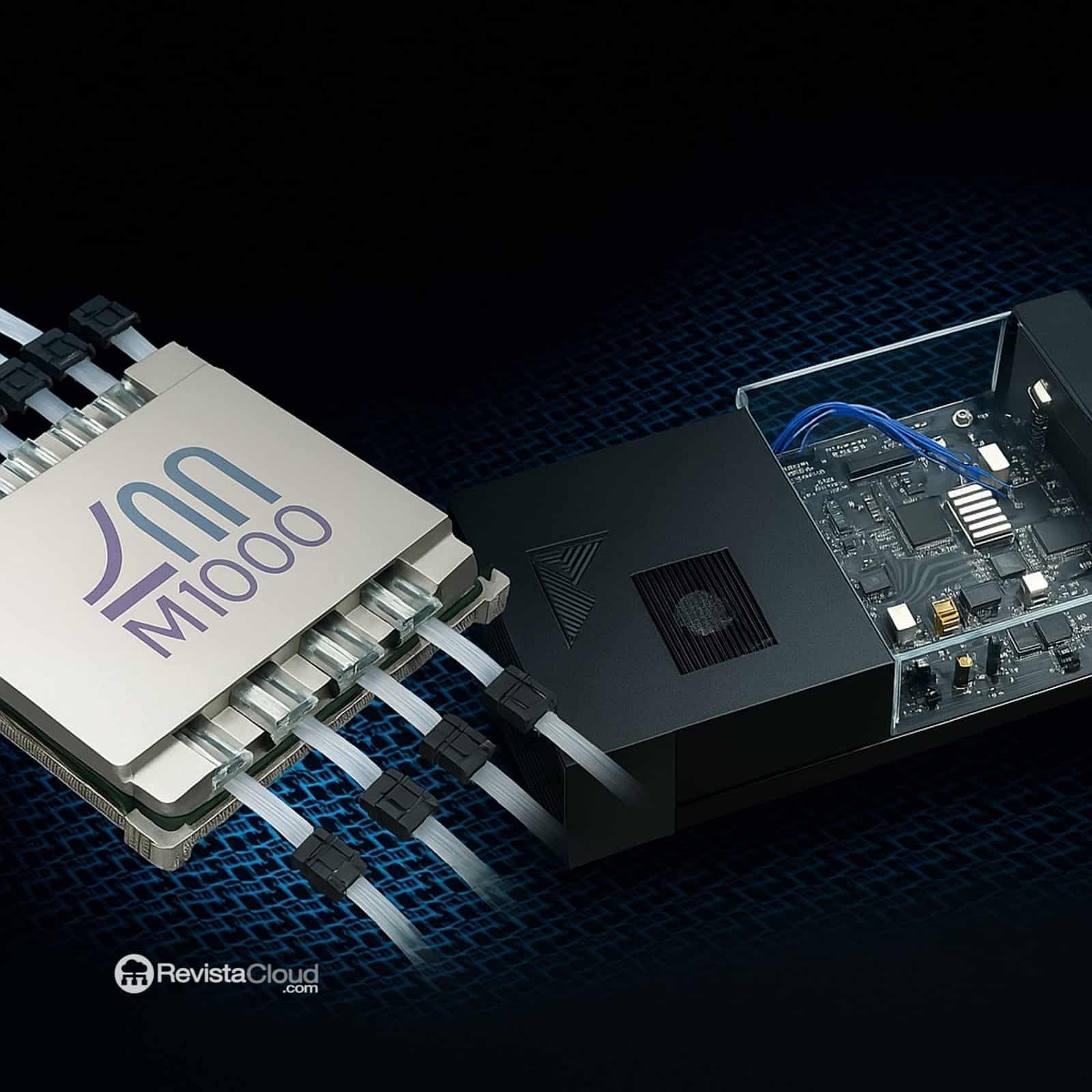
Spain aims to increase its influence in one of the less visible but more strategic branches of semiconductors: integrated photonics. The Council of Ministers has authorized the Ministry for Digital Transformation and the Civil Service to participate, through the Spanish Society for Technological Transformation (SETT), in Attypics Photonics, a new Valencian company focused on photonic chips. The public investment amounts to 24.5 million euros and is part of the PERTE Chip initiative.
This operation is not an isolated aid. It is structured as a public-private co-investment between SETT and the Valencian company Baladre Capital. In the initial phase, both entities will contribute 50 million euros to Attypics Photonics, with SETT holding 49% and Baladre Capital 51%. The project also envisions a second phase with an additional 200 million euros, contingent on meeting planned objectives.
The announcement comes at a time when Europe is trying to bridge part of the industrial gap in semiconductors. For years, the debate focused on processors, advanced fabs, and dependence on Asia or the United States. Integrated photonics adds another layer: chips that use light to transmit, process, or sense information, offering advantages in speed, energy consumption, and integration capacity across diverse applications.
From university research to manufacturing
Attypics Photonics was founded in April 2026 based on the MICRONANOFABS-NTC Singular Scientific and Technological Infrastructure at the Polytechnic University of Valencia (UPV), an environment with over 15 years of experience in manufacturing and technological services linked to photonic chips. The company’s ambition is to become a private “Lab-to-Fab” player, capable of transmitting scientific knowledge and prototypes from the laboratory to an industrial manufacturing capacity.
This point is significant. Spain has high-level research in photonics, active universities, and specialized centers, but scaling from research to industrial production is often the most challenging step. It requires investment, cleanrooms, equipment, specialized personnel, repeatable processes, industrial clients, and certifications. Attypics aims to occupy that intermediate space between advanced R&D and scalable production.
The company will provide research, development, prototyping, integration, and manufacturing services for photonic integrated circuits. Its potential applications span healthcare, telecommunications, quantum computing, energy, defense, aerospace, sensors, optical communications, and new computing systems. Not all these markets will mature at the same pace, but they all share a need for components capable of moving or processing information more efficiently.
| Project Key | Announced Data |
|---|---|
| SETT public investment | 24.5 million euros |
| Initial co-investment total | 50 million euros |
| SETT’s participation | 49% |
| Baladre Capital’s participation | 51% |
| Second phase planned | Additional 200 million euros |
| Cleanroom size (initial phase) | 1,240 m² |
| Cleanroom size (full phase) | 7,502 m² |
| Direct employment (initial phase) | 100 skilled jobs |
| Direct employment (after second phase) | Over 300 jobs |
| Final location | Paterna, Valencia |
Why photonic chips matter
Integrated photonics does not replace all traditional electronics but can complement it in areas where data movement, energy efficiency, or sensing precision are critical. In data centers, telecommunications, and AI systems, data transport is already a major bottleneck. In medical sensors, defense, aerospace, or quantum computing, the ability to manipulate light in miniaturized circuits opens possibilities that conventional electronics cannot easily address.
The advantage of a photonic chip lies in integrating optical functions onto a manufacturable platform. Instead of relying on large, expensive, or difficult-to-assemble optical components, integrated photonics seeks to incorporate some of these functions into compact circuits, with processes closer to semiconductor manufacturing. This leap does not eliminate complexity but enables thinking about industrial scaling.
Attypics aims to work with 200mm and 300mm wafers, two important formats to approach more competitive industrial capacities. Moving to larger diameters is not just a matter of size; it also involves adapting processes, equipment, quality control, and repeatability. In Europe, the availability of advanced photonic manufacturing lines is a strategic sector debate.
| Sector | Potential uses of integrated photonics |
| Telecommunications | High-speed optical communications |
| Data centers | More efficient interconnection between systems |
| Healthcare | Sensors, diagnostics, and biomedical devices |
| Quantum | Control, readout, and communication of quantum systems |
| Defense | Sensing, communications, and advanced systems |
| Aerospace | Instrumentation, navigation, and communications |
| Energy | Monitoring, sensors, and smart grids |
The opportunity exists but is not guaranteed. The market for photonic chips remains fragmented, with different technologies, an evolving supply chain, and a need for standards. Public investment can help reduce initial risk, but success will depend on customers, execution capacity, and connection with the European industry.
Valencia strengthens its role in semiconductors
Choosing Valencia is no coincidence. The Polytechnic University of Valencia and its Nanophotonics Technology Center have been linked to research and transfer in integrated photonics for years. The region has also been building an ecosystem of companies, technological centers, universities, and European projects related to semiconductors, photonics, communications, and advanced manufacturing.
The planned final location in Paterna can reinforce this environment if the project progresses as announced. The first phase will take place in new facilities with 1,240 m² of cleanrooms. The full plan includes 7,502 m², a much more ambitious scale for a Spanish project in this field.
Employment will also be an important indicator. The government anticipates 100 highly qualified direct jobs in the first phase and over 300 after completing the second, plus induced indirect employment. In semiconductors, these profiles are not improvised: process engineers, photonics specialists, cleanroom operators, manufacturing technicians, encapsulation experts, testing, quality, automation, and industrial management professionals are needed.
The challenge will be attracting and retaining talent in a increasingly competitive European market. Germany, the Netherlands, France, Belgium, Italy, and Ireland are also strengthening capabilities related to chips. If Spain wants to turn projects like Attypics into a real industry, it will need specialized training, financial stability, and continuity beyond initial investments.
PERTE Chip: from announcement to industrial capacity
This investment is part of PERTE Chip, one of the tools Spain aims to use to strengthen its position in the semiconductor value chain. These operations seek to go beyond research, supporting projects with market transfer, production, and workforce impact.
SETT plays an increasingly visible role here. Beyond executing part of PERTE Chip, it manages instruments like Next Tech and Spain Audiovisual Hub. Its participation in Attypics demonstrates a strategy: investing in projects considered strategic, sharing risk with private investors, and accelerating sectors where the market alone may not provide enough initial funding.
This approach makes sense in semiconductors because entry barriers are high. Cleanrooms, equipment, processes, and certifications require significant capital before revenue appears. However, it also demands rigor. Public co-investment must translate into real capabilities, not just headlines. The market will assess whether Attypics secures clients, achieves process stability, scales effectively, meets deadlines, and delivers products in demand.
The project also aligns with the European debate on the second phase of the Chips Act and the specific role of photonics. Europe has already identified integrated photonics as a key technology for communications, computing, quantum, and sensors. The question is whether it can shift from pilots, research centers, and dispersed capabilities to an industrial network with sufficient scale.
A small bet in the face of the challenge but significant for Spain
The 24.5 million euros in public investment alone will not change the global semiconductor landscape. the US and Asia continue to invest vastly more in factories, advanced packaging, memory, logic, and AI capabilities. But for Spain, Attypics could be a meaningful piece because it targets a niche where the country can develop specialization rather than trying to compete head-on with giants in advanced electronics manufacturing.
Integrated photonics could be one of those spaces where Europe still holds knowledge, emerging companies, and scientific centers competitive. The risk is repeating familiar patterns: good science, interesting pilot projects, and difficulties in scaling. The creation of Attypics aims precisely to address that issue through a private structure, public investment, and manufacturing focus.
Success will not only be measured by the inauguration of cleanrooms. It will be evaluated through processed wafers, delivered circuits, industrial clients, patents, European projects, contracts, exports, and the ability to attract companies around it. If Attypics manages to become an accessible manufacturing platform for startups, tech SMEs, research centers, and large firms, its impact could be greater than the initial size of the investment.
Spain needs more projects like this if the PERTE Chip is to have a real industrial impact. Not all will be large advanced logic factories. Some should focus on materials, photonics, encapsulation, design, sensors, testing tools, or specialized manufacturing. Technological sovereignty is built not with a single plant but with a connected capabilities chain.
Attypics Photonics now joins this conversation. It has initial capital, public backing, private partners, university roots, and a technology with potential demand. The hardest part remains: demonstrating that a science-born infrastructure from Valencia can compete as an industrial provider in the European photonics chip market.
Frequently Asked Questions
What is Attypics Photonics?
It is a newly created Valencian company founded in April 2026, stemming from the MICRONANOFABS-NTC environment at the Polytechnic University of Valencia, focused on photonic chips.
How much will the government invest?
SETT will invest 24.5 million euros as part of an initial co-investment of 50 million euros alongside Baladre Capital. The project includes a second phase with an additional 200 million euros.
Where will the facilities be located?
The full-scale phase will be in Paterna, Valencia, with plans for 7,502 m² of cleanrooms. The initial phase will occupy 1,240 m².
Why are photonic chips important?
Because they enable integrating optical functions into chips and can be useful in telecommunications, healthcare, quantum technology, energy, defense, aerospace, and more efficient computing systems.
