
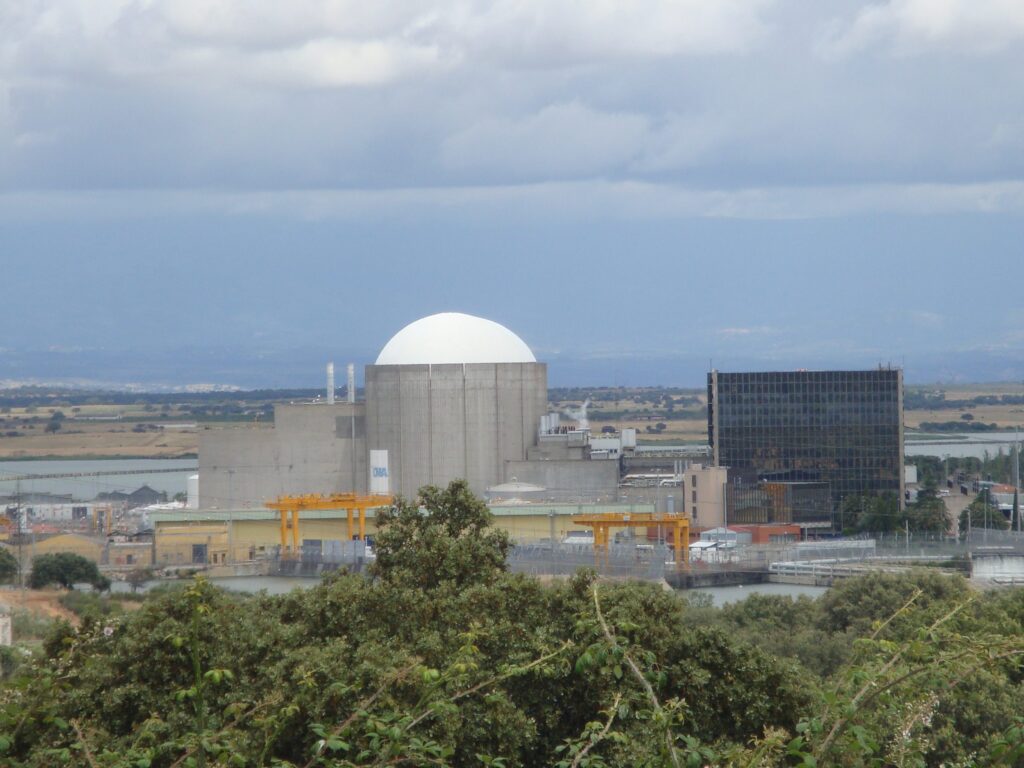
The Government has authorized the two reactors at the Almaraz nuclear power plant, in Cáceres, to keep operating until June 8, 2030, a limited extension that changes the shutdown dates previously set for 2027 and 2028. The decision follows a favorable, conditional report from the Nuclear Safety Council (CSN), in a context marked by international uncertainty and the risk of new swings in gas prices.
The Almaraz extension in 20 seconds
- Almaraz I and II can operate until June 8, 2030.
- The extension adds 31 months for Unit I and 19 months for Unit II.
- The CSN has issued a favorable report, though with safety conditions.
- The Government links the decision to international energy uncertainty and the risk of high gas prices.
- The official schedule still keeps the full shutdown of Spain’s nuclear fleet by 2035, for now.
The measure is set out in Order TED/864/2026 of August 12, published in the Official State Gazette (BOE). The previous authorization let Almaraz I run until November 1, 2027, and Almaraz II until October 31, 2028. The license holder, Almaraz-Trillo Nuclear Power Plants (CNAT), asked in October 2025 to extend both units until June 2030.
The new deadline wasn’t picked at random. The facility’s Periodic Safety Review (PSR) is valid precisely until June 8, 2030, a detail included in the ministerial order itself.
The CSN approves continued Almaraz operation
Keeping a nuclear plant running depends on more than energy policy. It requires the mandatory report of the Nuclear Safety Council, which assesses nuclear safety and radiological protection.
On July 16, the regulator issued a favorable report, with conditions, for both Almaraz units. The decision rested on a technical evaluation of the submitted documentation and on ongoing oversight during the current operating period. Per the CSN, the plant keeps an adequate safety level to continue operating for the requested period.
This was no minor review. The authority says its opinion drew on 29 documents prepared by 16 specialized teams. Almaraz I began commercial operation in 1981 and Almaraz II in 1983, so both units will comfortably pass four decades of operation during this new phase.
Extending the life of such an old plant requires keeping the technical conditions the regulator sets. In fact, the favorable CSN report is conditional on operating within the limits and requirements in the authorization.
That point matters, because the debate about nuclear continuity has two different layers. The first is political and energy-related: whether to keep these facilities in the power system. The second is technical: a plant can only keep running if the regulator considers it safe.
Gas market uncertainty changes the energy picture
The Government presents the extension as a limited measure tied to energy circumstances that have changed since the original shutdown dates were set.
The Ministry for Ecological Transition and Demographic Challenge (MITECO) explicitly cites the uncertainty from the Middle East conflict and the ongoing war in Ukraine, especially their possible effects on international gas markets.
The main goal is to temporarily reduce the Spanish electricity system’s exposure to possible spikes in imported fossil fuel prices.
This isn’t a declared change in Spain’s renewable energy strategy. The ministry argues the Almaraz extension should coexist with the rollout of renewables and energy storage, seen as structural solutions to cut external energy dependence.
Still, the decision highlights the challenge of managing an energy transition that can’t rely on adding installed capacity alone.
Solar and wind can generate electricity without burning fossil fuels, but their output depends on the weather. So the system has to combine renewables with storage, interconnections, backup capacity, and other technologies that can supply electricity when demand needs it.
Nuclear provides continuous generation with little dependence on daily wind or solar swings. But it raises other questions, like waste management, infrastructure costs, long construction times for new reactors, and especially high safety standards.
Almaraz stays open, but Spain keeps its 2035 shutdown plan
The extension doesn’t mean Spain has dropped its nuclear shutdown schedule.
MITECO makes clear the 2035 closure date for Spain’s entire nuclear fleet stays unchanged. Extending Almaraz adds 31 months to Unit I and 19 months to Unit II, but doesn’t change the broader timeline for the other reactors for now.
Spain currently has seven operating reactors: the two at Almaraz, two at Ascó, and the reactors at Cofrentes, Vandellòs II, and Trillo.
Almaraz’s situation does set an important precedent in the Spanish energy debate. A previously fixed closure date has been revised after reassessing technical conditions and the energy landscape.
The international context has shifted too. While Spain aims to phase out nuclear by 2035, other countries are extending reactor lifespans, building new plants, or exploring technologies like small modular reactors (SMRs).
That doesn’t necessarily mean Spain will follow the same path. Nor does the Almaraz extension automatically imply further extensions.
What the decision shows is that energy security is once again a key factor in the debate.
Electrifying transport and parts of industry, the growth of data centers, the expansion of AI, and the ongoing move away from fossil fuels will all raise the importance of a reliable electricity supply in the coming decades.
Spain has significant renewable capacity and keeps expanding it. The challenge will be to back that growth with enough storage, grid infrastructure, and interconnections to make sure electricity is available where and when it’s needed.
Almaraz will now stay part of that energy mix a little longer, until June 2030, as long as it keeps the safety conditions the CSN requires.
After that, the question remains: what role will Spanish nuclear energy play toward 2035?
Frequently Asked Questions
Until when will the Almaraz nuclear plant operate?
The new authorization lets both Almaraz I and Almaraz II operate until June 8, 2030, as long as they meet the set conditions.
How much is the reactors’ lifespan extended?
Unit I gains 31 months over its previous schedule, and Unit II 19 months.
Has the Nuclear Safety Council approved the extension?
The CSN issued a mandatory favorable report, with conditions. It concluded that safety levels remain adequate for continued operation during the requested period.
Has Spain canceled its 2035 nuclear shutdown plan?
No. The Government explicitly states that this extension doesn’t currently change the plan to fully phase out nuclear power by 2035.
