
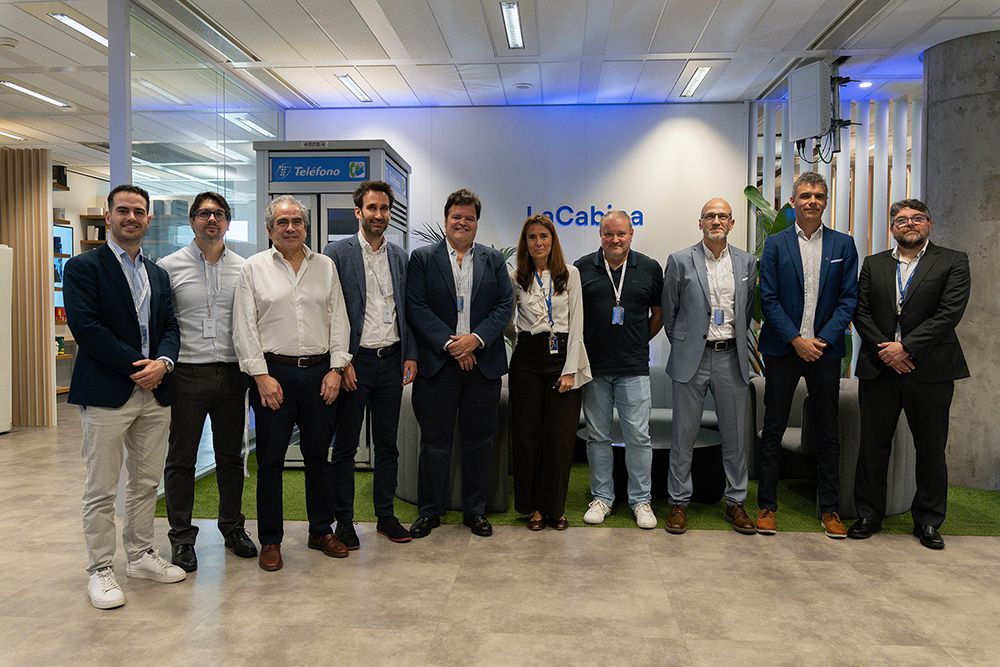
Spain aims to play a visible role in shaping the next generation of European cloud and edge infrastructures. Telefónica Spain, Arsys, Mondragon Corporation, and OpenNebula Systems, the four national companies directly involved in the IPCEI-CIS, have showcased their progress during the event “Digital Sovereignty and Edge within European IPCEI Projects: The 8th Initiative,” organized by Telefónica and Arsys.
The gathering provided context for an initiative that goes far beyond technology. IPCEI-CIS, also known as 8th, seeks to foster a European ecosystem of interoperable, open, and secure cloud and edge infrastructures, capable of reducing dependencies, strengthening data control, and enabling new digital services for companies, public administrations, and industry.
The European Commission describes IPCEI-CIS as the first Important Project of Common European Interest in cloud and edge computing. Its goal is to develop a multi-provider cloud-edge continuum, with federated, efficient, and reliable technologies for distributed data processing. The initiative comprises 19 direct projects led by European companies and around 100 indirect partners, with approved public funding of up to €1.2 billion and a total mobilization of up to €3.5 billion.
Digital sovereignty, but applied to real infrastructure
Digital sovereignty has become a widely used phrase in Europe, sometimes excessively. In this case, the debate grounds itself in a concrete necessity: having cloud and edge infrastructure that enables European organizations to run applications, process data, and deploy advanced services without fully depending on non-European providers or closed architectures.
During the event, Jesús Marcos from the Secretariat of State for Telecommunications and Digital Infrastructures (SETELECO) highlighted public-private collaboration’s role in these R&D projects. “IPCEIs are a key tool for European sovereignty. Without the momentum from the Recovery Plan and close cooperation between the public and private sectors, Spain couldn’t participate in projects of this scale. Our goal is for this effort to have a real and lasting impact,” he stated.
This statement encapsulates the program’s logic. Europe does not want to merely regulate cloud usage or enforce compliance. It aims to build its own technological capacity, promote interoperability, and create alternatives for sectors requiring control over data, latency, resilience, and compliance. This is especially relevant in areas such as industry, healthcare, public administration, finance, energy, and mission-critical digital services.
Telefónica Spain focused its contribution on deploying edge nodes and connectivity that ties these distributed capabilities together. Luis Almansa, an expert in IT Transformation Strategy at Telefónica Spain, explained that the company is deploying an edge node network across the country to transform data centers into low-latency micro data centers. He indicated that 17 nodes with available IT infrastructure are already in place, designed to allow clients to deploy applications requiring proximity, performance, and quick response times.
Arsys, Mondragon, and OpenNebula: three complementary pieces
Arsys showcased its work on an orchestration platform geared toward an open, multi-provider ecosystem. Javier Arnáez, manager of the Arsys Lab innovation department, emphasized data sovereignty as the project’s core. The idea is to enable companies to run applications and manage data on nearby edge nodes efficiently, with control and security, keeping data value within Europe.
This approach aligns with one of the major challenges in current cloud usage. Many organizations now operate across multiple clouds, private data centers, colocation facilities, edge environments, and specialized services. The issue isn’t just acquiring capacity but moving workloads, governing data, and operating services coherently without being locked into a single provider. Interoperability stops being a secondary technical issue and becomes a condition for genuine sovereignty.
Mondragon Corporation contributed an industrial perspective. Michel Íñigo, Senior Innovation & Technology Manager, highlighted that the project aims to deploy decentralized Artificial Intelligence solutions capable of optimizing production in real time. In factories and industrial settings, edge computing is not just a trend; it addresses the need to process data near machines, reduce latency, ensure operational continuity, and prevent sensitive data from having to leave towards a centralized cloud.
OpenNebula Systems’ contribution focused on the software layer. Alfonso Carrillo, Principal Edge Solutions Architect, and Pablo del Arco, Cloud & DevOps Innovation Engineer, advocated for the role of European open-source software in simplifying multi-provider sovereign clouds. “We provide the open-source software layer that reduces complexity in multi-provider sovereign clouds, ensuring unified management and workload portability,” they said.
OpenNebula occupies an interesting position in this conversation because its technology has long been aimed at managing private clouds, hybrid clouds, and edge environments with an open foundation. In a project like 8th, that layer can help different infrastructures work as part of a shared continuum rather than isolated islands.
The cloud-edge continuum as the foundation for new European services
The concept of the cloud-edge continuum is central to 8th. The aim isn’t to replace the cloud with the edge or to create a single, centralized European cloud, but to build a distributed infrastructure where data and applications can run in the most suitable location: a central data center, a regional node, a location near the user, a factory, or a specialized environment.
This is especially important for services that combine low latency, regulatory compliance, and data control. An industrial vision system, healthcare application, mobility platform, digital public service, or AI-based predictive maintenance solution may not always fit well into a remote cloud. Often, these require nearby processing but with the elasticity, management, and automation typical of cloud environments.
Spain has several advantages in this race. It benefits from telecommunications operators with national networks, cloud providers with enterprise experience, technological centers, advanced industry, and specialized cloud software companies. The challenge is to convert these assets into real, interoperable, and competitive services against major global platforms.
The event organized by Telefónica and Arsys demonstrates that Spanish participants are working across different layers of the same challenge: connectivity and edge nodes, multi-provider orchestration, decentralized industrial AI applications, and open software for managing the entire ecosystem. These pieces alone are not enough, but together they point toward an infrastructure closer to Europe’s vision: a distributed, secure cloud with greater data control.
The true impact of IPCEI-CIS will not only be measured by prototypes or presentations but by its ability to generate usable services for companies and governments, attract ecosystems, facilitate migrations, reduce technological dependencies, and foster sustainable business models. Digital sovereignty requires public investment but also viable products, customer adoption, and capable providers delivering quality service.
Spain is not starting from zero in this journey. The participation of Telefónica, Arsys, Mondragon, and OpenNebula in 8th positions the country as a relevant contributor in technology, use cases, and infrastructure. The next challenge is to move from European collaboration to deployments that demonstrate real value in practical settings.
FAQs
What is IPCEI-CIS or 8th?
It’s an Important Project of Common European Interest dedicated to next-generation cloud-edge infrastructures and services. Its goal is to create an interoperable, open, and secure European ecosystem for distributed data processing.
Which Spanish companies are directly involved?
The involved Spanish companies are Telefónica Spain, Arsys, Mondragon Corporation, and OpenNebula Systems.
Why is this important for digital sovereignty?
Because it aims to strengthen European control over data, infrastructures, and digital services, reducing dependencies and enabling interoperable cloud and edge alternatives for businesses and public administrations.
What does edge computing bring to the project?
Edge computing enables processing data close to users, factories, machines, or critical services, reducing latency and improving control, security, and operational continuity.
