
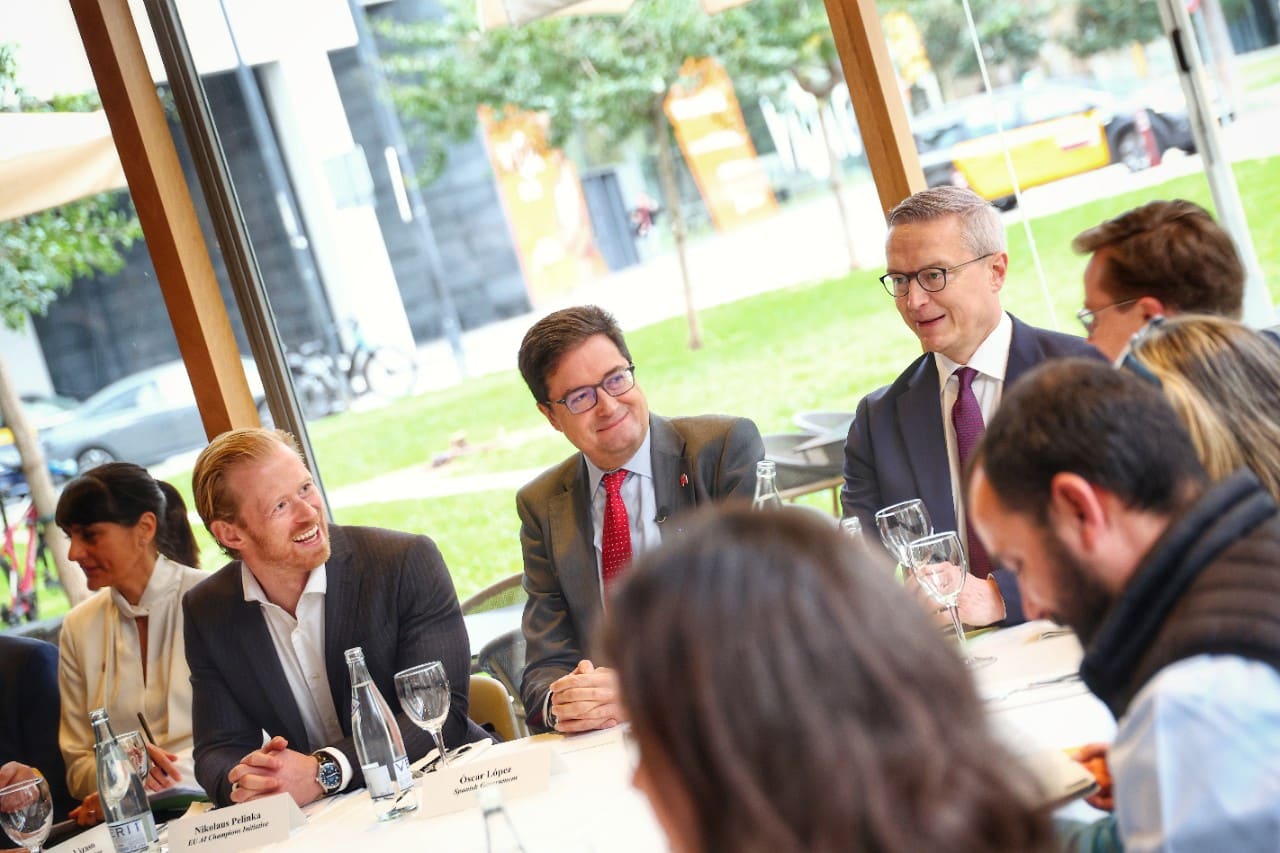
The race for digital sovereignty in Europe has shifted from an academic debate to a matter of industrial muscle, supply chains, and the actual capacity to deploy critical technology. In this context, the Spanish government has announced a 100 million euro contribution aimed at supporting Spanish companies developing projects related to European digital sovereignty, always in collaboration with partners from other EU countries. The announcement was made by the Minister for Digital Transformation and Public Function, Óscar López, during a meeting with his German counterpart, Karsten Wildberger, at Mobile World Congress 2026 in Barcelona.
This measure is part of the IPCEI AI (Important Project of Common European Interest – Artificial Intelligence), a European initiative driven by Germany to coordinate “unique and high-impact” projects at the continental level. According to the Ministry, its goal is to build a European ecosystem of next-generation Artificial Intelligence that spans from research and development to initial industrial deployments, with public-private collaboration across the entire value chain.
The political message: “Europe can’t go it alone”
The announcement comes at a time when, even within MWC, the conversation about AI is intertwined with a broader backdrop: who owns the data, where models are run, and what rules govern the infrastructure. On this note, the minister emphasized that Spain “is committed to the European AI race,” but that “we cannot go it alone,” calling for increased cooperation and a clear orientation towards the single market.
The event — organized by the EU AI Champions Initiative — brought together a broad range of Spanish and German companies: from operators and infrastructure manufacturers to banking, industry, and consumer sectors. The Ministry highlighted the presence of companies such as Telefónica, Indra, Santander, La Caixa, Iberia, Deutsche Telekom, Ericsson, Orange, SAP, Schwarz Group (Lidl), Mastercard, Volkswagen, and Nokia, alongside startups from both countries.
Nine Spanish candidates for IPCEI-AI
Beyond the official photo, the announcement comes with a concrete list: Spain has selected nine candidates to present to the European Commission within the framework of IPCEI-AI. A key condition, per the project scheme, is that these companies must seek partners in other member states to scale their proposals and achieve European dimension, a common requirement in pan-European initiatives.
Candidates selected by Spain (IPCEI-AI)
| Candidates Mentioned by the Ministry |
|---|
| IDIADA |
| OpenNebula |
| Indra |
| Multiverse Computing |
| Telefónica |
| Openchip |
| Ideaded |
| Horse Powertrain |
| Semidynamics |
The candidate companies will participate on March 10 and 11 in Berlin, in sessions designed to identify cross-border collaborations with other IPCEI-AI participants within the EU.
A “tractor customer” and a market demanding scale
In practice, the €100 million announcement acts as a lever to push projects that, by nature, require European scale: critical mass of data, distributed infrastructure, talent, and manufacturing capacity. Within the IPCEI framework, the logic is precisely that: financing strategic initiatives that are too big (or too risky) to undertake alone and that, in addition, generate ripple effects across multiple economies within the bloc.
International comparisons also matter. While the U.S. and China mobilize private and public investment at much higher rates, Europe is seeking its own lane: strengthening competitiveness without renouncing a framework of rights and regulation. The official narrative frames this effort within a “European model” aiming to combine innovation, regulation, competitiveness, and digital rights.
The Champions factor: private capital and results pressure
At the same time, the EU AI Champions Initiative is emerging as a business and investor backdrop. According to the Ministry, it is a pan-European coalition comprising more than 110 companies, ranging from startups to large conglomerates, with a private investment group led by General Catalyst with €150 billion allocated over the next five years.
This detail is significant for one reason: in AI, the market no longer just rewards announcements; it demands a roadmap, deployments, and returns. If combining public funds (like this €100 million) and private capital (through the initiative’s vehicle) works, IPCEI-AI could become a launchpad for European projects capable of competing in infrastructure, models, and applications.
The real question, as always, isn’t just intention but execution: administrative speed, the ability to coordinate partners across countries, and, most importantly, converting funding into products and deployments that go beyond demos. MWC 2026 has served as a showcase for the announcement; in the coming weeks, with Berlin as the meeting point, will be the first real test of European coordination.
Frequently Asked Questions
What is IPCEI-AI, and why is it important for Europe?
It’s a pan-European project to boost a next-generation AI ecosystem through public-private collaboration, from R&D to industrial deployments.
What do the €100 million announced by Spain consist of?
Funds allocated to Spanish companies for projects related to European digital sovereignty, linked to collaborations with partners from other EU countries.
What must the nine selected candidates do?
Seek cross-border alliances within the EU to give their projects a European dimension; collaboration sessions will be held on March 10 and 11 in Berlin.
What is the EU AI Champions Initiative, and what role does it play here?
It’s a pan-European business coalition supporting AI development in Europe; according to the government, it includes over 110 companies and has private investor backing of €150 billion over five years.
via: digital.gob.es