
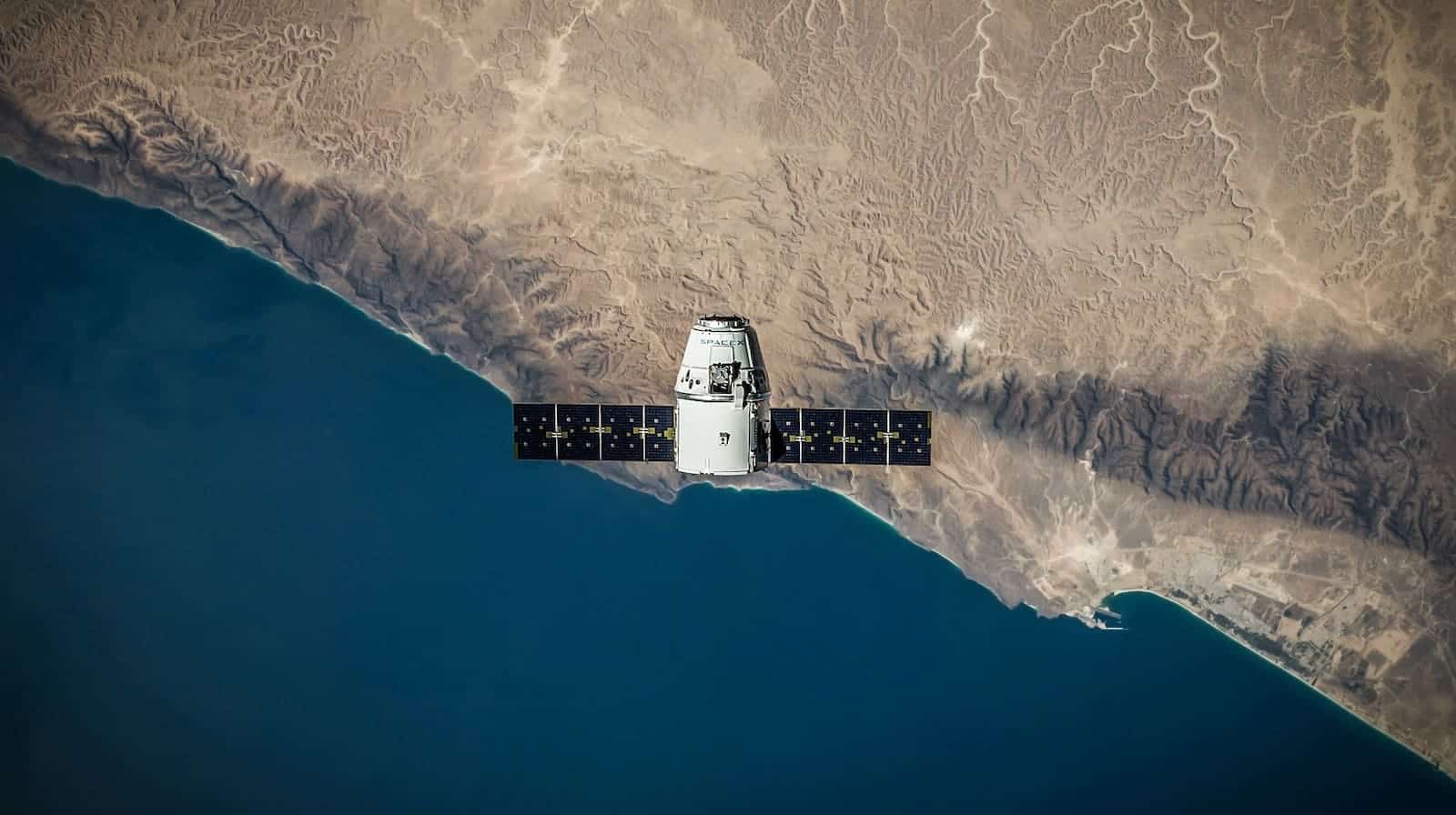
SpaceX has submitted a request to the U.S. Federal Communications Commission (FCC) to launch and operate up to 100,000 Starlink Gen3 satellites, also known as Starlink V3. The proposal, identified as SAT-LOA-20260630-00264, represents an unprecedented scale expansion for the company’s satellite internet network and aims at a new low Earth orbit (LEO) architecture.
The application does not equate to authorization. The FCC will need to review the file, analyze spectrum use, coordinate with other operators, assess interference risks, and consider orbital safety implications. However, the document clearly indicates SpaceX’s intentions: a much denser network with larger satellites, greater capacity per unit, and a reliance on Starship for large-scale deployment.
According to the information in the application, SpaceX proposes two main orbital ranges for this Gen3 constellation: between 323 and 327.5 kilometers and between 473 and 477.5 kilometers, with inclinations ranging from 26º to 96.9º. This means a very-low Earth orbit network, closer to the surface than many of the current Starlink layers.
A much larger constellation with heavier satellites
The figure of 100,000 satellites illustrates the project’s ambition but does not fully explain the technical shift. The Starlink Gen3 satellites would be significantly different from current models. Wccftech reports each unit could weigh up to 2,000 kilograms, compared to approximately 575 kilograms for Gen2 satellites as per the same information. Furthermore, there is mention of a larger platform, advanced phased-array antennas, bigger solar panels, new onboard computers, upgraded modems, and argon Hall thrusters for maneuvers and orbital maintenance.
This mass increase directly impacts launch hardware. Falcon 9 would no longer be the ideal launch vehicle for such a constellation if SpaceX aims to deploy efficiently. SpaceX promotes Starship as a system designed to deliver over 100 tons to orbit in a fully reusable configuration, aligning better with larger satellites and mass launches.
Starlink already represents the world’s largest satellite constellation. According to Space.com, as of June 1, 2026, there were 10,413 Starlink satellites in orbit, with 10,397 operational, based on tracking by astronomer Jonathan McDowell. Reuters also reported in January 2026 that the FCC authorized SpaceX to deploy an additional 7,500 Gen2 satellites, raising the total approved for that generation to 15,000.
The new Gen3 request goes far beyond this scale.
More capacity, new bands, and lower latency
Operating in such low orbits is straightforward in principle: the closer the satellite is to the user, the lower the latency. It also improves link budgets but requires deploying many more satellites to maintain coverage, because each one sees a smaller portion of Earth.
SpaceX aims to combine this proximity with a much broader spectral use. The request targets Ku, Ka, V, E, W, and D bands, with downlink frequencies such as 10.7–13.4 GHz, 17.3–21.2 GHz, and 37.5–42.5 GHz, as well as uplink bands reaching 231.5–275 GHz. The company also seeks authorization to operate some spectrum in a non-conforming manner, in unprotected regimes, ensuring no interference with existing users through good-faith coordination.
The architecture would include advanced beamforming via phased-array antennas, electronic beam steering, optical inter-satellite links, and dynamic power control to optimize capacity and reduce interference. Theoretically, this would support consumers, enterprises, governments, mobility services, mobile networks, and a new wave of connected AI devices.
Estimations based on the documentation suggest up to 1 Tbps of downlink capacity per satellite, with 160 to 200 Gbps of uplink and a combined radiofrequency and laser link capacity around 4 Tbps per satellite. These figures are intended as technical targets, not immediate commercial service levels.
| Element | Starlink Gen3, according to the request and published analysis |
|---|---|
| Satellites requested | Up to 100,000 |
| Orbital type | VLEO, very low Earth orbit |
| Nominal altitudes | 323–327.5 km and 473–477.5 km |
| Inclinations | 26º to 96.9º | Bands | Ku, Ka, V, E, W, D |
| Technologies | Phased-array, optical links, electronic steering, dynamic power control |
| Key vehicle | Starship |
Space is also beginning to resemble network infrastructure
The proposal confirms that Starlink is no longer just satellite internet for rural areas. SpaceX is building an orbital communications layer capable of competing in residential connectivity, backhaul, mobility, government services, defense, maritime and aerial connectivity, emergency coverage, and increasingly, networks for devices and AI systems.
The language of the request also points in this direction. SpaceX links Gen3 to “AI-driven progress” and the need for high upstream capacity. While this framing has clear commercial implications, the technical reality is that many future applications will not only download data from the internet but will also transmit video, sensors, telemetry, commands, images, and data from distributed locations.
An ultra-dense orbital network could serve unfibered areas, remote operations, ships, aircraft, defense, disaster response, mining, energy, agriculture, polar research, and industrial deployments where terrestrial connectivity is costly or fragile. It could also reinforce SpaceX as an infrastructure provider for government and enterprise clients, not just consumers.
The debate: orbital capacity, interference, and space debris
The challenge lies in the scale. 100,000 satellites are not a minor expansion. Although operation in VLEO can reduce satellite longevity due to atmospheric drag accelerating reentry, it also increases orbital traffic density and the need for coordination.
Low-altitude satellites have advantages for natural disposal, but maneuvers, collision avoidance, radio interference, sky brightness, and effects of repeated reentries will become increasingly contentious. Space.com notes that the size of Starlink already raises concerns among astronomers and space safety experts regarding its impact on observations, collision risks, and atmospheric reentry effects of large debris.
The FCC will also need to consider coexistence with other constellations and existing services. Amazon is advancing its Project Kuiper network, and operators like OneWeb/Eutelsat compete in different orbital layers. Increasingly, countries view orbital connectivity as a strategic infrastructure. Near-Earth space is becoming an extension of telecommunications networks, but it is not infinite or conflict-free.
A gamble dependent on Starship
The Gen3 application also represents a bet on fully industrializing Starship. Without a high launch cadence and a payload capacity well above Falcon 9, deploying 100,000 satellites weighing up to two tons each would be extremely complex and expensive.
SpaceX aims to close the loop: manufacturing satellites en masse, launching with its reusable heavy-lift rocket, operating them with its own network, selling global connectivity, and, if demand for AI and data grows as expected, turning low Earth orbit into another layer of the digital infrastructure.
This does not mean the project will be approved or fully deployed as proposed. Regulatory filings are often ambitious and flexible, allowing for adjustments, phases, and negotiations. But they signal the direction: Starlink Gen3 is not just a speed upgrade; it’s an attempt to scale satellite internet into a massive orbital network with more spectrum, capacity, and a much broader role in the digital economy.
The real question is no longer if Starlink will keep growing, but how much regulatory, technical, and orbital space the U.S. is willing to grant a single company to turn low Earth orbit into a global-scale communications network.
Frequently Asked Questions
What has SpaceX requested from the FCC?
It has requested authorization to launch and operate up to 100,000 Starlink Gen3 satellites in very-low Earth orbit.
Has the FCC approved these satellites yet?
No. This is a regulatory application. The FCC must review it before granting, modifying, or rejecting the authorization.
How would Starlink Gen3 differ from previous generations?
Larger satellites, increased capacity, use of more frequency bands, optical links between satellites, advanced antennas, and operation in lower orbits.
Why would Gen3 depend on Starship?
Because of their larger mass and size, Starship would be the logical vehicle for deploying them at scale more cost-effectively.
What risks does a 100,000-satellite constellation pose?
Increased orbital traffic, more complex coordination, potential interference issues, impact on astronomical observations, and more reentries of debris at end-of-life.
