
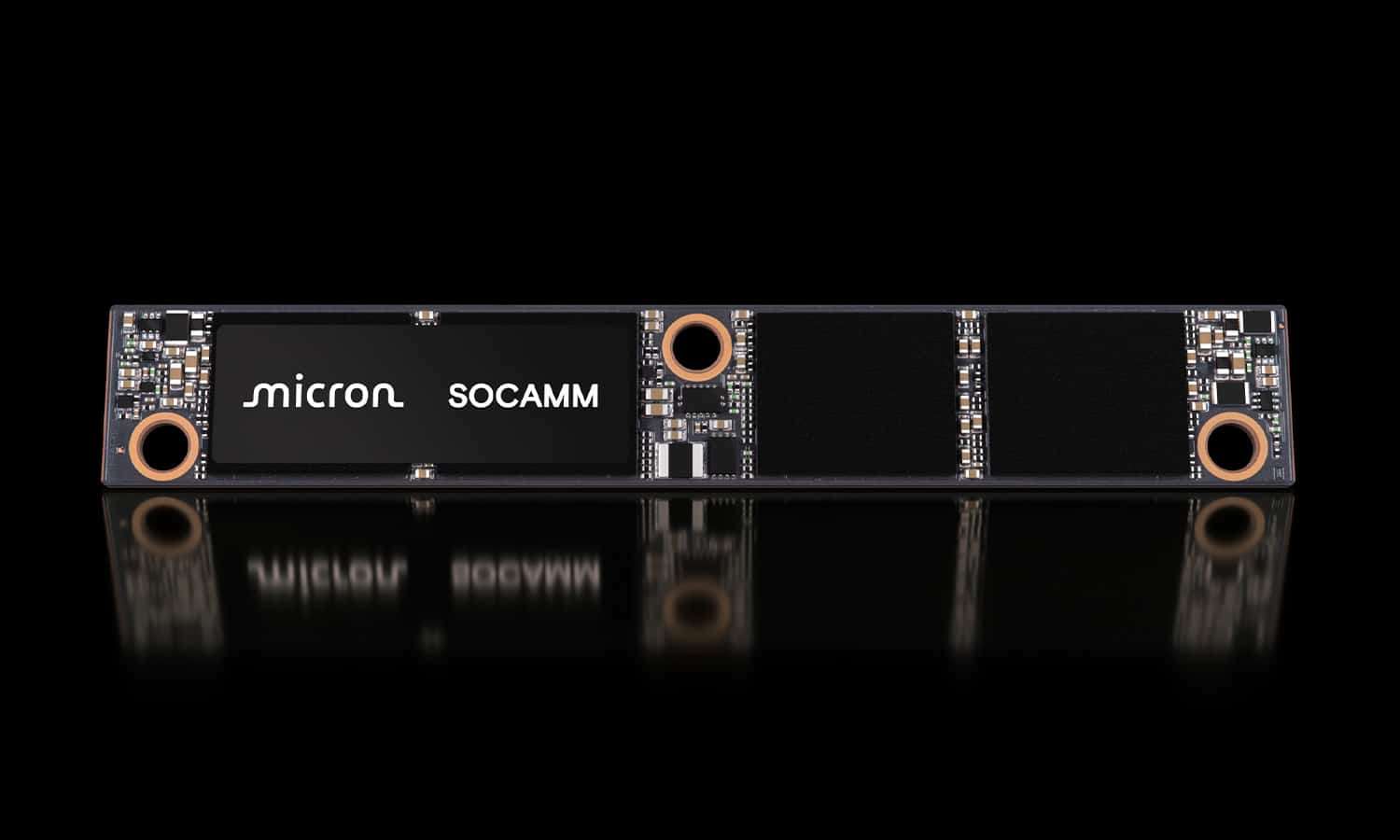
For years, the debate over memory in artificial intelligence data centers has almost always revolved around the same initials: HBM. It makes sense: the bandwidth of High Bandwidth Memory has become a pillar for training and running increasingly larger models. But in parallel, and almost quietly, another front is growing that points to something different: more modularity, higher density, and less reliance on “permanent soldered” on-board designs.
This is where SOCAMM (and its evolution, SOCAMM2) comes in—a module format based on LPDDR memory that NVIDIA has showcased as part of its AI system roadmap. The idea breaks away from the traditional “all fixed” approach on accelerated server boards: rather than placing the DRAM directly integrated and permanently soldered, it advocates for modules that can be mounted and replaced, opening the door to longer lifecycles, more flexible maintenance, and, most importantly, rethinking how system memory is distributed around large chips.
Why SOCAMM Matters Even if HBM Already Exists
HBM will continue to be the muscle for the GPU. But the entire system isn’t powered solely by that muscle: it also needs memory for CPU tasks, services, orchestration, queues, pre-processing, caches, and an increasing portion of inference where power efficiency and scalability are paramount. LPDDR has an advantage here in energy efficiency and density, and SOCAMM aims to turn it into a “server-ready” component in module format.
NVIDIA has positioned SOCAMM2 within the context of its Rubin platform and the evolution of large-scale systems, where the focus isn’t just on “more FLOPS,” but also on how to feed data into the machine without increasing power consumption and complexity. The promise, as described by industry insiders, is clear: package LPDDR into server-oriented modules, with closer integration to the processor and room for configuration changes without having to redesign an entire board.
Modularity: The Detail That Changes Operations
In practice, modularity has two very direct implications for infrastructure operators:
- Maintenance and Replacement: If a memory block fails, the “soldered-on” model turns repair into a logistical (and economic) nightmare. If memory is modular, replacement becomes more akin to a standard inventory operation.
- Server Lifespan: In environments where renewal cycles are shortened due to demand pressures, being able to extend deployment through partial changes (or at least avoid a full RMA for a single failure) offers a real operational advantage.
This doesn’t mean it’s “plug and play” like a traditional DIMM: SOCAMM isn’t emerging as a universal standard, and that’s precisely one of the current tensions.
The Big Question: Will There Be a Standard or Will Everyone Go Their Own Way?
Today, SOCAMM is seen as a move driven by NVIDIA, not as a standard established by JEDEC from the outset. And that matters: in memory, the standard defines scale, and scale determines price and availability.
According to industry sources circulating in Asia, Qualcomm and AMD are studying the integration of SOCAMM into future chips and server platforms for AI, which would expand the “SOCAMM front” beyond a single player. If this materializes, the push toward formalizing specifications, compatibility, and variants (module form factor, chip arrangement, energy management integration) would grow naturally, as no one wants to depend on a proprietary design to build a full range of products.
If this move is confirmed in products, the domino effect would be immediate: SOCAMM would cease to be “NVIDIA’s piece” and could become a format to be standardized or at least harmonized among multiple silicon designers.
The Inevitable Clash: LPDDR Also Powers Mobile Devices
This brings up the other side of the headline: SOCAMM is made from LPDDR. And LPDDR isn’t an infinite resource: it’s a key memory in the mobile market (and many client devices). If AI platforms start consuming significant volumes of LPDDR for servers, the market will feel the strain.
Industry circles are already talking about supply tensions and the need to coordinate capacity between high-value memories (HBM) and high-volume memories (LPDDR), especially if AI demand continues to grow and data centers compete for any component that can improve density and efficiency. In other words: even without “dramatic shortages,” sustained pressure can push prices upward and force manufacturers to prioritize ranges and clients.
What Infrastructure Teams Should Watch in 2026
For systems, procurement, or capacity planning teams, SOCAMM signals several ongoing trends:
- Increased hybrid memory designs: HBM for the GPU, but modular LPDDR for the rest of the system and inference profiles where cost is king.
- Greater emphasis on serviceability and repairability: Modularity isn’t just engineering; it’s about availability and recovery times.
- Risk of “orphaned formats”: Without sufficient standardization, operational risk is ending up with platforms that are difficult to maintain long-term.
- Impact on prices and supply chains: If LPDDR becomes a core component of AI servers, purchasing cycles and supply reservations could tighten.
In summary, SOCAMM isn’t meant to overthrow HBM. It’s filling a gap that AI servers have left open: efficient, scalable, and more “operable” memory in a world where everything accelerates… and where replacing each component without redesigning an entire board is highly valuable.
Frequently Asked Questions (FAQ)
What is SOCAMM, and how does it differ from traditional server RAM?
SOCAMM is a modular approach based on LPDDR, aimed at AI platforms. Unlike “soldered-down” approaches, it seeks modularity and more energy-efficient design, with integration meant for accelerated systems.
Does SOCAMM replace HBM in AI GPUs?
No. HBM remains the critical memory for feeding the GPU with extreme bandwidth. SOCAMM targets system memory and architectures where efficiency and density are as important as raw performance.
Could SOCAMM cause LPDDR prices to rise or lead to shortages elsewhere?
If LPDDR use in servers grows enough, it could strain the supply chain and impact availability and prices, especially during periods of high demand.
What should infrastructure managers require before investing in SOCAMM?
Clear compatibility standards, availability of spare parts, long-term support commitments, and signals of standardization (or multi-vendor adoption) to avoid dependence on overly proprietary formats.