
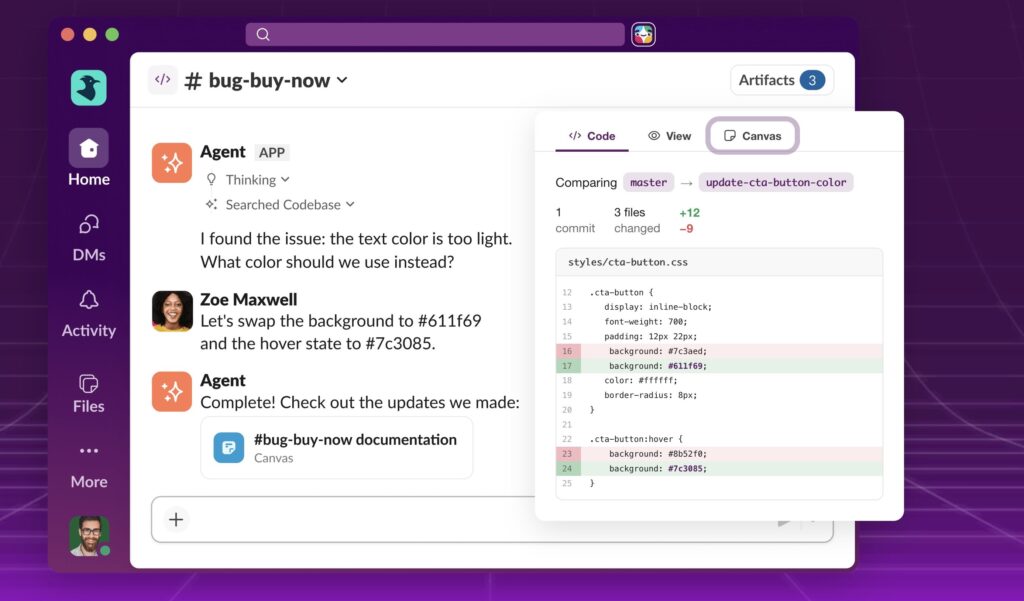
Slack wants AI coding to stop being a private chat between one developer and their assistant. The platform has introduced Slack Code, a collaborative space where human teams and agents like Claude, Devin, GitHub Copilot, ChatGPT, or Vercel agents can work on the same task, review code changes, and get ready to deploy without leaving Slack.
Slack Code in 20 seconds
- Slack Code adds dedicated channels for working with programming agents alongside the rest of the team.
- You can check code diffs, documentation, and previews right from Slack.
- Initial partners include Anthropic, Cognition, GitHub, ChatGPT, and Vercel.
- Sensitive actions, like deploying to production, may require human approval.
- Slack Code is available for Slack plans, but each agent needs its own access.
The approach reflects a shift showing up in development tools. Code assistants first appeared mainly as individual copilots inside editors or terminals. Newer agents can handle more complete tasks, look up information, change multiple files, and prepare changes with more autonomy. Slack now wants to bring that interaction into the space where developers, product managers, designers, and other teams already talk.
What Slack Code is and how it works
The core new feature is Code Channels, channels built specifically for developing a task with one or more agents.
Slack’s proposed workflow is fairly simple. Facing a bug, a new feature, or a change to an application, a team member can call a compatible agent. From there, a dedicated code channel is created for that work.
Instead of a session between just one person and the AI, channel participants can follow what the agent is doing, review proposed changes, compare versions, check previews, and give extra instructions.
The difference from just dropping a chatbot into Slack is the nature of the workspace. Code Channels are built to produce results, not just hold conversations.
For example, a product manager might spot an issue reported in Slack and ask an agent to look into a fix. The agent could use the available context, review shared documentation and screenshots, and prepare a change.
A developer could then join the same channel to review the diff, check the result, and authorize creating a pull request (PR).
Slack even imagines people without advanced programming skills taking part in certain steps. That doesn’t mean any employee can replace engineering work, but that context and decisions around development can be shared with more roles without needing a terminal or IDE.
When the work is done, the channel can be archived and kept as searchable history.
ChatGPT, Claude, Devin, and Copilot join the channels
Slack Code is designed as an open platform supporting several agent providers.
Its initial partners include Anthropic with Claude, Cognition with Devin, GitHub Copilot, ChatGPT, and Vercel agents. These companies are building integrations through the Code Channels APIs.
That matters because Slack isn’t trying to force a single AI model for programming. It wants to be the collaborative layer where multiple agents and their teams interact.
The company also plans to open these APIs to more developers.
If it works, Code Channels could eventually handle tasks beyond software development. Slack mentions marketing or legal document review as possible extensions.
This fits a wider trend in enterprise AI: moving from the copilot that answers questions to the agent that takes a task and uses tools to complete it.
But that shift brings a new challenge. When an agent can change code, reach repositories, or act on corporate systems, controlling what it can do matters far more than when AI only produced text.
Slack is building a dedicated interface for living with agents
Code Channels aren’t arriving alone. Slack is updating other parts of its interface to give agents a distinct presence.
Agent DMs let users chat directly with agents, similar to private messages with colleagues, but the agents are marked as such.
There’s also an Agents tab to check on agents and sessions, watch statuses, find blocked conversations, or stop ongoing tasks.
Another feature, Add to Slack, aims to make it easier to add agents built with outside platforms and tools. Slack lists compatible solutions including NanoClaw, Lovable, Hyperagent, Superhuman, n8n, Vercel, ChatGPT, LangChain, Runlayer, and Skydive. The process automates things like OAuth, configuration, and environment variables, per the company.
Identity management is another key piece. As companies deploy dozens or even hundreds of agents, they need to track which agent did each action, with what permissions, on whose behalf, and over which resources.
Slack says these agents fall under its existing security, permissions, and admin controls.
For especially sensitive operations, human oversight stays. Deploying code to production, for instance, can be prepared by an agent but needs a specialist to review and approve it first.
From individual coding to collaborative AI
The most interesting part of Slack Code may not be writing code through a messaging app.
The real shift is making the work agents do visible.
Today, a developer can have a long session with a coding agent inside their terminal or editor. The AI analyzes the problem, suggests options, and ends up generating a change. When that work reaches the team through a pull request, much of the reasoning and context can stay in that private session.
Slack wants that process to happen out in the open, in front of the team.
That can help projects where product, design, and engineering work closely together, but it also raises questions. More participants in a session don’t guarantee better decisions, and the speed of code generation makes solid technical review even more necessary.
Traditional tools remain essential. Git repositories, continuous integration, automated tests, development environments, and observability platforms are still part of the software cycle.
Slack Code aims for another layer: where humans and agents coordinate work before changes go into the product.
Its availability reflects that. It can be used on various Slack plans, but access to specific agents has to be contracted or enabled separately, and availability may vary by region and provider agreements.
AI-assisted coding started by completing lines in an editor, then grew into chat-based functions that generate whole features, and more recently into agents that can work across entire repositories.
Slack Code’s next move is to stop agents from working only for individual users and let them take part in shared team spaces.
Frequently Asked Questions
What is Slack Code?
Slack Code is a Slack space focused on collaborative work with programming agents. Its Code Channels let conversations, code changes, previews, and reviews live in one place.
Which agents does Slack Code support at launch?
Initial partners include Anthropic with Claude, Cognition with Devin, GitHub, ChatGPT, and Vercel, with agents like Claude, Devin, and GitHub Copilot. The plan is to widen the ecosystem through their APIs.
Can an agent deploy code straight to production?
Slack includes controls for human oversight on sensitive operations. An agent can prepare a change, but a specialist has to review and approve it before deployment.
Does Slack Code replace GitHub or development environments?
No. Slack Code mainly acts as a collaborative space to coordinate work between humans and agents, while repositories, tests, and other tools stay part of the development cycle.
via: salesforce
