
The next big battleground for memory in Artificial Intelligence could be decided not just by capacity or bandwidth but by the method of physically joining each layer of the chip. This is the interpretation from the new analysis by Counterpoint Research, which predicts that SK hynix will adopt hybrid bonding for HBM5 and that this generation will enter the market around 2029-2030, alongside the next major cycle of AI GPUs. According to the firm, this shift would mark the transition of hybrid bonding from a promising technology into large-scale production within the HBM market.
Counterpoint’s thesis isn’t without foundation. In March 2026, Applied Materials and SK hynix announced a long-term R&D partnership to accelerate innovations in next-generation DRAM and HBM, with joint work on materials, process integration, and advanced packaging at the new EPIC Center in Silicon Valley. Applied also explained that these initial programs aim to explore new materials, complex integration schemes, and HBM-specific packaging solutions, with the goal of enhancing performance and manufacturability in future memory architectures.
Also on this roadmap is BESI. Applied describes its Kinex system as a hybrid bonding die-to-wafer platform developed in collaboration with BE Semiconductor Industries. Designed for high-volume manufacturing environments, it is optimized for applications such as HBM, 3D circuits, and co-packaged optics. The company emphasizes that the system integrates wet cleaning, plasma activation, and inline metrology to control overlay and performance — elements that become critical as the industry scales advanced packaging toward mass production.
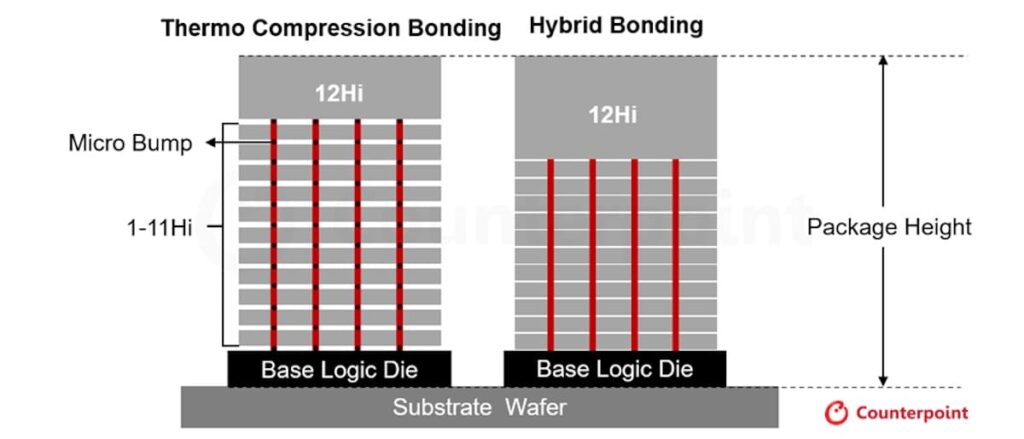
The technical basis of this shift is well understood, but it is becoming increasingly urgent. Current HBM relies heavily on microbumps and processes like thermo-compression bonding, solutions that have served well so far but are starting to show limits as stack heights increase, pitches decrease, and power, height, and thermal efficiency demands grow. Counterpoint argues that hybrid bonding offers clear structural advantages: finer interconnections, reduced die-to-die spacing, lower overall height, and better energy efficiency. In essence, this isn’t just packaging refinement but an industrial architecture shift essential for continuing to scale HBM beyond current generations.
The interesting part is that SK hynix is already preparing the commercial groundwork for this transition, even if it hasn’t officially spelled out a closed roadmap toward HBM5. In its public communications in 2026, the company has made clear that its immediate focus is on HBM3E and HBM4, two families it considers central to the memory supercycle driven by AI. For instance, at MWC 2026, it showcased HBM4 for next-gen data center platforms, featuring 2,048 I/Os, bandwidth 2.54 times wider than previous generations, and over 40% improvement in energy efficiency, alongside its DDR5 offerings and modules tailored for AI and server environments.
This suggests the 2029-2030 window mentioned by Counterpoint aligns with a phased evolution: first HBM4 and broadening of the AI ecosystem in the short term, followed by HBM5 where hybrid packaging won’t just be a laboratory curiosity but an industrial requirement for further increases in density, bandwidth, and efficiency. In this scenario, the advantage will not only depend on cell quality but also on the ability to integrate materials, chemical-mechanical polishing, surface control, bonding, and performance within a unified manufacturing chain.
Counterpoint also highlights a strategic factor beyond the process itself: the structural scarcity of memory for AI. The firm warns that accelerating AI adoption could intensify supply bottlenecks through the end of the decade, with 2028 perhaps serving as a turning point when new production clusters become operational. From this perspective, moving the supply chain toward hybrid bonding earlier would have not only technical implications but also commercial ones: whoever masters this transition first will be better positioned to protect margins, performance, and market share in a segment where demand outpaces capacity.
For now, the big question isn’t whether the industry will move toward hybrid bonding for HBM, but when. Counterpoint believes HBM5 will be the real turning point. Meanwhile, Applied Materials is already discussing tools specifically optimized for HBM and volume production. SK hynix is positioning itself through partnerships, HBM4 showcases, and an explicit strategy to sustain the AI memory supercycle. The conclusion is quite clear: although there’s no official “hybrid HBM5” announcement from SK hynix yet, the directional course is becoming quite evident.
Frequently Asked Questions
Has SK hynix officially confirmed that HBM5 will use hybrid bonding?
Not publicly and explicitly. What exists now is a Counterpoint Research forecast placing that adoption around 2029-2030 and a series of industry moves pointing in that direction.
What role do Applied Materials and BESI play in this?
Applied and SK hynix have announced a joint R&D alliance for next-gen DRAM and HBM, and Applied markets Kinex, a hybrid bonding platform developed with BESI and optimized for HBM and other advanced applications.
Why is hybrid bonding so critical for HBM5?
Because it allows for finer pitches, lower stack heights, improved energy efficiency, and higher bandwidth than microbump-based approaches — especially crucial as HBM stacking scales up in layers and thermal demands grow.
What is SK hynix’s closest publicly available roadmap?
The company’s current focus is on HBM3E and HBM4 as the drivers of the ongoing AI memory supercycle, and at MWC 2026 showcased a HBM4 with 2,048 I/Os, offering 2.54 times more bandwidth than previous generations and over 40% better energy efficiency.