
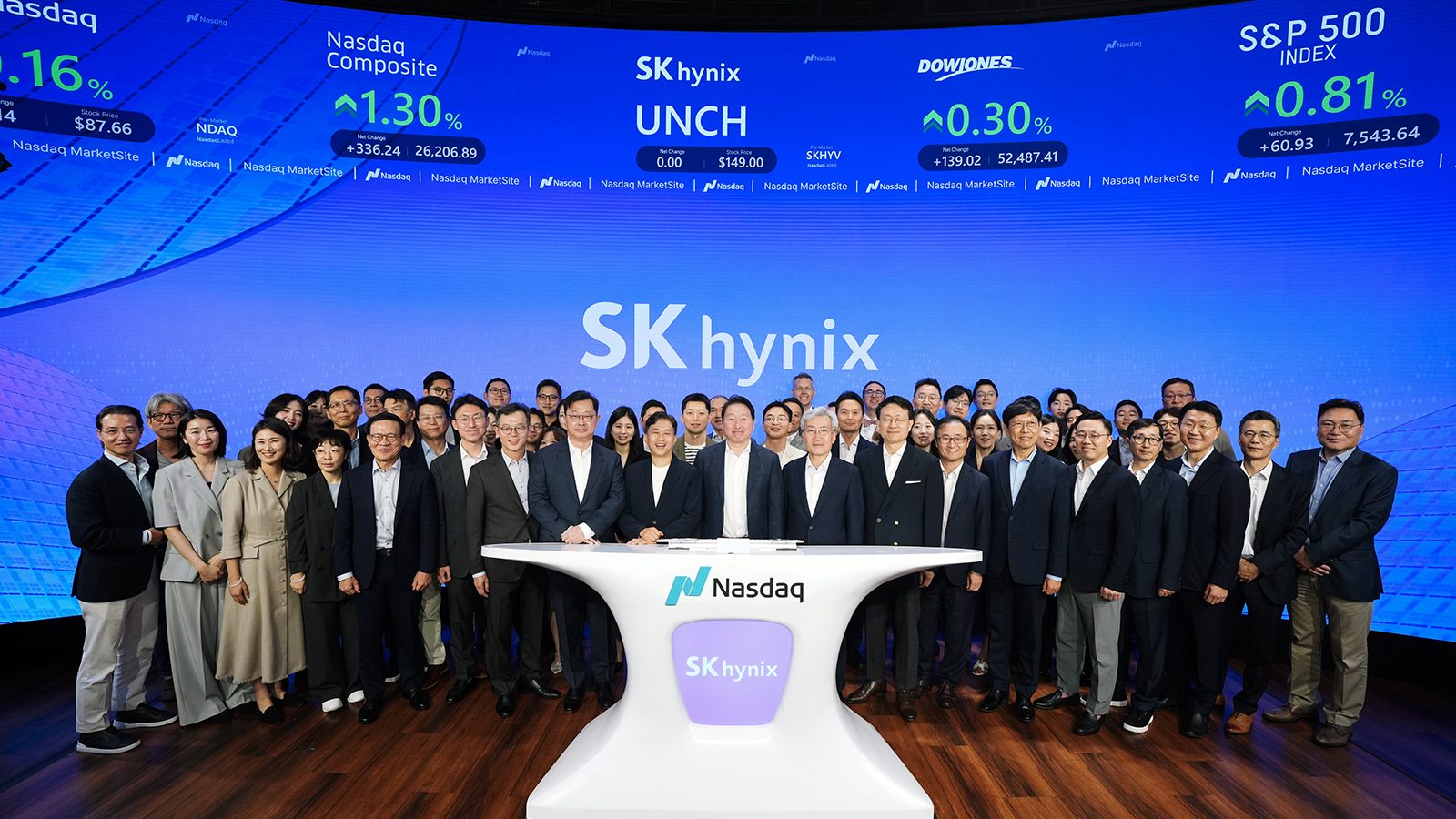
SK hynix has made its debut trading in the United States with a deal that shifts the financial landscape of the memory market. The South Korean manufacturer raised $26.5 billion through an ADR offering on the Nasdaq, funds which will be used to expand DRAM and HBM production, install new lithography equipment, and strengthen advanced packaging needed for artificial intelligence accelerators.
Key facts about SK hynix’s debut in 20 seconds
- Funds raised: $26.5 billion.
- Offer details: 177.9 million ADRs at $149 each.
- Conversion rate: Ten ADRs represent one SK hynix common share traded in South Korea.
- Demand: The issuance received requests worth more than seven times the available volume and attracted over 500 institutions.
- First trading session: ADRs closed at $168.01, a 12.8% premium over the offering price.
- Stock ticker: Trading initially began under SKHYV and will change to SKHY on July 13.
- Market capitalization: Approximately $1.03 trillion at debut.
- Industrial goal: Increase capacity for HBM, advanced DRAM, and packaging for AI systems.
Although presented as the largest IPO by a foreign company in the U.S., it is not a conventional IPO. SK hynix had been trading in South Korea for decades. The operation combines a capital increase with the listing of U.S. depositary receipts on Nasdaq, a structure allowing investors to gain exposure to the company in dollars and during U.S. market hours.
The scale is exceptional. The offering surpassed the nearly $25 billion raised by Alibaba in 2014, becoming the largest U.S. placement by a foreign issuer. The lead banks were Bank of America, Citigroup, Goldman Sachs, and JPMorgan, along with nine other entities.
The deal is driven not only by excitement over AI-related memory demands. Manufacturing high-bandwidth memory (HBM) requires growing investments in wafers, lithography, interconnections, and packaging. High-bandwidth memory isn’t just a faster DRAM module; it stacks multiple chips vertically connected to feed GPUs with data flows far exceeding conventional memory capacities.
Each new generation increases manufacturing complexity. Producers must control chip thickness, stack alignment, electrical connections, temperature, and yield. Properly processed wafers can lose value if defects emerge during cutting, stacking, or final testing.
That’s why encapsulation capacity has become as critical as DRAM manufacturing itself. SK hynix has gained advantage by coordinating its memory products with Nvidia’s accelerators for years and reserving capacity for products like HBM3E and HBM4 before the current market volumes emerged.
SK hynix versus Samsung, Micron, and Nanya
The following table compares the reference stock valuations and some key data of the leading companies exposed to the memory market. The figures are recent but fluctuate daily and are not entirely comparable: Samsung combines memory, mobile, displays, electronics, and foundry operations, while Nanya is heavily focused on conventional DRAM.
| Company | Reference Market Cap | Market Position | Relevant Data |
|---|---|---|---|
| SK hynix | ≈1.03 trillion dollars as of 07/10/2026 | About 56.4% of the HBM market and nearly 29% of DRAM | Raised $26.5 billion on Nasdaq; 2025 revenues near $65 billion; preparing advanced encapsulation in Indiana |
| Samsung Electronics | 1.10 trillion dollars at end of May; lost over $80 billion in value on 07/06/2026 | About 38% of DRAM; biggest rival in HBM; largest memory manufacturer by sales | Estimated Q2 revenue of 171 trillion won and operating profit of 89.4 trillion won |
| Micron Technology | 1.09 trillion dollars at end of May 2026 | About 22% of DRAM; third largest global HBM supplier | Committed over $250 billion in the U.S. through 2035; secured memory orders worth $22 billion |
| Nanya Technology | ≈47 billion dollars as of 07/10/2026 | Smaller manufacturer of conventional DRAM; not a direct competitor in advanced HBM | Gross margin of 79.5% in Q2; plans to invest $6.2 billion in 2027 |
Samsung, Micron, and SK hynix valuations surpassed or hovered around a trillion dollars during Q2 2026, fueled by memory prices rising and expectations that data center demand will stay above supply. Reuters estimated at end-May Samsung at $1.10 trillion, Micron at $1.09 trillion, and SK hynix at $1.34 trillion, though all three saw adjustments afterward.
SK hynix debuted in the U.S. market with approximately $1.03 trillion valuation. The company controls about 56.4% of the HBM market, according to MarketWatch data, maintaining its position as one of the top two global DRAM and NAND manufacturers.
Samsung retains a larger industrial scale and higher share in traditional DRAM. Counterpoint estimates its market share around 38%, compared to 29% for SK hynix and 22% for Micron. In HBM, SK hynix gained early ground with Nvidia’s chips, while Samsung has had to accelerate validation and ramp up production to catch up.
Preliminary results from Samsung show that a favorable market environment benefits not only the HBM leader. The company forecasted second-quarter revenues of 171 trillion won and operating profit of 89.4 trillion won—nearly nineteen times the same period in 2025. Average prices for DRAM and NAND increased by about 44% and 53%, respectively, quarter-over-quarter.
Micron offers a different scenario. As the only major U.S.-based DRAM and HBM manufacturer trading on Wall Street, it benefits from a higher valuation. The company is expanding factories in New York, Idaho, and Virginia, upping its U.S. investment commitment to over $250 billion through 2035. It also reported secured supply agreements worth $22 billion with customers in data centers, automotive, and consumer markets.
Nanya is not a direct rival for HBM but illustrates how widespread the shortage has become in traditional DRAM. The Taiwanese producer achieved a gross margin of 79.5% in Q2, up from -20.6% a year earlier. Its market value was around $47 billion, with plans to quadruple its annual investment by 2027.
This contrast is revealing. SK hynix commands a premium for leading the most advanced memory for AI, yet Nanya enjoys extraordinary margins without producing HBM. The reallocation of wafers toward data center products has reduced the available supply of DDR4, DDR5, LPDDR, and NAND, pushing prices higher across nearly all segments.
The $26.5 billion will also be invested after wafer production
SK hynix will allocate the funds to projects such as the first factory in the Yongin cluster, expansion of Cheongju facilities, and the P&T7 packaging and testing line. It also expects to receive new EUV lithography equipment before the end of 2027.
Yongin will host an increasing share of next-generation DRAM production. This project is part of a broader expansion within South Korea, aimed at ensuring sufficient capacity to meet orders from large cloud providers and accelerator manufacturers.
Cheongju will play a particularly important role in HBM. After memory chips are manufactured, they must be thinned, stacked, connected, and subjected to thermal and electrical testing. This phase currently limits the number of units shipped almost as much as wafer availability.
The company is also building an advanced packaging plant in West Lafayette, Indiana, valued at around $4 billion. Scheduled to open around 2028, it will be SK hynix’s first major U.S. factory and could receive up to $458 million in grants and $500 million in loans under U.S. semiconductor legislation.
The U.S. facility will not replace Asian manufacturing but will focus on a strategic stage of the HBM supply chain, collaborating with universities and clients designing accelerators, processors, and AI systems.
For SK hynix, the capital raised reduces reliance on debt or a single-cycle profit for expansion. The company went from posting operational losses of 7.73 trillion won in 2023 to achieving a record operating profit close to $31 billion in 2025.
There is also a cost to existing shareholders: ADRs are backed by new shares, increasing the total number of shares outstanding and diluting ownership. The market has accepted this dilution, anticipating that the investment will create sufficient capacity and profits to justify it.
Valuation depends on supply shortages lasting several years
Kwak Noh-jung, CEO of SK hynix, believes 2027 could be the worst supply year in the industry’s history. He expects customer demand to remain above supply even beyond 2030.
This outlook explains why investors valued the company near a trillion dollars and requested seven times the available ADRs. If shortages persist, SK hynix could sell virtually all its production at high prices and through multi-year deals.
Risks include a moderation in cloud provider investments. Giants like Microsoft, Meta, Amazon, and Alphabet are committing enormous sums to data centers, but they need to prove AI services generate enough revenue to sustain that pace.
Reducing their budgets would first impact future GPU and HBM orders. Memory is also cyclical: when multiple manufacturers expand capacity simultaneously, shortages can quickly turn into oversupply.
SK hynix also has high exposure to Nvidia and a small number of large clients. Its technological leadership provides bargaining power, but much of its growth depends on product schedules and purchasing decisions by a few companies.
Samsung has a more diversified portfolio but must regain ground in HBM. Micron offers a U.S.-based alternative with strong public incentives, though some of its new factories will take years to become fully operational. Nanya benefits from the price of traditional DRAM but could see margins shrink quickly if capacity is reintroduced to the market.
The Nasdaq listing turns these industry differences into a direct comparison for U.S. investors. No longer is it necessary to choose between Micron and funds with indirect exposure to South Korea. SK hynix can now be bought on the same exchange, with the same currency and in the same time zone as Nvidia, AMD, or Broadcom.
The $26.5 billion raised provides the company with room to defend its lead in HBM4 and prepare for future generations. The key factor, less visible than the stock debut, will be how many wafers it can produce, how many stacks pass testing, and how quickly it can deliver validated memory for upcoming AI accelerators.
Frequently Asked Questions
Is SK hynix more valuable than Samsung Electronics?
Both companies exceeded a trillion dollars during 2026 and have traded positions based on stock prices. Samsung is more diversified, while SK hynix is much more exposed to cyclical memory and HBM markets.
Why is HBM more difficult to manufacture than conventional DRAM?
Because it stacks multiple chips inside a single package, requiring precise thinning, alignment, bonding, and testing of each layer without compromising thermal or electrical performance.
Which competitor poses the biggest threat to SK hynix?
Samsung has greater scale and investment capacity, while Micron benefits from strong U.S. industry support and an increasing HBM presence. The biggest threat depends on who validates their next-gen products first with Nvidia and other accelerators.
Does supply shortage mean stocks will keep rising?
Not necessarily. Valuations currently discount several years of strong demand. A slowdown in data center spending, manufacturing issues, or a rapid increase in capacity could push prices and profits lower.
