
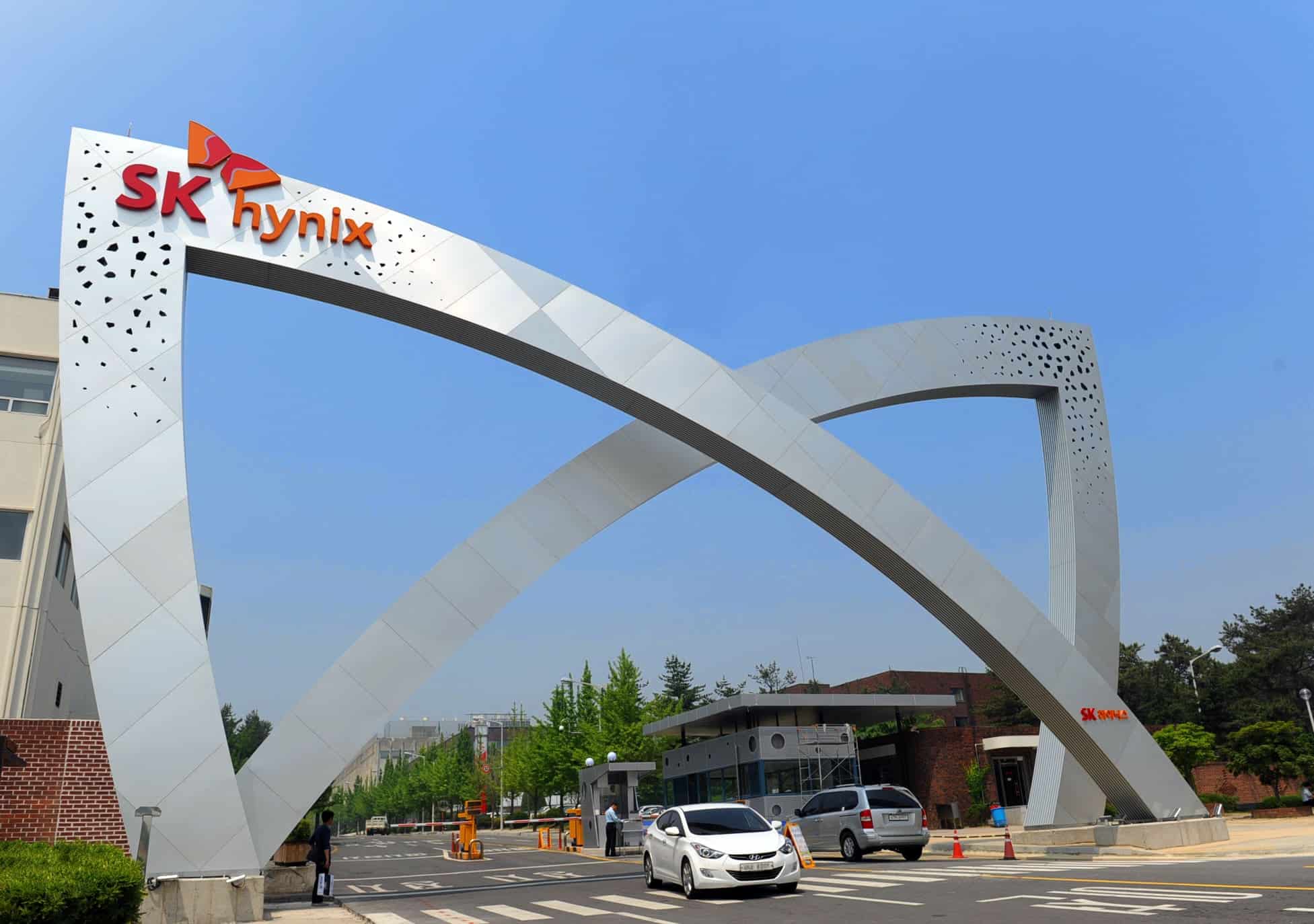
SK hynix has approved the issuance of American Depositary Receipts (ADRs) on the Nasdaq, in a move that could become one of the largest capital raises directly linked to the AI infrastructure boom. The South Korean memory manufacturer plans to issue up to 17.79 million new ordinary shares, which will form the basis for the ADRs trading on the Nasdaq Global Select Market.
The headline figure is substantial: 45.45 trillion won, approximately $29.4 billion at current exchange rates. The final amount will depend on the demand survey among institutional investors, but the decision confirms a growing trend in the sector: AI investment is no longer solely funded by operational profits, but increasingly by large capital operations to build factories, purchase equipment, and secure production capacity for years to come.
This move comes at a particularly favorable time for SK hynix. The company has become a major beneficiary of high-bandwidth memory (HBM) demand, a critical component for AI accelerators. The market rewards those capable of supplying large-scale advanced memory, and SK hynix aims to leverage this window to strengthen its balance sheet and finance industrial investments that will position it against Samsung, Micron, and other competitors.
An ADR issuance with an industrial purpose
The structure approved by SK hynix’s board of directors involves new shares, not existing securities. Each ADR will represent 0.1 ordinary shares, meaning 10 ADRs will equal one common share. The communicated reference price is 2,555,000 won per common share, based on the closing price on June 23, 2026, though the final price will be set after the bookbuilding process.
The ADR is scheduled to commence trading on July 10, 2026, on the Nasdaq Global Select Market. Subscription and payment are set for July 14, with the associated new ordinary shares expected to be listed on July 29. The deal will be led by BofA Securities, Citigroup Global Markets, Goldman Sachs (Asia), and J.P. Morgan Securities.
| Key Data | Details |
|---|---|
| Type of operation | ADR on new shares |
| Market | Nasdaq Global Select Market |
| Maximum new shares | 17,790,000 |
| Conversion | 1 ADR = 0.1 common share |
| Reference price per share | 2,555,000 won |
| Reference price per ADR | 255,500 won |
| Maximum planned amount | 45.45 trillion won |
| ADR listing date | 07/10/2026 |
| Subscription and payment | 07/14/2026 |
| New ordinary shares listing | 07/29/2026 |
| Depositary | Citibank, N.A. |
| Share registrar | Korea Securities Depository |
The use of funds is as important as the amount raised. SK hynix has indicated that the proceeds will be fully dedicated to investments in facilities. The plan includes the construction of Phase 1 of the Y1 factory at the Yongin Semiconductor Cluster, the Cheongju P&T7 advanced packaging plant, and investments in equipment and facilities related to EUV scanners.
The industrial implications are clear. SK hynix is not raising capital for operating expenses, buybacks, or acquisitions. It is securing funds to expand capacity in the most critical segments of the AI supply chain: memory manufacturing, advanced packaging, and lithography equipment.
HBM makes SK hynix a strategic asset
HBM memory is no longer a secondary component. In current AI systems, GPUs and accelerators need to transfer enormous amounts of data between memory and processing units. When the bottleneck lies in feeding the processor with sufficient bandwidth, memory becomes a performance factor as important as the main chip itself.
SK hynix has established a prominent position here. The company has been a major supplier of HBM for AI accelerators and has captured much of the investor enthusiasm around AI infrastructure. Its Nasdaq listing is not just about raising money; it also aims to increase visibility among U.S. investors, improve comparability with other sector players, and access a broader capital base.
This move follows months of speculation. SK hynix had acknowledged exploring an ADR issuance in the U.S., but details about size, timing, or structure were not finalized. The decision on June 24 turns that possibility into an official plan, subject to final pricing and market conditions.
For U.S. investors, ADRs provide direct exposure to one of the key companies in the AI supply chain without the need to operate on the Korean stock exchange. For SK hynix, the benefit lies in trading within a financial marketplace where many of the major AI themes are already active, from accelerator manufacturers to cloud infrastructure and semiconductor providers.
Factories, packaging, and EUV: funds target bottlenecks
Understanding the planned use of funds sheds light on why this operation matters beyond the stock market. Yongin is one of South Korea’s major industrial projects aimed at strengthening its semiconductor leadership. The Y1 factory is part of a cluster designed to centralize production, suppliers, and advanced capabilities around memory.
Cheongju P&T7 aims at another front: advanced packaging. AI doesn’t just rely on making smaller chips. It also requires efficient integration of memory and logic, improved interconnects, reduced latency, and increased bandwidth. Advanced packaging has become a critical layer, enabling higher system performance even as traditional miniaturization becomes more complex and costly.
Mention of EUV is also significant. Extreme ultraviolet lithography is among the most expensive and challenging technologies in advanced semiconductor manufacturing. While memory and logic have different dynamics, investing in EUV scanners highlights the necessity for complex equipment in AI memory supply chains to stay competitive.
| Funding destinations | Strategic insights |
| Yongin Semiconductor Cluster Y1 | Enhanced capability for advanced memory production |
| Cheongju P&T7 | Strengthening advanced packaging |
| EUV scanners | Technological upgrade in manufacturing |
| Tools and related costs | Preparing for long-term AI demand cycles |
The scale of investment also reveals the state of the market. AI demand compels memory manufacturers to make capacity decisions before full demand visibility. Building fabs and purchasing equipment are not impulsive decisions. Lead times are long, costs are enormous, and the window for competitive advantage can close if they’re late.
Risks: funding at peaks with a demand that must be sustained
While the operation makes sense, it is not without risks. The first is valuation. SK hynix enters this issuance after a significant stock price increase driven by AI memory demand. Raising capital amid enthusiasm can be wise for the company but raises questions about how much future growth is already priced in.
The second is cyclical risk. Memory markets have historically been volatile. Investment cycles often lead to shortages and high prices, followed by capacity expansions that can cause excess supply if demand cools. While HBM and AI may mitigate some of this cyclicality, they do not eliminate it altogether.
The third relates to execution. Building factories, installing EUV equipment, expanding advanced packaging, and scaling production with good yields require industrial precision. Raising capital is one thing; converting it into useful, profitable, and timely capacity is another.
There is also a concentration risk. Much of the current excitement around memory stems from a few key clients and the race to build AI data centers. If major buyers adjust their timelines, change architectures, or if competition and AI spending slow down, expectations could be revised downward.
AI is reshaping capital markets
SK hynix’s decision reflects a broader pattern. AI is pushing chip companies, data centers, energy, networking, and cloud firms to raise capital at a scale reminiscent more of physical infrastructure than software. The AI narrative often begins with models and applications but ultimately leads to factories, substations, wafers, racks, memory, fiber, and cooling systems.
Within this context, SK hynix’s ADR issuance is more than just a financial operation. It signals how the next phase of AI development is being financed. Manufacturers with a strong position in scarce components are seeking capital before the cycle shifts. Investors are looking for exposure to bottlenecks, and governments are watching, as semiconductors have become vital to economic security.
For South Korea, this move reinforces SK hynix’s role as a strategic national asset. For the U.S., it broadens access for investors to a key player in the global AI supply chain. For Europe, it highlights once again that AI infrastructure is being financed and concentrated around large industrial platforms outside its territory.
The placement still needs to finalize pricing and conditions. But the message is clear: SK hynix aims to finance from the Nasdaq the expansion of memory that will power the next generation of AI. If demand holds, this could bolster its leadership. If the cycle cools, it will be remembered as one of the major capital bets around the AI bubble—or potential non-bubble.
Frequently Asked Questions
What has SK hynix approved?
SK hynix has approved an ADR issuance in the U.S., linked to new ordinary shares, with a scheduled listing on the Nasdaq Global Select Market.
How much capital can the company raise?
The announced target amount is 45.45 trillion won, approximately $29.4 billion, though the final figure will depend on the price set after the bookbuilding process.
What will the funds be used for?
The company plans to allocate all proceeds to facilities: Yongin Semiconductor Cluster Y1, Cheongju P&T7 advanced packaging, and investments in EUV scanners and related equipment.
Why is this important for AI?
Because SK hynix is a key player in advanced memory and HBM, essential components for AI accelerators and data centers.
