
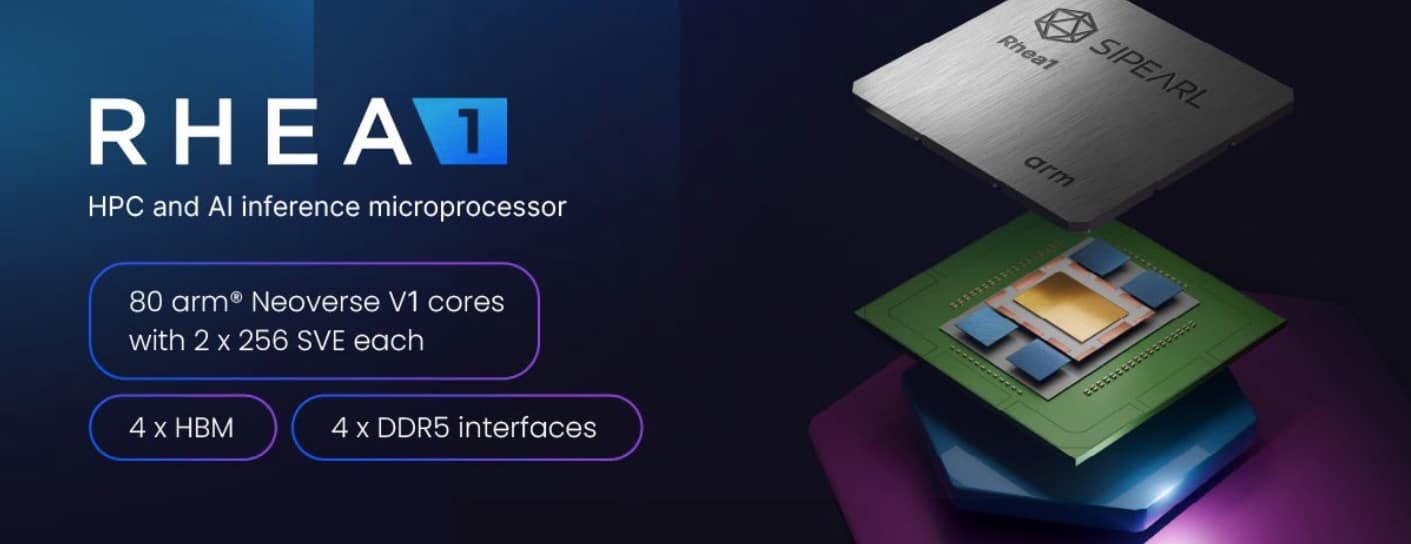
SiPearl has delivered the first units of its Rhea1 processor to Bull to begin their integration into JUPITER, the supercomputer being built at the Jülich Supercomputing Centre (JSC) in Germany. The project, procured by the EuroHPC Joint Undertaking, will thus bring a processor designed in Europe into a platform also developed in Europe, a significant step for the European strategy of building its own technology for supercomputing and artificial intelligence.
The Rhea1 processor in 20 seconds
- SiPearl delivered the first Rhea1 units to Bull on 09/22/2026 for integration into JUPITER.
- Each CPU packs 80 Arm Neoverse V1 cores, four HBM stacks, and four DDR5 interfaces.
- Bull is integrating the processors into its BullSequana XH3000 platform for JUPITER’s CPU cluster.
- SiPearl’s early performance tests are positive, though final figures haven’t been published yet.
- This order is SiPearl’s first Rhea1 order and its first significant source of revenue from this processor.
The move marks Rhea1’s shift from development and testing into a real supercomputing installation. SiPearl presents the processor as its first generation of CPUs for high-performance computing (HPC), artificial intelligence, and data centers, while Bull is handling its integration into the BullSequana XH3000 platform that will be part of JUPITER.
The supercomputer is being developed under the European EuroHPC initiative and will be installed at the Jülich supercomputing center in Germany. JUPITER will be the first European exascale-class system and will combine a GPU-based partition with a CPU cluster in which Rhea1 will take part.
A European processor with 80 Arm cores
Rhea1 packs 80 Arm Neoverse V1 cores into a single package, each with two 256-bit vector extension units, plus four high-bandwidth memory (HBM) stacks and four DDR5 interfaces.
SiPearl hasn’t yet released final performance figures for the processor. The company says benchmark testing is continuing in its labs and that early results are positive, with some scenarios where performance is reportedly exceeding its initial expectations.
The company plans to publish consolidated results during fall 2026.
That caution matters because September’s announcement confirms the physical delivery of the first processors and their integration into JUPITER, but doesn’t yet provide a final performance figure that would allow Rhea1 to be compared against other HPC CPUs.
According to SiPearl, Rhea1 packs in 61 billion transistors and was designed for workloads that need to combine compute capacity with high memory bandwidth.
The company also highlights security features aimed at preventing backdoors and remote shutdown mechanisms, a point directly tied to its pitch for hardware built for sovereign infrastructure.
Rhea1 will be part of JUPITER’s CPU cluster
JUPITER’s architecture isn’t based solely on SiPearl’s new processors. Rhea1 will be part of the Cluster Module, a CPU-based section that complements the Booster, built around GPUs.
Thomas Lippert, director of the Jülich Supercomputing Centre, says the CPU-based architecture is designed for a broad set of complex workloads with heavy data-processing needs. In particular, Rhea1’s high memory bandwidth is aimed at applications that need efficient access to large amounts of information.
This combination means the supercomputer doesn’t have to rely on a single type of processor for every application. The design goal is to offer different computing resources for scientific workloads with different characteristics.
JUPITER is intended for research work related to extreme weather forecasting, climate science, energy, artificial intelligence, quantum computing, and structural biology, among other fields mentioned by the project’s leaders.
Rhea1’s inclusion also has an industrial dimension. SiPearl and Bull are two European companies working across different layers of the infrastructure: SiPearl develops the CPU, and Bull integrates the processor into a supercomputing system.
Philippe Notton, CEO and founder of SiPearl, says integrating Rhea1 into JUPITER represents a step toward a European supercomputing infrastructure built with hardware developed on the continent.
Anders Dam Jensen, executive director of EuroHPC JU, also places the project within the framework of the European Processor Initiative, the European program that has backed the development of processors for supercomputing.
SiPearl’s first major commercial order
The processor delivery also has a direct consequence for SiPearl as a company.
The company confirms that the equipment destined for JUPITER is its first Rhea1 order and its first significant source of revenue tied to this processor. That’s a meaningful data point, as it marks Rhea1’s first generation moving from technology development into commercial operation.
SiPearl describes itself as a fabless European processor designer focused on high-performance, energy-efficient CPUs for supercomputing, artificial intelligence, and data centers.
The company currently has around 200 employees across France, Spain, and Italy, and is backed by the European Union and France.
Rhea1 will be the first generation of its processor family and, according to the company, will launch in late 2026. The processor will also have continuity within SiPearl’s strategy: the company says Rhea2 will be used in Alice Recoque, Europe’s second exascale-class supercomputer, which will be located in France.
For now, the JUPITER announcement is limited to Rhea1. The company doesn’t provide technical details about Rhea2 in this release beyond its future integration into Alice Recoque.
A CPU built for HPC, AI, and high-bandwidth memory
Rhea1’s configuration is aimed at workloads where memory access can limit performance just as much as compute capacity.
The 80 Arm Neoverse V1 cores handle general-purpose processing, while the four HBM stacks provide a high-bandwidth memory subsystem. The four DDR5 interfaces add conventional memory capacity to the design.
This combination lets SiPearl position Rhea1 as a CPU for HPC workloads with large data volumes. However, the company hasn’t yet published the final test results in this announcement that would reveal its performance in specific applications.
The announced timeline puts those figures in the fall. Until then, the results described by SiPearl should be treated as preliminary data from its own labs.
Integration into JUPITER will be the next step in testing the processor’s behavior within a large-scale supercomputing system. Bull will be responsible for incorporating Rhea1 into its BullSequana XH3000 platform and completing the system’s CPU module.
For Europe, the project also serves as a demonstration of a more complete technology chain. The processor comes from a European company, the supercomputing system is integrated by Bull, and the machine is installed on European infrastructure funded and coordinated through EuroHPC.
That doesn’t mean every component of JUPITER is of European origin, nor that the system stops using international technology. The announcement focuses specifically on Rhea1’s role as a European processor within Bull’s platform.
September’s milestone therefore confirms that Rhea1 has cleared an important stage: the first chips have been delivered to the integrator, and work has begun to incorporate them into a European exascale-class supercomputer.
The next data point that will help better assess the processor will be its consolidated performance results, which SiPearl plans to publish during fall 2026.
FAQ
What is Rhea1?
Rhea1 is the first generation of high-performance processors developed by SiPearl. It integrates 80 Arm Neoverse V1 cores, four HBM stacks, and four DDR5 interfaces.
Where will Rhea1 be used?
The first Rhea1 processors will be integrated into JUPITER, the European exascale-class supercomputer installed at the Jülich Supercomputing Centre in Germany.
Which company is integrating Rhea1 into JUPITER?
Bull is integrating Rhea1 into its BullSequana XH3000 supercomputing platform to form part of JUPITER’s CPU cluster.
When will Rhea1’s final performance be known?
SiPearl says benchmark testing is ongoing and that it will publish consolidated performance figures during fall 2026.
