
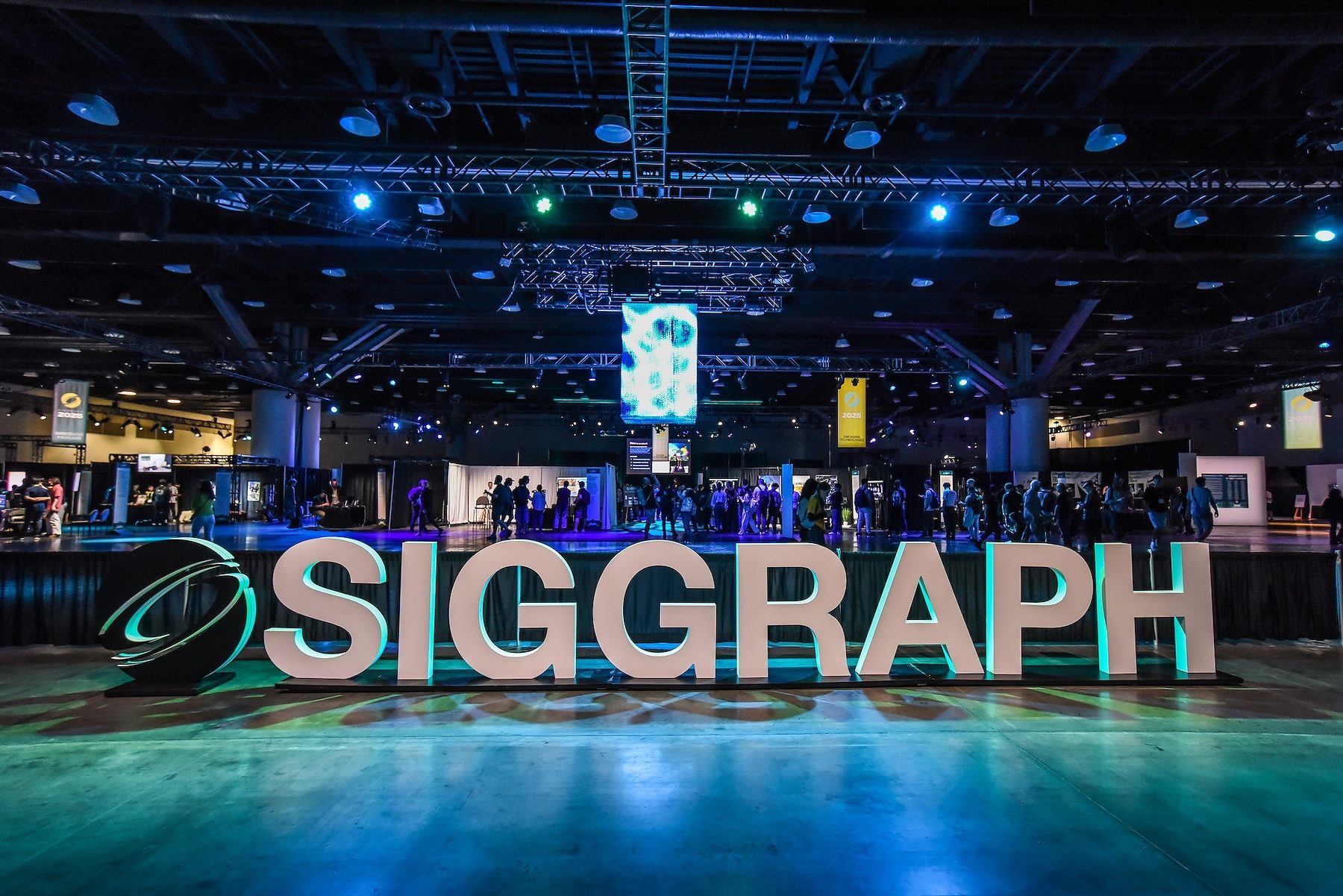
SIGGRAPH 2026 will bring together researchers, artists, film studios, game developers, and tech companies from July 19 to 23 at the Los Angeles Convention Center. The 53rd edition will dedicate a significant part of its program to generative artificial intelligence, physical simulation, robotics, virtual reality, and new techniques used in productions like Avatar: Fire and Ash, Battlefield 6, and the adaptation of Wizard of Oz for Sphere.
The key points of SIGGRAPH 2026 in 20 seconds
- SIGGRAPH returns to Los Angeles for the first time since 2023.
- The program will combine academic research, visual effects, video games, and artificial intelligence.
- Studios like Wētā FX, Sony Pictures Imageworks, Netflix, Electronic Arts, and Activision will showcase their processes.
- The schedule includes generative models, neural simulation, virtual reality, motion capture, and graphics applied to medicine.
The conference will return to a city closely linked with cinema, animation, video games, and immersive media. Organizers highlight that professionals from studios and universities in Southern California will participate across nearly every area of the event, from technical presentations to artistic demonstrations and developer workshops.
Organized by the Association for Computing Machinery (ACM), SIGGRAPH is not just a trade show focused on commercial products. Its program blends research that may take years to reach the market with tools already used in films, graphics engines, industrial simulators, video games, and medical systems.
Artificial intelligence enters audiovisual productions
Generative artificial intelligence will play a major role at SIGGRAPH 2026, although the program does not present it as a sole substitute for conventional graphic techniques. Several sessions will explore how to combine generative models with rendering, compositing, simulation, and artist-supervised processes.
One presentation will address using generative AI to adapt Wizard of Oz for Sphere, the Las Vegas venue with an interior screen enveloping the audience. Representatives from Magnopus and Sphere Entertainment will explain how they scaled the technology to work with large-format setups, quite different from traditional cinema screens.
There will also be workshops on the relationship between AI and computer graphics, differentiable physics, and co-creation between humans and generative systems. Researchers from the University of California, Los Angeles, will participate in sessions on material simulation, deformable bodies, and numerical methods.
| Technology Area | Application Addressed at SIGGRAPH 2026 |
|---|---|
| Generative AI | Image creation, adaptation, and compositing |
| Foundational Models | Perception and generation of worlds and scenes |
| Differentiable Physics | Training systems through simulations |
| Neuronal Simulation | Approximation of materials and physical phenomena |
| Video Relighting | Adjusting lighting after recording |
| Automated Compositing | Blending real and digital elements |
| Motion Capture | Producing cinematics and characters |
AI will also be featured in a roundtable discussing 50 years of collaboration between graphics researchers and filmmakers. Paul Debevec, a Netflix and Eyeline Labs researcher renowned for his work in lighting and image capture, will participate in a debate on how these tools are accelerating the journey from lab to screen.
Claims about acceleration and efficiency will come from the participants themselves and should be evaluated case by case. Generative models can reduce certain tasks, but professional productions still require artistic direction, review, temporal coherence, rights management, and adaptation to studio workflows.
Additionally, the conference will include a session on the visual approach of Avatar Aang: The Last Airbender. The Paramount Animation and Flying Bark Productions team will explain a hybrid process that transfers part of the illustrative stylization to the compositing phase, ensuring consistent strokes across frames.
From Avatar and Battlefield 6 to Virtual Scenes
Production sessions will give a technical look at various film and game projects. Wētā FX will present work done for Avatar: Fire and Ash, while Electronic Arts will explain how it organized motion capture for cinematic scenes in Battlefield 6.
Sony Pictures Imageworks will participate with sessions on generating character variations and managing digital assets. These processes are crucial in productions that need to populate scenes with large numbers of characters without manually designing each outfit, trait, or accessory combination.
| Session or Project | Technical Focus |
|---|---|
| Avatar: Fire and Ash | Visual effects and digital production |
| Wizard of Oz in Sphere | Generative AI for immersive formats |
| Battlefield 6 | Large-scale performance capture |
| Avatar Aang | Integration of 2D and 3D animation |
| Sony Pictures Imageworks | Character variations and asset management |
| IO Interactive’s Glacier Engine | Game engine development |
| Virtual Theater | Live production within virtual reality spaces |
SIGGRAPH will also dedicate a space to spatial storytelling—experiences where the story unfolds around the viewer, not just on a screen. The program will include performances in virtual environments, immersive reality projects, and demonstrations of the technical systems enabling live performances in digital spaces.
The Immersive Pavilion will feature VR, AR, and mixed reality experiences, including Uncanny Alley: A New Day by The Ferryman Collective, whose members will also participate in sessions on virtual theater production.
The Games Summit will focus on video games. Besides the Battlefield 6 performance capture process, Activision will present research on reducing motion sickness in games, while AMD and IO Interactive will analyze the development of the Glacier engine.
Not all of the program will be dedicated to big productions. There will also be sessions on graphics programming, education, digital art, accessibility, and indie creation.
Slang, Physical Simulation, and Graphics Applications in Medicine
Nvidia will offer a hands-on course on Slang, an open-source shading language designed to simplify graphics development across multiple platforms. Shading languages define how light, materials, textures, and other effects are computed on a GPU.
The course will focus on maintaining performance without creating entirely separate code versions for each graphics interface. Slang targets both real-time graphics and compute workloads utilizing GPUs.
Physical simulation will be another key focus area. A course from the University of Southern California will cover the evolution from classical methods to neural approximations for elastic materials. Another session will analyze Boltzmann’s method in neural networks, suitable for simulating fluids in parallel on GPUs.
| Course or Workshop | Field of Application |
|---|---|
| Introduction to Slang | Multiplatform shader programming |
| Classical and Neural Physics | Elastic material simulation |
| Boltzmann Method in Neural Networks | Fluids, industry, VFX, and gaming |
| Differentiable Physics | Optimization and learning via simulation |
| Graphics4Science | Scientific instrumentation and visualization |
| Graphics in Medicine | Surgical planning, visualization, and assistance |
Medical applications will be showcased in the Frontiers section. Researchers from institutions like USC, UC Irvine, and Cedars-Sinai will discuss how to bring graphic technologies from development labs into operating rooms.
A project on space systems composed of small luminous flying elements will also be presented. This session will explore concepts related to swarms, 3D visualization, and new ways to create suspended images in space.
SIGGRAPH will continue its tradition of technical papers, considered a primary academic space for advances in computer graphics. This year’s submissions will include simulations of knitted fabrics, deformable material dynamics, video compositing, and digital illumination.
The diverse program demonstrates that computer graphics are no longer confined to entertainment. Techniques used to create a digital creature can be applied to designing robots, simulating medical procedures, studying materials, or building industrial digital twins.
Los Angeles will serve as a showcase for this convergence. Film studios, game companies, universities, and AI labs will share a space where the boundaries between images, simulation, and software are becoming increasingly blurred.
The organization expects to gather thousands of attendees, though no specific number has been disclosed. The full program includes art galleries, posters, professional networking events, and educational activities spanning the five days of the conference.
Frequently Asked Questions
When will SIGGRAPH 2026 take place?
It will be held from Sunday, July 19 to Thursday, July 23, 2026.
Where will SIGGRAPH 2026 be held?
At the Los Angeles Convention Center. The city has not hosted the conference since 2023.
What technologies will stand out this year?
The program features generative AI, real-time graphics, physical simulation, virtual reality, visual effects, video games, and medical applications.
Is SIGGRAPH only about film and animation?
No. Besides audiovisual production, it encompasses academic research, GPU programming, robotics, scientific visualization, video games, digital art, and medical technology.
Press note image: SIGGRAPH 2025 General Conference photo by John Fujii © 2025 ACM SIGGRAPH
