
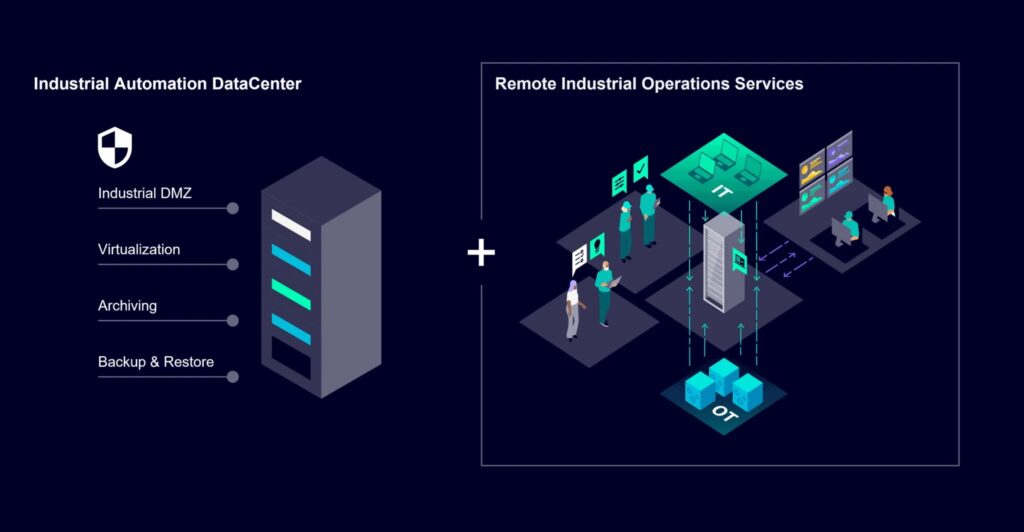
Industrial Artificial Intelligence is shifting from a laboratory promise to a matter of infrastructure—and that distinction matters much more than it seems. In practice, many factories today don’t face a shortage of ideas for applying AI; rather, they lack the capacity to deploy it safely, seamlessly, and effectively within operational technology (OT) environments where availability, latency, and cybersecurity are as critical as the models themselves. In this context, Siemens has chosen to enhance its pre-integrated industrial data center offering with a new generation of its Industrial Automation DataCenter, designed as an edge-ready AI platform.
The announcement came just before Hannover Messe 2026, the major industrial trade fair held from April 20 to 24 in Hannover, and it features two specific technology partners: NVIDIA, for accelerated computing and DPUs, and Palo Alto Networks, for security layers tailored to AI workloads and applications. Siemens presents this evolution not as a simple upgrade of hardware, but as a solution to one of the industry’s most persistent challenges: deploying AI-ready IT/OT infrastructure remains costly, slow, and technically demanding for many companies.
An industrial data center designed to run AI alongside production
Siemens’ approach builds on an existing core: a turnkey industrial data center delivered pre-installed, pre-configured, and tested as a complete system. The innovation is that this unit now incorporates NVIDIA’s accelerated computing layer and a strengthened cybersecurity architecture so AI workloads can operate directly at the industrial edge, close to machines and plant processes.
This is especially relevant because, in manufacturing environments, sending all data to the cloud for processing isn’t always practical. There are scenarios where response time is critical: quality control with vision systems, predictive maintenance, process optimization, or real-time production line analysis. In these cases, running AI locally—rather than hundreds of kilometers away—reduces latency, enhances operational continuity, and limits the movement of sensitive data.
Siemens positions this as a core advantage of the new platform version. The system supports high-performance virtualization for OT applications, backup and restore functions, data archiving, and an industrial demilitarized zone (DMZ) to segregate IT and OT networks. Building on this foundation, it integrates NVIDIA GPUs for AI acceleration and BlueField DPUs for real-time data processing and infrastructure security services.
NVIDIA’s entry into the factory at the edge
NVIDIA’s role is one of the most significant aspects of this announcement. The company already holds a dominant position in enterprise AI and data centers, but this collaboration with Siemens signals its entry into a specialized and sensitive market: industrial infrastructure where automation, OT systems, deterministic networks, and critical processes coexist.
In this scenario, NVIDIA’s contribution goes beyond providing GPUs for model training and inference. It also introduces BlueField, a line of DPUs designed to offload, accelerate, and isolate network and security functions at the infrastructure layer. According to Siemens, these DPUs enable traffic analysis, microsegmentation, deep visibility, and zero-trust approaches without compromising latency or the deterministic nature of the industrial network. In essence, this isn’t just about “bringing AI into the factory,” but doing so without disrupting operational stability in environments that cannot tolerate improvisation.
The underlying message is clear: NVIDIA aims to establish a presence not only in the cloud and enterprise models but also within the physical and operational layers of industry. The implications are significant—if this architecture becomes standard, NVIDIA could shift from merely selling accelerators to major AI labs or hyperscalers to becoming a key enabler in transforming industrial plants, OT processing centers, and edge environments where AI deployment has been more fragmented or ad hoc.
Security as a fundamental part of design, not an add-on
The other pillar of this announcement is the collaboration with Palo Alto Networks, which provides Prisma AIRS, a platform aimed at protecting AI applications, models, and data from threats during runtime. Siemens integrates this as a security layer in a type of infrastructure where the convergence of IT, OT, and AI naturally expands the attack surface.
This point is crucial because many discussions around industrial AI focus heavily on performance and automation, but often overlook the impact of adding connectivity, models, and data flows in environments that have traditionally been closed and secure. Siemens seeks to address this by ensuring security is embedded from the outset of deployment, not added after. The company also emphasizes that their Remote Industrial Operations services leverage remote supervision, continuous cybersecurity measures, preventive maintenance, and support through its own OT Security Operations Center.
It’s important to clarify that an integrated, validated platform doesn’t eliminate all risks by itself. However, it can significantly reduce complexity and the initial effort many industrial companies face when trying to build secure, operational AI environments. Siemens estimates that just the integration, installation, and engineering of such an environment could require up to 80 hours, not counting the potential for incompatibilities or operational downtime. This figure, provided by Siemens itself, illustrates the barriers they aim to lower.
Why this news matters to European industry
Siemens’ move comes at a particularly pivotal moment for European industry. AI applied to manufacturing, energy, infrastructure, and automation no longer relies solely on software but demands platforms that can be deployed swiftly, supported reliably, and interoperably. With the backing of NVIDIA and Palo Alto Networks, Siemens aims to position itself precisely there: in the layer where AI transitions from a demo to a productive infrastructure.
Underlying this is a strategic corporate perspective. Siemens finished its fiscal year 2025 with 78.9 billion euros in revenue and 10.4 billion euros in net profit, and it’s reinforcing its focus on industrial software, automation, and AI. This new evolution of the Industrial Automation DataCenter aligns with that strategy and reflects a broader industry trend: companies don’t just want AI models, they want solutions that can be installed, operated, secured, and maintained without redesigning large portions of their plants.
In summary, Siemens has not just announced a technical upgrade but presented a way to bring industrial AI into the factory’s real-world environment—edge, OT, cybersecurity, and validated deployment. NVIDIA’s deepening involvement alongside Siemens signals that the next phase of AI deployment will not be confined to cloud data centers alone but will extend into the core operational layers of industry.
Frequently Asked Questions
What is the Siemens Industrial Automation DataCenter AI-ready?
It is Siemens’ latest generation of the turnkey industrial data center, now enhanced to run AI workloads at the edge with NVIDIA’s accelerated computing and Palo Alto Networks’ cybersecurity.
Why is deploying AI at the industrial edge important?
Because many industrial applications require real-time data processing close to production—with low latency and without relying continuously on the cloud—especially in vision systems, predictive maintenance, and process optimization.
What does NVIDIA contribute to Siemens’ industrial solution?
NVIDIA provides GPUs for AI acceleration and BlueField DPUs for real-time data processing, security functions, and infrastructure segmentation.
What role does Palo Alto Networks play in this platform?
Its Prisma AIRS platform adds runtime security for applications, models, and data, helping to strengthen protection in increasingly connected industrial environments.
via: press.siemens
